.svg&w=384&q=75 "logo")
Hijikata Shines Against Auger-Aliassime as Aussie Tennis Thrives
Rinky Hijikata walked onto the grandstand court as the underdog. Within minutes, he had world No.4 Felix Auger-Aliassime on edge.
The Canadian burst out of the blocks, racing to a 2-0 lead in the opening set and looking every bit the heavyweight. Hijikata didn’t flinch. The Australian settled on serve, started moving with purpose, and turned the set on its head. Point by point, he dragged himself back into the contest and seized control, surging to a 5-3 lead in the first.
Every service game, he looked composed. No fuss, no panic. Just clean ball-striking and quick feet. Auger-Aliassime, so dominant early, suddenly found himself under real pressure from a man playing his first match on this stage at Flushing Meadows.
The countdown to Hijikata’s appearance had been building all evening. Tournament organisers had scheduled him to follow Stan Wawrinka’s farewell. By the time he finally stepped out to face the world No.4, the crowd was primed for another storyline. Hijikata wasted no time providing one.
Joint storms through after gritty fightback
On the outside courts, another Australian was already making noise.
Maya Joint is into the second round after a gutsy, three-set comeback that announced her arrival in style. She dropped the opening set 6-3 to Liudmila Samsonova despite matching her in heavy rallies and court coverage. Samsonova absorbed everything and still found a way to edge ahead.
That’s where Joint flipped the script.
Backed by a lively crowd on court 9, she found a fresh gear in the second set. The momentum shifted sharply as she started dictating with confidence, racing to a 3-1 lead and never loosening her grip. She took the second set 6-2, then repeated the dose in the decider, running away with it 6-2 again.
From 0-1 down in sets to 3-6, 6-2, 6-2, Joint didn’t just survive; she took over. By the final games, she was dominating the baseline and feeding off the noise around her. When match point landed, she couldn’t hide her excitement. This was a breakthrough, and she knew it.
Wawrinka’s last US Open stand ends in straight sets
Inside the main arena, a different kind of emotion took over.
Stan Wawrinka’s grand slam career came to a close at the US Open, the stage where he once toppled Novak Djokovic in a four-set classic to lift the 2016 title. This time, there was no fairytale run. The 39-year-old bowed out in the first round, beaten 7-6, 7-6, 6-0 by Matteo Berrettini.
The scoreline told one story. The farewell told another.
Tournament organisers rolled a career highlights video on the big screens, charting more than two decades of Wawrinka’s journey in New York. The crowd rose to him. Berrettini stayed on court, applauding, visibly moved to be sharing the moment with a player he grew up watching.
“It’s been more than 20 years since I first came here,” Wawrinka told the crowd, his voice catching as he spoke about playing qualifying in his early days and the special pull of New York. He admitted one of the reasons he kept playing until 41 was to feel nights like this again. Ten years on from his US Open triumph, this was where he wanted it to end.
“I am going to miss it. I love the game so much,” he said, thanking the fans for their support over the years.
Berrettini, who described it as a dream to share the court with a player he once watched winning slams, had already done his part in turning the match into a contest. The first two sets were tight, both decided by tiebreaks, before the Italian ran away with the third.
Even in defeat, Wawrinka remained a showman. In the third set, he flicked a ball over the net on a contentious point that sparked one of the night’s strangest moments.
Double-hit drama and a joke at 41
Early in the third set, Wawrinka reached for a tricky ball at the net and appeared to hit it twice in two separate motions before it floated over. Berrettini immediately appealed, arguing the shot was illegal.
“You could see his two motions,” he insisted to the chair umpire, convinced Wawrinka had effectively double-hit the ball.
By the letter of the law, the racquet must move in one continuous motion. Stop and swing again, and it’s an illegal shot. The point went to video review.
Wawrinka, in the middle of the tension, defused it with a quip at the net, telling Berrettini, “I’m 41, that’s why I am slower than you.” The Italian cracked a smile as they waited on the verdict.
The replay, shown at full speed, cleared Wawrinka. The shot was deemed legal, to Berrettini’s obvious frustration. Later, Australian great Jelena Dokic noted that slow-motion replays from the broadcast angle suggested Berrettini had a case and that the ball did appear to be struck twice. The on-court system, though, doesn’t use slow motion.
Wawrinka took the advantage from the call but still lost the game. Berrettini pressed on to lead 7-6, 7-6, 3-0 and never looked back. The result ended Wawrinka’s grand slam story, but not the respect he carries every time he walks off a big court.
Khachanov on Kyrgios: “You reap what you sow”
Away from the match courts, another headline cut through the noise.
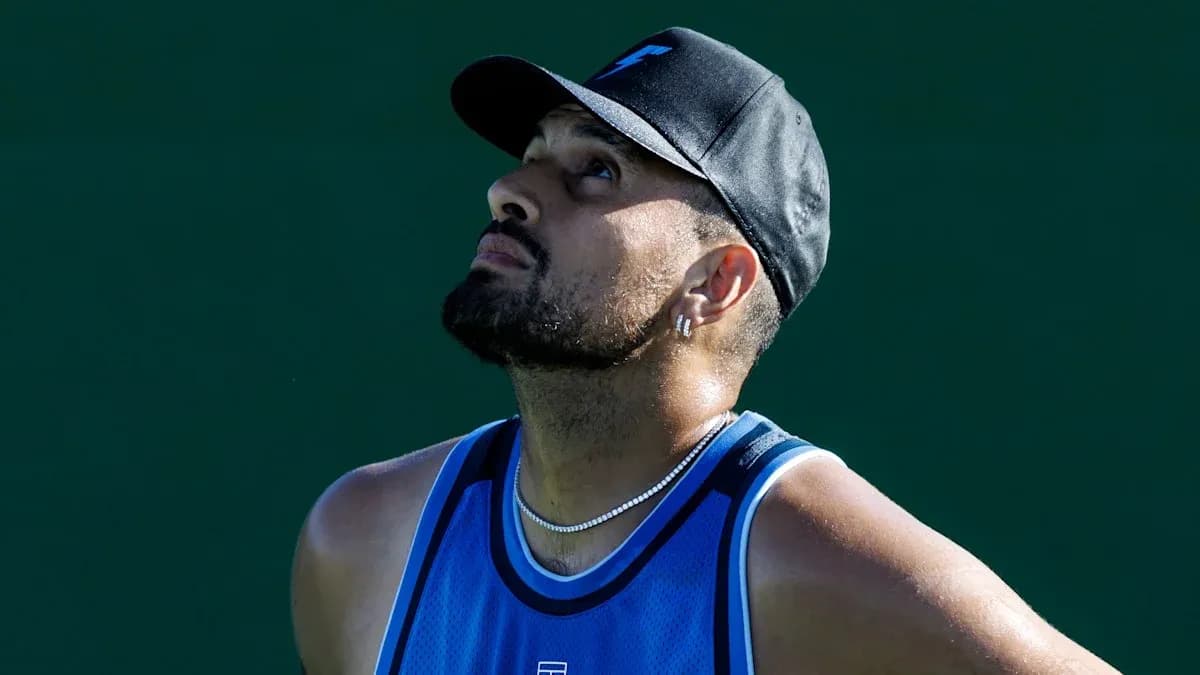
Karen Khachanov did not hold back when asked about Nick Kyrgios’ suspension for testing positive to cocaine in June. Kyrgios had publicly accepted responsibility last month, calling it a “huge mistake” and saying he would step away from the spotlight to work through personal issues.
Khachanov, who has faced Kyrgios on tour and watched him regularly sound off on social media about doping and drug bans, didn’t sugar-coat his reaction.
“Even when he wasn’t playing, he always liked to pick on someone, writing things on Twitter and so on,” he said at the US Open. “And now, when all that has turned against him… what do you want me to say? In the end, you reap what you sow.
“Honestly, it’s not just that I’m not surprised, but to some extent, I can’t feel too much pity either. What he got caught for was ultimately his choice. And in the end, look what happened. It backfired on him.”
It was a blunt assessment, and it landed hard in a locker room that has long heard Kyrgios’ opinions on others.
Popyrin, Dimitrov and a night that belongs to the Aussies
On another outside court, Alexei Popyrin found himself under pressure from Grigor Dimitrov, who started sharply to take a 4-2 lead in the opening stages. Dimitrov’s clean ball-striking and early control underlined why he remains such a dangerous opponent when his game clicks.
But this night in New York kept swinging back to the Australians.
Joint’s comeback, Hijikata’s fearless start against a top-four star, the echoes of Wawrinka’s farewell and Khachanov’s pointed words about Kyrgios all fed into the same question: where does Australian tennis go from here?
On this evidence, the next chapter might be written by names still finding their way onto the marquee.