.svg&w=384&q=75 "logo")
Harriet Dart's Gritty Comeback at US Open
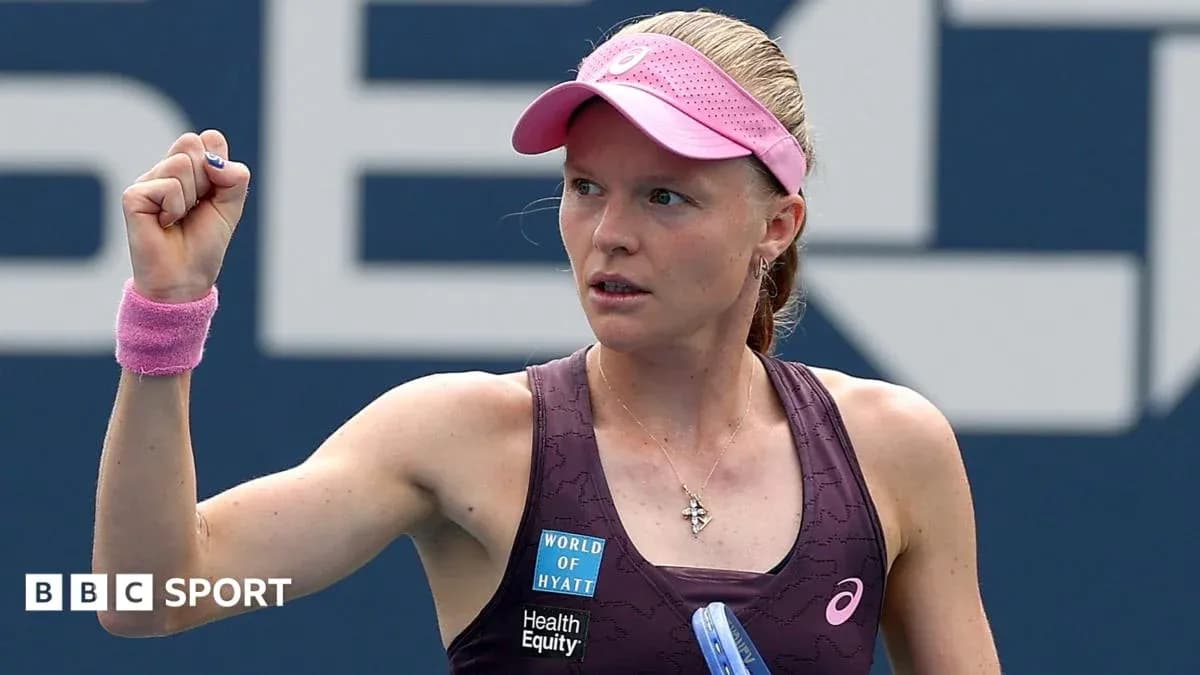
Harriet Dart had been waiting 19 long months for this feeling. Under the lights and noise of New York, with her family scattered around the stands, the Briton finally dragged herself back into the winning column at a Grand Slam.
This was not a straightforward return. It rarely is with Dart.
Down a set and a break to American Peyton Stearns, ranked more than 75 places above her, Dart looked to be heading for another early exit on the biggest stage. Stearns was swinging freely, feeding off the home crowd, and Dart’s chances of a first main-draw major win since the 2025 Australian Open seemed to be slipping away.
Then the night turned.
A comeback built on grit
Dart had started brightly, carving out four break points in the opening game of the match. She converted none of them. Stearns escaped, settled, and then began to bully Dart’s serve, finally breaking in the eighth game and closing out the first set 6-3 without facing another break point.
When Dart was broken again in the first game of the second set, the pattern looked set. Another Slam, another first-round defeat for a player who had failed to qualify for four of the previous six majors and had twice fallen at the first hurdle at Wimbledon despite wildcards.
But Dart has been hardened by the long route. She had already gone three sets in all three of her US Open qualifying matches, including comebacks after dropping the opening set to Kristina Penickova and Heather Watson. She knows how to live in the trenches.
Stearns, by contrast, began to unravel. The American’s aggression produced 40 winners, but they came with 47 unforced errors. As her radar drifted, Dart pounced. She broke twice in the second set, turned the scoreboard around, and levelled the match 6-3 with a controlled, almost stubborn refusal to go away.
The pressure finally told on Stearns. Dart had dragged her into her kind of match.
The third set and a new edge
By the decider, momentum belonged to Dart. She read the American’s patterns, absorbed the pace, and redirected it with growing confidence. Breaks came in a flurry early in the set, three in a row as both players wrestled for control.
The key moment arrived in the sixth game. Serving under real pressure, Dart held firm, stitching together a crucial hold that snapped the run of breaks and steadied the contest. It felt like a small moment. It wasn’t. From there, she tightened her grip.
On her fourth match point, Dart finally finished the job, sealing a 3-6 6-3 6-2 victory in just under two and a half hours. She dropped her shoulders, then sprinted to her box.
Waiting there was not just family, but a Grand Slam champion.
Bartoli’s touch and a “home away from home”
Since January, Dart has been working with 2013 Wimbledon champion Marion Bartoli, and the signs of that partnership are starting to surface. This win follows a run to the quarter-finals at the Challenger event in Vancouver in July and qualification for the Cincinnati Open in August. The building blocks have been quietly stacking up.
Dart spoke openly about how Bartoli’s experience has filtered into every part of her day: how a Grand Slam morning begins, how it ends, what the nerves feel like, how to manage the little details that so often decide tight matches. She feels she is learning every time they talk. Performances like this suggest that belief is justified.
Around them in New York, the Dart clan has turned Flushing Meadows into something resembling a family gathering. Her uncle and cousins who live in the city, another cousin over from the UK, her mother on site since qualifying began, her father flying in on the eve of the match – they were everywhere she looked.
Dart calls New York her “home away from home”. On this evidence, it’s more than a throwaway line. The noise from her “community” of supporters rolled down from the stands, and she responded with the kind of fight that has been missing from her Slam record for too long.
A different kind of second round
Now comes a very different test: 25th seed Marie Bouzkova in the second round. Bouzkova brings a more measured, constructed game than Stearns, and far fewer free points. Dart will need the same resilience, but with cleaner execution.
What she has, at last, is momentum. A main-draw win at a major. A body of work in recent months that suggests this is not an isolated spike. A coach who has walked this path and a family who have turned a foreign city into familiar ground.
Dart joins compatriots Toby Samuel and Katie Boulter in the second round. For the first time in a long time at a Grand Slam, she walks into it not as a survivor clinging on, but as a player who has just reminded herself – and everyone watching – that she still belongs on this stage.