Guy Sasson’s Grand Slam Dream Ends in New York
Guy Sasson’s Grand Slam dream ended on a hot New York afternoon, not with a rout, but with a match tiebreak that slipped agonizingly away.
One point from history? Not quite. One match. And that was painful enough.
One Match Short in New York
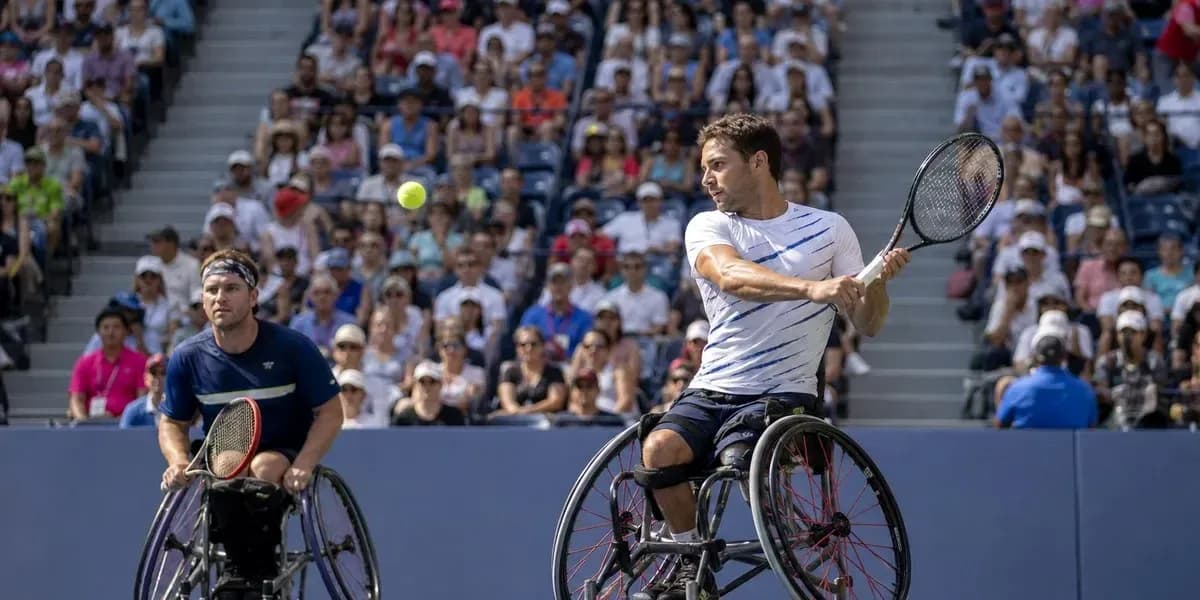
Coming into the US Open, Sasson and his Dutch partner Niels Vink stood on the brink of something enormous. They had already swept the doubles titles at the Australian Open, Roland Garros and Wimbledon in the quad division. Three Slams in the bag. New York was supposed to be the final piece, the calendar Grand Slam.
They were the top seeds. The pair across the net, Sam Schroder of the Netherlands and Australian Jin Woodman, were seeded second. On paper, it looked like the final everyone expected. On court, it became a test of nerve.
Schroder and Woodman struck first, hard and clean, racing through the opening set 6:2. Sasson and Vink responded like champions, tightening their patterns, finding depth, taking the second set 6:3 to drag the contest into a deciding match tiebreak.
That was where the dream dissolved. In those compressed, brutal few minutes that define a whole season, Schroder and Woodman held their composure better, edging the breaker 10:7 and snatching the title. For Sasson, the calendar Grand Slam in doubles will have to wait.
Partner Turns Rival in Singles
Sasson’s campaign in New York was not defined by doubles alone. As world No. 3 and the third seed in the quad singles draw, he carved his way into the semifinals, only to run into a familiar obstacle: his own partner, Vink.
The semifinal carried its own drama. Vink jumped ahead in the first set, leading 5:2 and threatening to run away with it. Sasson refused to fold. Point by point, he clawed back to 5:5, injecting tension into a match that had looked one-sided.
The surge came too late. Vink steadied, closed out the set 7:5, and then controlled the second 6:3 to move into the final. He went on to win the singles title, underlining his status as the dominant force in the division and adding another layer of complexity to one of the sport’s most intriguing partnerships.
A Program on the Rise
Back home, the performances in New York did not go unnoticed. Israel ParaSport Center CEO Boaz Kramer hailed the efforts of Sasson and Sergei Lysov, framing their Grand Slam breakthroughs as the product of years of work, sacrifice and a tightly knit support system.
For Kramer, titles at this level are not isolated miracles; they are milestones on a carefully built path. He stressed that the center will keep backing both players and their coaches, Ofri Lankri and Damien Martinique, with one clear destination on the horizon: LA28.
The message was clear. This isn’t a golden moment to be admired from a distance. It is a foundation to build on.
Lysov’s Battle, Brand’s First Steps
Lysov, playing the US Open for the second time in the men’s wheelchair division, found his route blocked early. His opening singles match stretched to three sets, but he fell short. Doubles offered no reprieve: another defeat, again in a match tiebreak, ended his run in the first round.
The margins were small, the frustration real. Yet for a player still carving out his place on this stage, every tight loss is also a lesson.
At the other end of the spectrum stood 17-year-old Dan Brand, tasting the US Open for the first time as a junior. He announced himself with a first-round singles win, a composed start in an intimidating arena. The second round turned into a grind. Brand pushed the match to a deciding set, only for severe cramps to hit in the middle of that final act. He fought, but the body would not cooperate, and he went out in three sets.
His doubles campaign, alongside Austrian partner Tilo Berman, brought another glimpse of promise. Seeded fifth, they advanced to the second round before bowing out to Yannick Alvarez of Puerto Rico and American Ryan Cozad.
For Brand, this was not a farewell, just an opening chapter. After a brief return home to Israel to reset with his family, he will head straight back into the fray at the J500 Osaka Mayor’s Cup World Super Junior Tennis Championships, running from September 21–27 in Japan.
Sasson chasing redemption after a near-miss Grand Slam, Vink setting the standard, Lysov searching for a breakthrough, Brand taking his first real strides on the world stage: the results in New York may be written, but the real question now is how far this rising Israeli contingent can push the story by the time LA28 arrives.