George Chuvalo: The Indestructible Heavyweight Champion
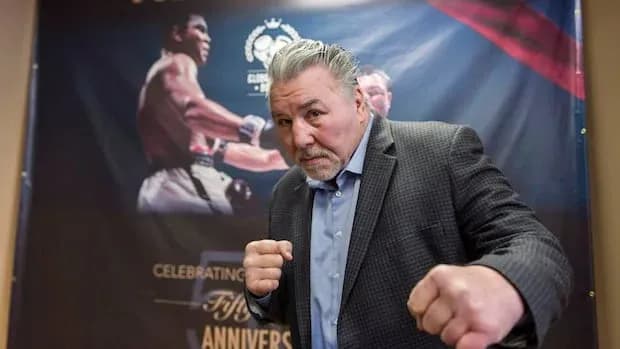
George Chuvalo, the granite-jawed Canadian heavyweight who stood in with the most fearsome punchers of boxing’s golden age and never once hit the canvas, has died at 89.
The Toronto-born fighter, who had been living with dementia in a long-term care facility in the city, died Saturday, according to online tributes from family and friends. Ontario Premier Doug Ford, calling Chuvalo a family friend, offered condolences and spoke of mourning “his passing” on social media.
For most of his life, Chuvalo’s story was told through his chin. It was the one thing nobody could crack.
The man Ali couldn’t budge
Chuvalo shared a ring with Muhammad Ali twice, going the distance both times — first in Toronto, then in Vancouver. He took the best of Joe Frazier. He absorbed George Foreman’s heaviest artillery. Not once did a referee count over him.
Ali would later call him the toughest man he had ever faced. Chuvalo respected the compliment, but he also understood what it meant to be defined by one night.
“In a crazy way, that fight is what defines me for a lot of my fellow Canadians,” he reflected in his 2013 autobiography, *Chuvalo: A Fighter’s Life*, written with Murray Greig. “But it took a long time before I came to appreciate how good it made me feel.”
The son of Croatian immigrants, Chuvalo was born Sept. 12, 1937, in Toronto’s Junction neighbourhood. Boxing first hooked him not in a gym, but at a newsstand, where a copy of *The Ring* magazine caught his eye. By 10, he was climbing through the ropes. A growth spurt and a love of weightlifting turned him into a six-foot, 210‑pound heavyweight.
After a brief amateur run, he turned professional in 1956 and began to make noise at the Jack Dempsey Tournament at Maple Leaf Gardens. Then the momentum stalled. Poor management left his career drifting until Toronto poultry magnate Irv Ungerman took over and revived it in the early 1960s.
The turnaround was dramatic. In 1964, Chuvalo blasted out contender Doug Jones in the 11th round at Madison Square Garden, a statement win in boxing’s most famous arena. He went back there the following year and lost a razor-thin decision to former champion Floyd Patterson in a fight *The Ring* later named its 1965 Fight of the Year.
“He just keeps coming and coming”
Chuvalo’s style was simple and suffocating. He marched forward, hands thudding to head and body, breaking opponents down rather than outsmarting them. Eighty‑eight per cent of his victories came by stoppage.
“You can’t believe his strength,” Canadian fighter Bill Drover once said. “There’s no way to stop him. He just keeps coming and coming. The only way you can stop him is with a stick of dynamite.”
Critics saw a plodding target. Chuvalo always pushed back, insisting his defence was underrated. But it was his durability that astonished people. He credited a 17.5‑inch neck, built through relentless exercise, for his ability to absorb punishment that would have ended other careers.
That neck carried him into a world title shot in 1966. Ali, ostracized in the United States for his association with the Nation of Islam and his opposition to the Vietnam War, found a willing challenger in Canada. Chuvalo stepped in as a replacement opponent and walked straight into the biggest night of his life.
The New York Times did not exactly roll out a red carpet. One headline dismissed him with brutal clarity: “Bettor’s-Eye View of Chuvalo: A Big Bum With a Lot of Heart.”
He didn’t win the belt that night, and he didn’t join Tommy Burns as a Canadian world heavyweight champion. What he did win was respect. Fifteen rounds with Ali, on his feet at the final bell, turned the “big bum” into a cult figure of toughness.
The paydays that followed mattered. With his wife Lynne and five children at home, Chuvalo fought contenders Jerry Quarry and Manuel Ramos, beating both. He dropped close decisions to Oscar Bonavena and Jimmy Ellis. The margins were often thin; the opposition rarely was.
In 1967, Frazier became the first man to stop him, battering him so badly that Chuvalo later needed a silicone implant to keep an eyeball from drooping. Three years later, Foreman hammered him to a fourth‑round stoppage, the referee stepping in before the fabled “never knocked down” streak could be broken by a clean knockdown.
Ali and Chuvalo met again in Vancouver in 1972. The rematch never caught fire like the first fight and was more one‑sided. Chuvalo boxed on, finally walking away for good in 1978 after a victory, with a final record of 73 wins, 18 losses and two draws, 64 wins coming by knockout.
A fighter outside the ring
For years after retirement, the damage didn’t show. Chuvalo spoke in rapid bursts, sharp and funny, always ready with a quip or a jab at himself. On the surface, he looked like one of the lucky ones.
Inside, it was different.
Like so many retired fighters, he struggled with what he once called the “humdrum” of everyday life. He tried on new roles: nightclub owner, real estate agent, fight promoter, television host. He even popped up on the big screen, suffering one of cinema’s most lopsided arm-wrestling defeats in a cameo in David Cronenberg’s *The Fly*.
He had told CBC Radio in 1968 that he didn’t want his four sons to box for a living. The ring, he could understand. What came for his family outside it, he never saw coming.
The youngest, Jesse, became hooked on heroin after a prescription painkiller ran out. At 19, in 1985, he shot himself. By then, older brothers George Jr. and Steven were also using heroin and slipping into petty crime to feed their habits.
Steven later spoke of the darkness that swallowed them, describing a sense of “worthlessness” he and his brothers shared in an interview with CBC’s *the fifth estate* in 1995.
“My dad spent quite a few years chasing us around the city, Georgie and I in particular, and dragging us out of drug houses and heroin houses and basically just trying to keep us alive,” he said.
The punches that never felled Chuvalo in the ring had found a way to land.
In 1993, George Jr., just three days out of jail in Kingston, Ont., overdosed on Halloween. Four days later, Lynne Chuvalo swallowed pills, left a suicide note, and ended her life at 49.
“I never thought she’d do it, but I’m not surprised,” Chuvalo told the New York Times shortly after, saying his wife had never recovered from burying their first child.
Steven, who had spoken publicly of wanting to make his father proud, overdosed and died eight months after his *fifth estate* interview aired.
Chuvalo tried to articulate the scale of that pain in his autobiography. “If you added up every punch I took and multiplied the total by 10,000,” he wrote, “it wouldn’t begin to equal the pain of losing three sons and a wife to drugs and suicide.”
Legacy of warning and resilience
He carried on. He remarried. He poured himself into his surviving children — oldest son Mitch and daughter Vanessa — and his grandchildren. He took his story on the road, visiting schools across the country, speaking bluntly about drugs and the wreckage they had left in his home.
“I’d like to think if you’re ever tempted with the idea of doing drugs, or you ever flirt with doing drugs,” he told students in a CBC Radio report in 1998, “I hope you think of me, George Chuvalo, and what drugs did to my family.”
Late in life, the man who had once seemed indestructible began to fade. In 2017, reports emerged of bitter family disputes involving his surviving children and his second wife, Joanne, amid divorce proceedings. At the heart of it was a painful question: how far his cognitive decline had progressed and who should control his care.
On a podcast five years later, Mitch Chuvalo revealed that his father no longer recognized him during visits.
By then, the city that had watched him grow from a Junction kid into a world-class heavyweight had formally stamped his name into its landscape. In 2019, Toronto opened the 7,000‑square‑foot George Chuvalo Community Centre in the neighbourhood where his story began.
A fighter to the last, remembered not just for the punches he took, but for the blows life landed and the way he kept getting up.