Elena Rybakina Wins First US Open Title Over Aryna Sabalenka
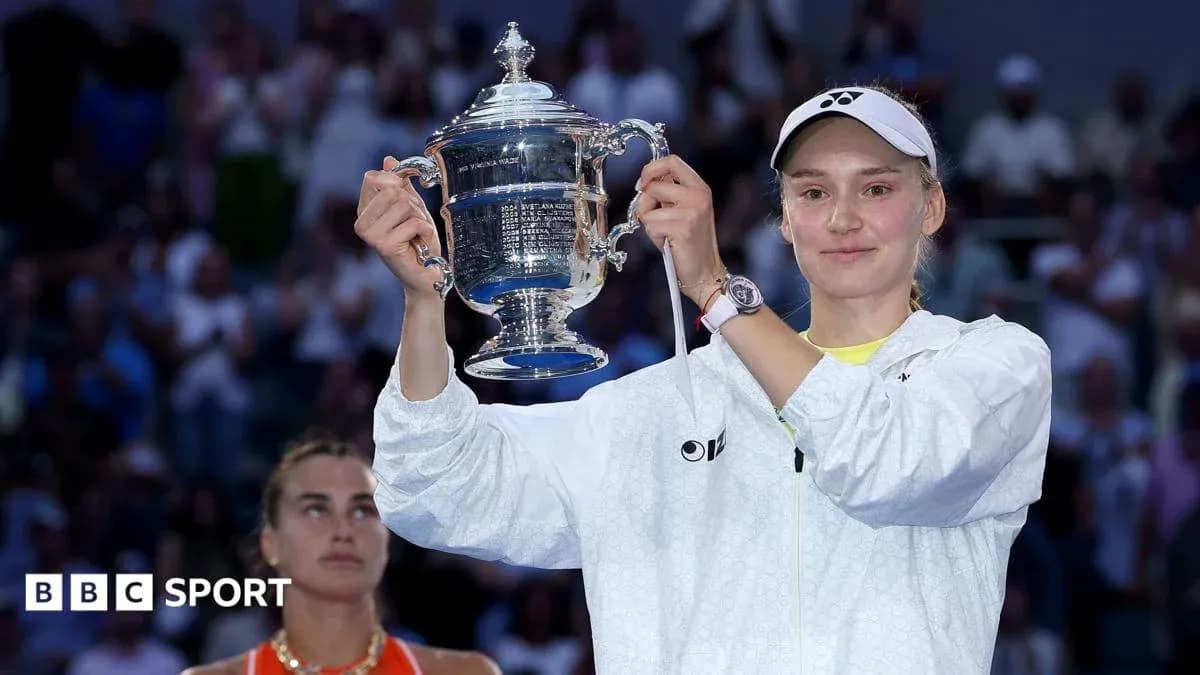
Elena Rybakina walked into Arthur Ashe Stadium already guaranteed the number one ranking. She walked out with something far heavier in her hands – her first US Open trophy and a statement win over the woman she has just dethroned.
The 27-year-old from Kazakhstan beat two-time defending champion Aryna Sabalenka 6-4 5-7 6-2, claiming her third Grand Slam title and underlining, on the sport’s loudest stage, why she now sits at the top of the women’s game.
Ice vs fire – rivalry with an edge
Rybakina and Sabalenka have built one of the defining rivalries of this era: two huge hitters, two opposing temperaments.
Sabalenka roars, rages, lives every point with visible intensity. Rybakina barely flinches. On this night, that contrast decided the championship.
From the start, Rybakina’s first serve misfired. For most players, that’s a nightmare against Sabalenka’s ferocious return. Rybakina simply adjusted. She dug in on second serve, stepped forward on the return, and repeatedly drove the ball deep into Sabalenka’s hitting zone, then just beyond it. The Belarusian’s frustration grew as the errors crept in.
The opening set went to Rybakina, not because she was at her peak, but because she stayed calm when her biggest weapon deserted her. Sabalenka, by contrast, looked tense, her game caught between aggression and anxiety.
Sabalenka strikes back
The match tightened in the second set. Sabalenka’s groundstrokes began to bite, the depth and weight of shot finally pushing Rybakina back. The incoming world number one’s level dipped just enough to invite pressure, and Sabalenka seized it.
At 5-6, Rybakina’s second serve came under siege. Sabalenka swarmed, attacked relentlessly, and on her third set point forced the decider she needed. The defending champion let out a defiant roar. For a moment, the momentum felt like it had swung.
But the fragility in Sabalenka’s game never fully disappeared. The loose errors that haunted the first set resurfaced early in the third, bringing with them the familiar negativity that has shadowed some of her biggest matches.
The world number one takes charge
Rybakina sensed it. At 1-1 in the final set, she locked onto Sabalenka’s serve again, driving returns deep and flat, pinning the champion to the baseline. The break for 2-1 felt decisive.
From there, Rybakina grew taller with every point. The shoulders relaxed, the timing returned, and the match began to look like so many of her best performances: clean, ruthless, unhurried. Sabalenka, forced to hit from increasingly uncomfortable positions, sprayed errors and gestured in frustration.
Rybakina surged to the finish line. Serving for the title, she showed a rare crack – a double fault on her first championship point. It could have opened the door. Instead, she shut it with an ace, the purest expression of her game and her new status at the top of the sport.
No wild celebration followed. Just a brief, unmistakable smile. For Rybakina, that was as telling as any scream.
A New York story rewritten
This US Open crown carries extra weight because it came in a city that has never quite embraced her, and that she has never fully figured out.
With her penetrating serve and thunderous, first-strike baseline game, Rybakina’s tennis is tailor-made for hard courts. Yet Flushing Meadows had stubbornly refused to yield. For a decade, she came and left without making a serious imprint.
Her game never seemed to align with the brash, chaotic energy of New York. Until now.
“I was coming here for the last 10 years and it was never successful. I’m falling in love with New York more and more,” she said afterwards, the history of those struggles hanging between the lines.
This fortnight changed everything. And it almost never happened.
From injury doubt to dominant champion
Just weeks ago, at the Cincinnati Open, Rybakina injured her ankle in the quarter-finals and could not walk for several days. Her participation in New York was in real doubt, her camp going “day by day” as they monitored her recovery.
She didn’t just show up. She imposed herself.
In the opening four rounds, Rybakina rode her serve like a hammer, blasting through matches and giving opponents almost no chance to settle into rallies. Her delivery, when on song, takes the racquet out of opponents’ hands; in the early stages here, it did exactly that.
The test came later. Against Zheng Qinwen and home favourite Coco Gauff, she dropped the first set in back-to-back matches. Those were the kind of contests that previously might have slipped away in New York. This time, she absorbed the blows, recalibrated, and clawed her way through both.
That resilience set the stage for Sabalenka. In the final, Rybakina showcased the full range: the bullying baseline power, the unreturnable serves, and the stubborn resistance when the match tightened.
Now, with Wimbledon 2022, the Australian Open earlier this year, and this US Open in her collection, she stands one trophy away – a French Open title – from the career Grand Slam.
“Some magic is happening. I was unlucky with injury and just going day by day,” she said. “We didn’t know how it was going to be so I’m super happy and still can’t believe it.”
Magic, perhaps. But also something more tangible: a game built for the biggest courts, a temperament built for the biggest moments, and a rivalry with Sabalenka that is starting to define this era.
New York finally has its Rybakina chapter. The question now is how many more Slams she will write into the history of the sport.