Elena Rybakina Claims First US Open Title and Third Grand Slam
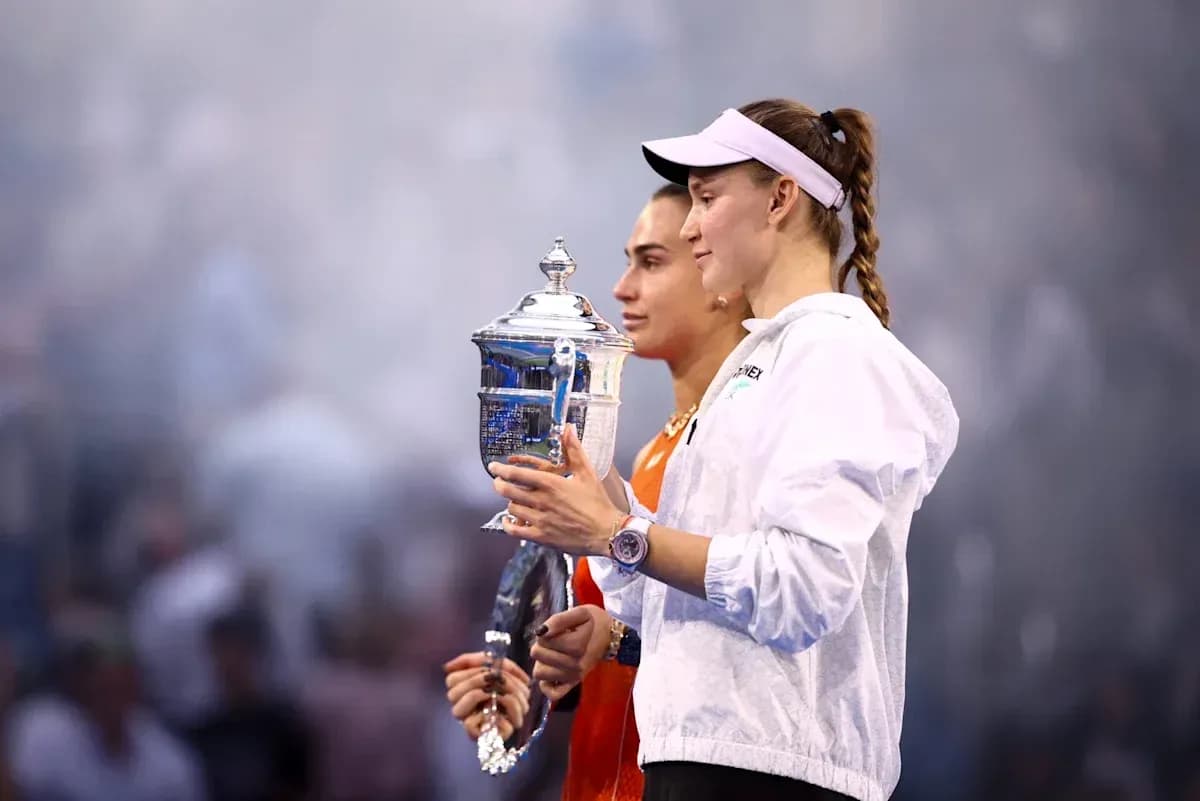
Elena Rybakina stood on the Arthur Ashe Stadium baseline on Saturday night with the No. 1 ranking on her racket and Aryna Sabalenka staring back at her. By the end of a bruising, breathless final, she had something far more precious in her hands.
A first US Open title. A third Grand Slam crown. And a place in tennis history.
Rybakina beat Sabalenka 6-4, 5-7, 6-2 in a final that swung wildly before the Kazakhstani’s calm, clean power settled it. Having only just overtaken Sabalenka as WTA world No. 1, she underlined that status with the kind of performance that defines a reign, not just a ranking.
This was not a procession. It was a test of nerve and endurance that Rybakina passed with authority.
From fourth-round ceiling to New York champion
Not long ago, Rybakina’s record in New York was modest. Her best result here? The fourth round.
To Marion Bartoli, that transformation is staggering. The former Wimbledon champion, speaking to Sky Sports Tennis, could barely disguise her admiration.
“Can you imagine that her previous best result here was the fourth round?” Bartoli said. “That's extraordinary, to come here with all the pressure of the world, knowing she had the No. 1 world ranking on her racket, to actually go on and win the title.”
The pressure was real. The response was ruthless.
Rybakina, already a Wimbledon champion in 2022 and Australian Open winner earlier this year, now owns three majors on three different surfaces. The only missing piece is Roland Garros. The career Grand Slam suddenly feels less like a dream and more like a looming possibility.
The reset that broke Sabalenka
The match turned on a moment that would have broken lesser players.
Sabalenka dragged the final into a deciding set, snatching the second 7-5 after catching Rybakina on her own serve late in the set. Momentum, noise, belief – all seemed to tilt towards the Belarusian. The crowd sensed a surge. So did Sabalenka.
Rybakina refused to carry that baggage into the third.
“The way she bounced back at the beginning of the third set tonight for me, was absolutely extraordinary,” Bartoli said. “It looked like she completely forgot what happened at the back end of that second set, when she got caught on her own service game.”
That reset was the key. No dramatics, no visible frustration. Just a quiet tightening of focus and a brutal clarity of purpose.
She stepped in. She attacked. She went after Sabalenka’s second serve and, often enough, her first as well.
“She just kept on moving on, and moving forward all the time,” Bartoli added. “The way she attacked Sabalenka's serve all the time, putting her under so much pressure.”
The third set became a statement. Rybakina’s return game bit harder, her depth pinned Sabalenka back, and the errors came. At 27, the new champion looked like the fresher, stronger athlete in the biggest moments.
History in the hard yards
The numbers behind this run are as telling as the scoreline in the final.
In the Open Era, Rybakina is the first US Open women’s champion to win three-set matches in the quarterfinals, semifinals and final. That is not a quirk. It is a measure of resilience.
Those three-set marathons demand everything: legs, lungs, and a mind that doesn’t blink. Rybakina’s calm exterior can mislead, but the grind of this fortnight exposed her competitive core.
“Physically and mentally strong” is a cliché until a player lives it over and over again under the New York lights. Rybakina did, and she did it against the best in the world.
Bartoli summed up the complete package with a note of awe.
“The ball-striking from that young lady is just something else. She can do anything on the tennis court. She's only missing Roland Garros now from completing a career Grand Slam.”
That ball-striking, so often described as effortless, has now carved out a career that is anything but.
A champion who isn’t finished
Three majors. World No. 1. A US Open title sealed by front-foot aggression rather than caution.
Rybakina leaves New York as the standard-bearer of the women’s game, and yet there is a sense she is still building, still adding layers. Clay remains the one surface where she has not yet imposed herself over two weeks. The French Open is the last door left to push open.
For now, there will be rest. She has earned it, after a fortnight that demanded every ounce of physical and mental energy.
But when the tour turns to Paris again, and the conversation shifts to who might complete a career Grand Slam, her name will no longer be a bold prediction.
It will be the obvious question.