Elena Rybakina's Quest for World No.1 After US Open Win
Elena Rybakina is now one win away from the summit of women’s tennis, and she is not pretending otherwise.
The world No.2 dismantled Naomi Osaka at the US Open, 6-1, 6-4 in just 66 minutes, a performance that underlined both her title credentials in New York and her looming push for the No.1 ranking. Unlike many players who dodge the subject, Rybakina met the question of top spot head-on.
“Of course I want it,” she said afterwards. “I don’t know anyone that wouldn’t wish this. That is definitely one of my goals. If I start well as I did today, I think I have all the chances to (become world No.1). I’ll try my best and hopefully, it will go my way.”
On this evidence, it might.
Osaka, whose 2026 US Open campaign is now over, never really managed to drag the match into the kind of physical and emotional battle she thrives on. The Japanese star struggled to land any sustained pressure on Rybakina’s serve, and the first set raced away from her in 27 one-sided minutes, the second seed striking cleanly and dictating from the baseline.
The scoreline said 6-1. The gap felt even bigger.
Osaka did raise her level in the second set, finding more depth and forcing Rybakina into a few uncomfortable rallies. The crowd sensed a contest and Osaka’s body language sharpened. Yet every time she threatened to claw her way back, Rybakina’s delivery slammed the door. The serve – heavy, precise, unyielding – remained the match’s defining shot.
That dominance has impressed those watching closely. Australian great Jelena Dokic has already tipped Rybakina as the favourite to lift the trophy in New York, a view that gains traction with every authoritative win. Next up is Qinwen Zheng in the quarter-finals, a clash that suddenly feels like a collision of the tournament’s form players.
Zheng arrives riding a surge of her own making.
Earlier in the day, the 23-year-old Chinese star produced one of the comebacks of the season to send six-time grand slam champion Iga Świątek out of the tournament in straight sets, 7-5, 6-3. The scoreline only tells half the story. Świątek led 5-0 in the opening set and appeared to be cruising, her weight of shot and angles pinning Zheng behind the baseline.
Then the match flipped.
Point by point, Zheng clawed her way back. She began to read Świątek’s patterns, stepped inside the court and started to hit through her. The Pole, usually so composed when protecting a lead, suddenly found herself dragged into longer rallies and forced to defend. The set, which looked destined to be a rout, turned into a heist.
“I guess to come back from 0-5 is not lucky, that’s all I can say,” Zheng said afterwards. “I didn’t start the match so well, but little by little I found my rhythm on this centre court because it’s been a long, long time since I’ve played here.
“I haven’t beaten a top-10 player in a while. The more matches I play, the more rhythm I get. I just feel really pumped and ready for my next match.”
The comeback carried echoes of their meeting at the 2024 Olympic Games, where Zheng also toppled Świątek en route to gold. This time, once she had stolen the first set 7-5, she never loosened her grip. The second set unfolded with Zheng in control, her confidence surging as she closed out a win that left the crowd stunned and the draw reshaped.
Now, the reward is a shot at Rybakina – a quarter-final that pits the tournament’s most imposing server against one of its most fearless shot-makers, with the added spice of Rybakina’s ranking chase and Zheng’s growing reputation for big-stage ambushes.
While the women’s draw crackles with storylines, the men’s side ticked along with Learner Tien and Karen Khachanov stepping onto court in the singles draw. Their match carries its own stakes: the winner earns a quarter-final date with Alexander Blockx.
Away from the baseline battles, the US Open has been wrestling with a very different kind of problem in the stands.
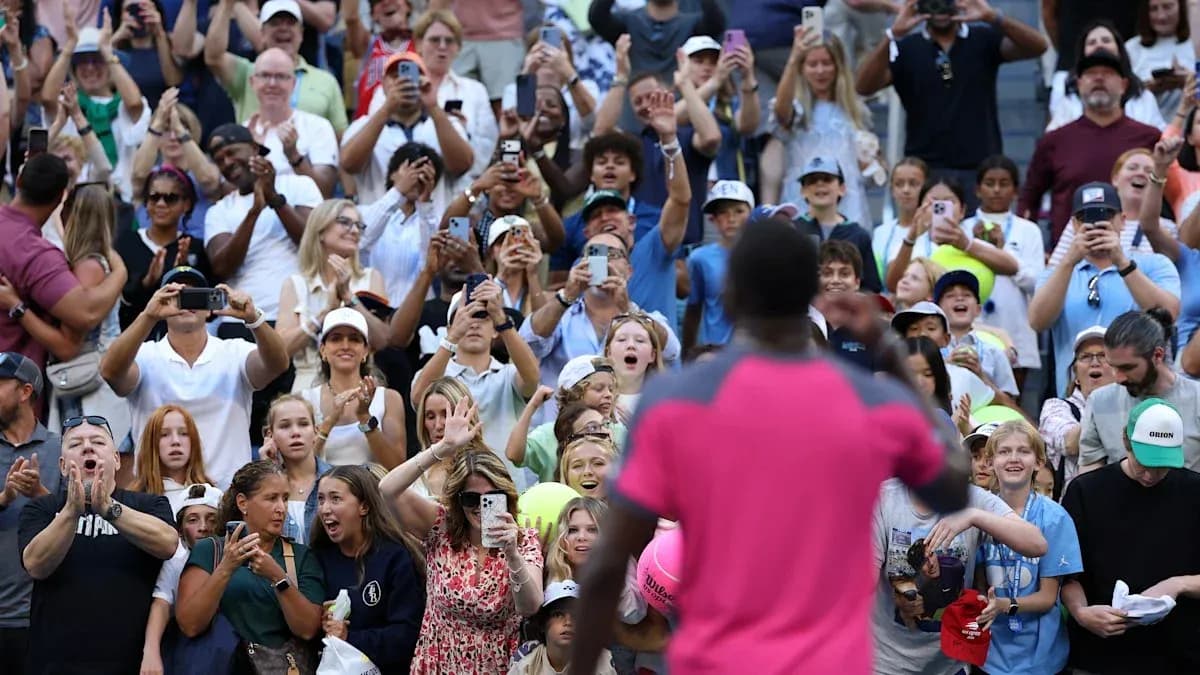
This year’s event has seen multiple matches disrupted by spectators using bright lights to capture content mid-point, a wave of influencer-driven behaviour that has irritated players and umpires alike. Coco Gauff and Naomi Osaka have both spoken about the issue, stressing that while they welcome new fans and fresh audiences, the basic etiquette of tennis – silence during points, no flash or harsh lighting – needs to be respected.
Tournament organisers have responded by using big screens around the grounds to remind fans to avoid disruptive filming and lighting, an attempt to calm the growing friction between content creation and live sport.
The scenes at Flushing Meadows have not gone unnoticed in London.
Wimbledon has already moved to shut the door on similar problems before they start. The All England Club has confirmed it has no intention of opening its gates to an influx of influencers next year and will not allow ring lights into the grounds at all. Those devices, which have become a staple of social media filming, will be banned from the premises, and content creators are not expected to receive accreditation.
French veteran Adrian Mannarino, who has been competing in New York, did not sugar-coat his view of the current atmosphere.
He described the US Open as having turned “into a bit of a zoo,” pointing to both influencer disruptions and the smell of marijuana drifting around the grounds. “People are allowed to move around in the crowd during points,” he told reporters after a doubles defeat. “The tournament puts up with it ... I don’t know if it’s the best thing for tennis in general.”
The contrast is stark. In New York, the sport is grappling with how to coexist with a new, restless kind of audience. In London, Wimbledon is drawing its lines early.
On court, though, the story remains the same as it has always been: serve, return, pressure, nerve. Rybakina’s pursuit of No.1, Zheng’s giant-killing charge, Osaka’s search for her peak level, Świątek’s response to another brutal loss – those are the battles that will define this fortnight, long after the ring lights have faded.