Elena Rybakina: US Open Champion and New World No 1
For years, Elena Rybakina lived in the shadows of her own résumé. A Wimbledon champion. A major winner on multiple surfaces. One of the cleanest, heaviest ball-strikers in the sport. Yet in every conversation about the defining players of this era, there was always a caveat, always a name or two placed just above hers.
She walks out of New York with all of that stripped away.
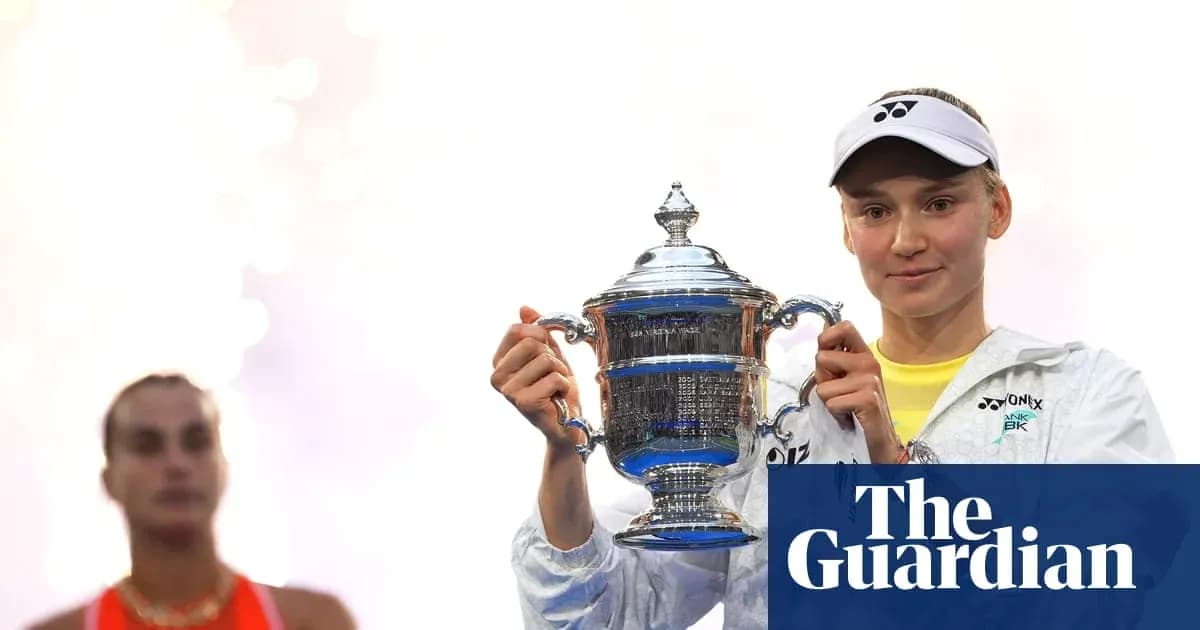
Rybakina is now the undisputed reference point in women’s tennis, the new world No 1 and the US Open champion after prising both titles from Aryna Sabalenka’s grip. On a night thick with tension and history at Flushing Meadows, the 27-year-old outlasted the top seed and two-time defending champion 6-4, 5-7, 6-2 in another bruising, brilliant chapter of their rivalry.
A title run built on grit, not ease
This fortnight was not Rybakina at her most fluent. It was Rybakina at her most stubborn.
She arrived in New York nursing an achilles problem that had cost her a week of preparation and left her unsure she would even step on court. Around her, the narrative hardened: the permutations for the No 1 ranking, the pressure of needing specific results, the constant reminders that this was her chance.
She didn’t blink.
Across the second week, she faced four straight opponents who knew what it meant to win at this level – grand slam or Olympic champions, all of them. Each time, she walked into the fire and walked out without a backward glance. The tennis was often good; the mentality was immaculate.
That resolve set the stage for the final. Against her fiercest rival, with the ranking guaranteed to change hands and a slice of history on the line, she produced the most complete mental performance of her career.
A final that lived up to the billing
This was no ordinary meeting. It was only the second time in the 38 years since both the Australian Open and US Open moved to hard courts that the same two players contested both finals in the same season. It was also a rare showdown between the world’s top two, with the No 1 spot itself riding on the result.
Whenever Rybakina and Sabalenka share a court on a major Sunday, the level spikes. This was their third grand slam final. It produced a third epic.
They flew out of the blocks, trading heavy blows from the baseline. Quickly, though, a pattern emerged. Rybakina’s ball came off her strings cleaner, earlier, more assured. The surprise was where the cracks appeared: in her greatest weapon.
Owner of the most formidable first serve in the women’s game, she opened a grand slam final with that shot in pieces. Across the first set she landed just 27% of her first serves, connecting with only eight of 30 attempts. For most players, that is a death sentence against Sabalenka.
Rybakina simply leaned on the rest of her arsenal.
She stepped in on return and mauled the Belarusian’s serve. She controlled the rallies, pinning Sabalenka behind the baseline. Her backhand, flat and fearless, did not miss. With almost no free points coming from her own delivery, she still suffocated the defending champion, taking time away and space away until the first set was hers and Sabalenka was searching for air.
Sabalenka’s fight, and the crack in the door
Sabalenka’s route to this final had been a story of resilience in itself, after a difficult summer that had tested her physically and emotionally. To give herself a shot at a third straight US Open crown was an achievement on its own. But from the start on Saturday night she looked rattled – by the stakes, by the scoreboard, by the woman across the net.
At 2-3 in the opening set, a double fault handed Rybakina the decisive break. The frustration boiled over. Sabalenka lashed a ball into the crowd and received a code violation. The tension never really left her shoulders, not least as she repeatedly failed to punish Rybakina’s vulnerable second serve.
Still, she refused to go quietly.
Her serve, so often her bellwether, finally clicked in the second set. The first-strike patterns returned. Rybakina’s own delivery steadied but her ground game wobbled just enough to offer Sabalenka a sliver of hope.
At 5-4, serving for the title, Rybakina felt the weight of the moment. Sabalenka sensed it. She stepped inside the baseline and ripped a backhand return down the line to earn her first break points of the match – double set point. Two second serves came her way; two chances went begging. Yet the pressure on Rybakina’s second delivery was no longer theoretical. It was real, sustained, and growing.
At 6-5, Sabalenka muscled her way to a third set point. Again the backhand answered the call, another searing return winner that dragged the final into a decider and sent a jolt through Arthur Ashe Stadium.
Momentum, for the first time all night, wore Sabalenka’s colours.
The reset of a true No 1
Plenty of players would have folded there: a set up, a break from the title, suddenly staring at a rampant two-time champion with the crowd roaring her on. Rybakina did the opposite.
She reset, instantly.
The serve that had betrayed her for an hour and a half returned with a vengeance. The ball toss steadied, the rhythm smoothed out, and with it came the full, destructive weight of her delivery. She breezed through her early service games in the third set, firing aces, forcing short replies, asking Sabalenka to keep matching her level.
Sabalenka couldn’t. Not this time. Not against this version of Rybakina.
Every hold from the Kazakhstani tightened the screw. Each missed opportunity from Sabalenka chipped away at the belief that had briefly surged at the end of the second set. Once Rybakina carved out her opening on return, the outcome felt inevitable. She had survived the storm, ridden out the nerves, and now stood alone at the summit.
A new ruler of the hard courts
By beating Sabalenka, Rybakina did more than take a ranking. She took a crown.
She now owns the three biggest hard-court titles in the sport: the Australian Open, the US Open and the WTA Finals. On this surface, there is no debate. She is the standard.
This victory also elevates her into a different historical bracket. Rybakina becomes a three-time grand slam champion, joining Lindsay Davenport, Jennifer Capriati, Ash Barty, Angelique Kerber and Virginia Wade in that select company. Her major haul now reads: Wimbledon 2022, Australian Open 2026, US Open 2026.
One piece is missing.
With New York conquered and Melbourne and London already in her pocket, Rybakina stands one French Open away from the career grand slam. For a player once viewed as a dangerous outsider in the era’s great battles, the question now is no longer whether she belongs at the top.
It’s how far, and how fast, she plans to redefine it.