.svg&w=384&q=75 "logo")
Dublin Heavyweight Drama: Carty vs. Allen Ends in No-Contest
On a heaving Dublin night built for legends, the heavyweight fight that was supposed to set the tone for Katie Taylor’s farewell barely made it past the opening bell.
More than 83,000 fans packed into Croke Park, ready for a classic storyline: the popular British brawler Dave Allen against local hope Thomas Carty, a Dublin heavyweight with momentum and a crowd at his back. It felt like the perfect stage, the kind of platform fighters dream about.
It lasted 80 seconds.
A Fall No One Saw Coming
The opening exchanges looked like what they were meant to be: two big men feeling each other out, jostling for position, trading early shots in the clinch. Then the fight turned surreal.
Carty, 11-1 with 9 knockouts coming in, says he felt the first shot to the back of the head in that initial clinch but brushed it off and kept working. Seconds later, they tangled again. Another blow landed high and around the back, and suddenly the Irishman’s world flipped.
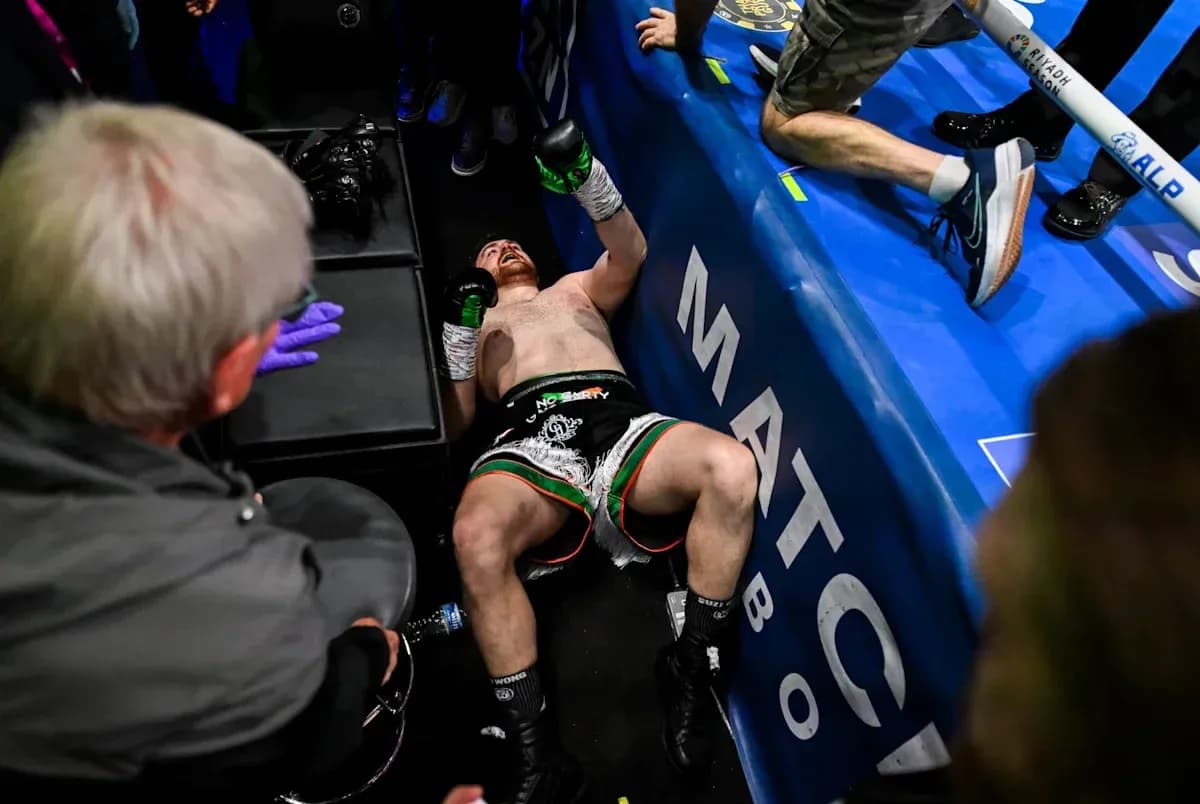
Next thing he knew, he was upside down, tumbling through the ropes.
He crashed out of the ring, clipping a bench on the way down before hitting the ground. The home fighter lay there, dazed, his leg trapped awkwardly under a stool. The crowd’s roar turned to a stunned murmur as officials, photographers, doctors and his coach swarmed around him.
Carty tried to get up. He couldn’t. His neck and the back of his head were in agony, and his leg was pinned. Ringside doctors took one look and made the call: he was in no state to continue.
The fight was over almost before it began.
Confusion in the Ring, Anger in the Stands
Inside the ropes, Allen was as baffled as anyone.
“It was half a round, and he went flying out of the ring,” he later admitted. He didn’t know if he’d be disqualified, handed a win, or dragged into a controversy that would run for days. The referee, ringside doctor and commission officials huddled together, trying to untangle what they’d just seen.
On the big screens, the replay rolled. Slow-motion shots of Allen’s punches landing around the back of Carty’s head drew an immediate reaction. The Croke Park crowd booed loudly, convinced their man had been fouled out of the fight.
The officials took a different view. The referee ruled the incident an unintentional accident. No disqualification. No win. No loss.
No-contest.
It closed off every other possible outcome. Had the referee deemed the final shot a legal blow that simply sent Carty through the ropes, Allen, 27-9 with 20 KOs, could have walked away with the victory. If the punch to the back of the head had been ruled intentional or the direct cause of the injury, Carty might have been awarded a highly controversial win.
Instead, the result sat in the middle: a freak ending, no closure.
Rough, Not Dirty? The Allen View
Allen has never pretended to be a stylist. He calls himself a rough fighter, someone who works on instinct, not precision.
“I’m a rough fighter, not a dirty fighter,” he said. “Half the time I’m not looking where I’m punching, I just want to hit you.”
He argued that Carty’s own movement played a part in where the punches landed. The first shot, he said, went around the back of the head because Carty ducked into it. The second came as Carty rushed in with his head low; Allen aimed for the ear, he insisted, but Carty turned and the punch landed on the back of the head.
From Allen’s perspective, there was no malice, no plan to exploit the rules. Just a messy exchange gone wrong in a sport where inches matter and timing can turn clean into questionable in a heartbeat.
“What Part Did I Not Fancy?”
Outside the ring, the narrative took on a different edge. Some fans and online voices suggested Carty didn’t want to continue, that he’d looked for a way out on a huge stage.
The accusation infuriated him.
He pointed to the brief footage of the fight: he was the one throwing and landing, he argued, and the only punches he absorbed were the two to the back of the head. For a fighter who had already endured a long layoff with a serious ACL injury, the idea that he would engineer a way out of the biggest night of his career struck him as absurd.
He talked about the financial and physical cost of his comeback. The months of rehab. The sacrifices from his team. The modest pay for a fight at this level. This was the springboard, the gamble he was willing to take in the hope of a bigger opportunity next.
He expected to wake up this week discussing his next move. Instead, he is fixated on only one thing.
A rematch.
One Man Wants It. The Other Doesn’t.
From Carty’s side, the path is clear. The fall, the boos, the no-contest, the questions about his heart — all of it demands a second fight with Allen. With the bizarre ending and the attention it drew, a rematch could easily stand alone as a headliner, with genuine needle and a ready-made storyline.
Allen doesn’t see it that way.
He says there’s “nothing in it” for him. The Croke Park appearance came with a specific incentive: a deal that secured six slots for his own fighters on future shows. That, he explained, was the only reason he took the bout in the first place.
Now, with his own career winding down, he has other priorities. The British heavyweight title still calls to him. He believes he has one or two fights left, and he wants those to push him toward that belt, not back into a chaotic night he feels he’s already left behind.
No bad blood, no accusations, but no appetite for a sequel.
A What-If Frozen in Time
Boxing loves closure. When a fight ends without it, the sport usually finds a way to circle back. Grudges get settled. Questions get answered. Careers get defined.
This one may be different.
Carty wants another crack at Allen. The crowd at Croke Park will feel they never saw the real fight. The replays will keep circulating, every angle dissected, every punch slowed down and argued over.
Allen, though, is already looking elsewhere, toward a British title shot and the final chapters of a long, hard career.
If he sticks to that path, Dublin’s wild 80-second heavyweight drama will stay exactly where it is now: a jagged, unfinished memory and one more what-if on boxing’s long list of nights that never quite became what they promised to be.