.svg&w=384&q=75 "logo")

De Minaur Overcomes Rain and Delays in US Open
Alex de Minaur had to wait four days to start his US Open. Once he finally walked on court, he needed just 99 minutes – and one brief lapse – to walk straight back off again.
New York’s stubborn, stop-start rain turned the opening week into a scheduling mess, pushing Australia’s world No.7 out of his Wednesday (AEST) slot and onto the back courts of Flushing Meadows. When he did get on, he treated Italian qualifier Andrea Guerrieri to a ruthless reminder of the gulf between a seasoned top-10 player and a 27-year-old making his grand slam main-draw debut.
The scoreline – 6-2, 6-2, 6-4 – barely flattered him.
Fast start, long wait
De Minaur broke Guerrieri in the opening game of each of the first two sets, ripped through the rallies and looked set for a lightning-quick win. His ball-striking was crisp, his movement typically electric, his intent obvious. This was a man in a hurry.
At 6-2, 4-2 up, the skies intervened again.
Play was suspended and de Minaur was forced back into the locker room for another two-hour wait, the latest twist in a week dominated by umbrellas and towels rather than forehands and serves. When he returned, he simply picked up where he left off.
He joined fellow Australians Dane Sweeny, Tristan Schoolkate, Taylah Preston, Kim Birrell, Maya Joint, Alexei Popyrin and James Duckworth as first-round winners, but did it with the kind of efficiency that matters in a grand slam fortnight.
“These tournaments, it’s all about adapting – and that’s the name of the game,” de Minaur said afterwards. “There’s too much to play for to let something like this affect you, so I’m glad [about how] I handled it. I’m glad I got in and out, played a relatively clean match, and now I can focus on the next one.”
One blip, then the door slammed shut
For two and a half sets, de Minaur barely gave Guerrieri a look. Then, with the finish line in sight, he blinked.
Serving at 3-2 in the third, he threw in a ragged game and lost his serve to love when trying to push 4-2 ahead. On his next service game, he trailed 0-30, suddenly flirting with handing the Italian a lifeline.
The wobble didn’t last. De Minaur steadied, tightened his patterns, and snuffed out the resistance. The left-hander on the other side of the net never came close to turning that brief opening into a genuine comeback.
De Minaur stepped off court having spent less than 100 minutes actually playing across two sessions, his body fresh and his tournament properly underway at last.
“Because of the rain, there’s nothing you can do about it,” he said. “You’ve just got to get out there, play your tennis match and, ultimately, if you win enough matches, you’re going to get out on the stadium court. So that’s the mindset.”
On this day, there was no stadium court. Pushed from the Grandstand, where he had originally been scheduled a day earlier, to the more anonymous court 11 in the back blocks of Flushing Meadows, de Minaur made sure the change of stage didn’t change the script.
Australians scattered by the storm
While de Minaur moved smoothly through, several compatriots saw their campaigns washed away.
Taylah Preston, the 20-year-old wildcard, endured a brutal lesson in her second-round match. American Taylor Townsend overwhelmed her 6-1, 6-1 in just 48 minutes. The numbers told the story: only two winners for Preston, against 28 unforced errors.
Kim Birrell at least made a fight of it. After being swept aside 6-1 in the first set by No.18 seed Ekaterina Alexandrova, she clawed her way back to take the second 6-2 and force a decider. But a double fault on the very first point of the third set handed immediate momentum back to the Russian, and Birrell never quite recovered, losing 6-1, 2-6, 6-3.
On the women’s side more broadly, Daria Kasatkina exited in frustrating fashion. Her rain-interrupted first-round clash with Spain’s former world No.2 Paula Badosa had been halted the previous day with Badosa just two points from victory. When they resumed, Badosa had to fend off two break-back points and needed nine match points in total, but finally closed it out 6-1, 5-4 to earn a meeting with 2024 champion Coco Gauff.
De Minaur’s wife, English player Katie Boulter, also suffered a heavy defeat. Wimbledon runner-up Karolina Muchova swept her aside 6-1, 6-0 in the second round.
“Of course, it’s difficult,” de Minaur said of juggling his own match with Boulter’s disappointment. “Ultimately, we’ve got each other’s backs no matter what, and we’ve always got one eye out on each other. Obviously, it was a tough day for Katie, and I had to do my best to just focus on my task ahead and get the job done in the best way possible. I’m glad I was able to achieve that today.”
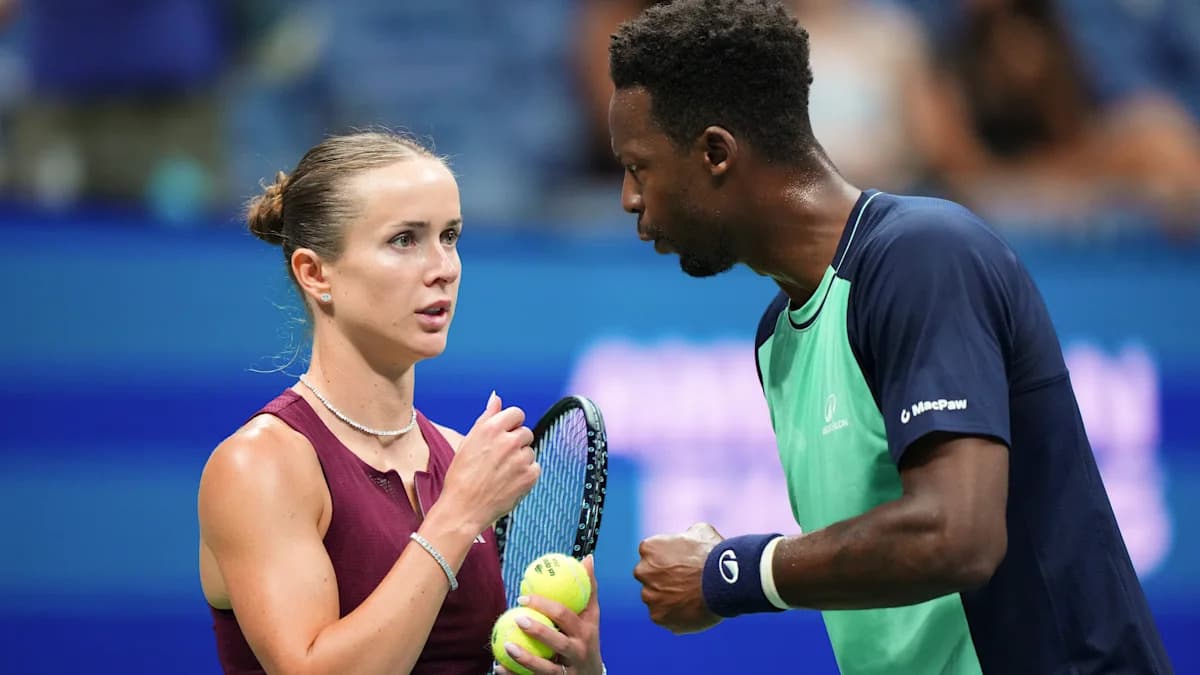
Maya Joint and James Duckworth will try to extend the Australian presence on Thursday (AEST), with Joint facing No.9 seed Elina Svitolina and Duckworth taking on Wu Yibing.
A tougher road ahead
The comfortable opening win might be the last straightforward day de Minaur gets in New York.
Next comes Botic van de Zandschulp in the second round, a dangerous Dutchman who also advanced in straight sets, brushing aside Brit Jan Choinski. Van de Zandschulp carries real US Open pedigree: he famously upset Carlos Alcaraz in the second round here two years ago and has the kind of heavy game that can trouble anyone on a hard court.
Beyond that, the projected path stiffens. No.31 seed Zizou Bergs looms as a likely third-round opponent, with top seed Alexander Zverev pencilled in for a potential quarter-final. Zverev has already been dragged deep into the New York grind, needing almost five hours to subdue Italy’s Lorenzo Sonego in his opener.
One obstacle, though, has already been removed from de Minaur’s section. In-form No.12 seed Rafael Jodar, a possible fourth-round opponent, crashed out in a stunning 6-2, 6-1, 6-1 defeat to lucky loser Bu Yunchaokete. Bu only entered the draw when Australia’s Thanasi Kokkinakis withdrew with an ankle issue, and has now blown the section wide open.
Back to his happy hunting ground
De Minaur arrives in New York with a curious mix of momentum and frustration. The first months of the season were outstanding: a second straight Australian Open quarter-final, a title run in Rotterdam, a clear step up in his standing at the top of the men’s game.
Since then, by his own elevated standards, he has stalled. A third-round exit at Roland-Garros. A fourth-round departure at Wimbledon. Good, but not the deep slam runs he now demands of himself.
The US Open, though, has often brought out his best. A three-time quarter-finalist in New York, he knows the courts, the bounce, the noise. He knows how to ride the chaos here.
This straight-sets win, on a rain-soaked back court with schedules shredded and plans rewritten, suited him perfectly. Adapt, adjust, move on.
If he can keep doing that over the next ten days, the man shunted to court 11 might yet find himself exactly where he wants to be – under the lights, on a stadium court, playing for something far bigger than a routine first-round win.