.svg&w=384&q=75 "logo")
Dan Brand: Israel's Rising Tennis Star
In a soccer- and basketball-obsessed Israel, where Deni Avdija’s NBA rise and the World Cup have dominated the sporting conversation, the country’s next big story is unfolding far from the spotlight, on quiet back courts and distant junior events.
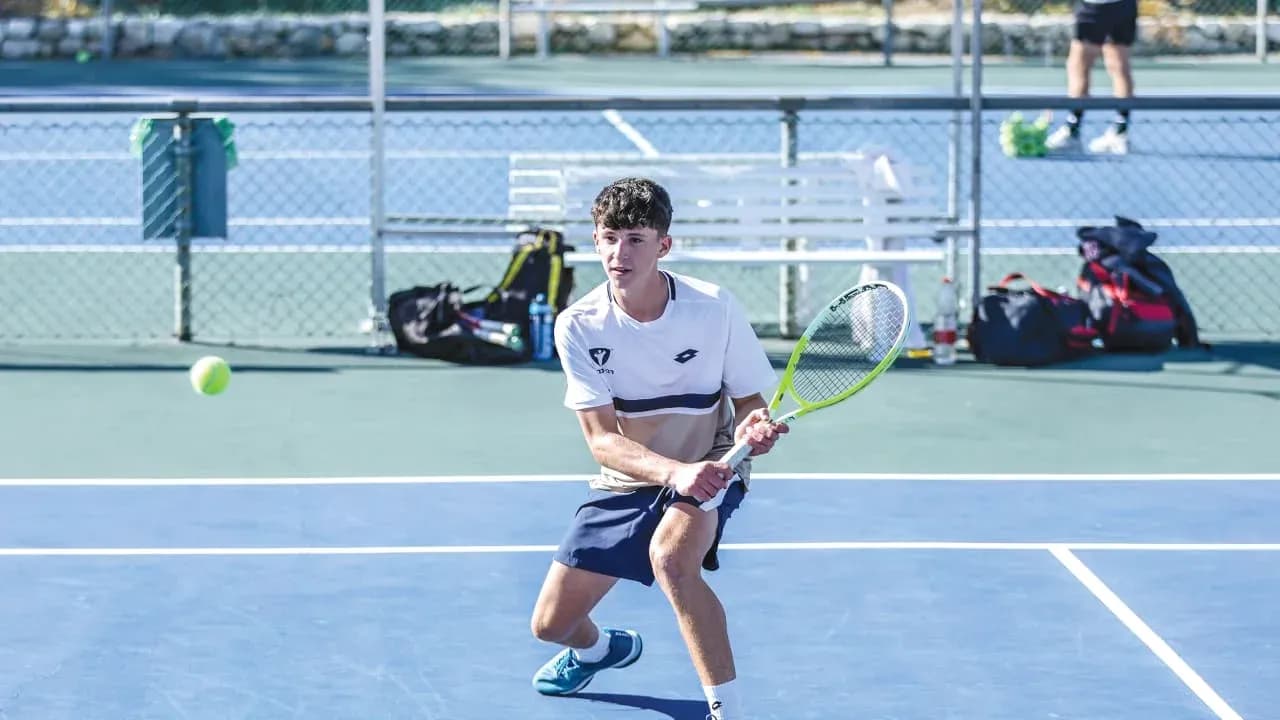
His name is Dan Brand. He is 17, from Kfar Saba, and he is already ranked No. 24 in the world in junior boys’ tennis. That number is likely to shrink soon.
A quiet climb to the Grand Slams
Brand’s season has already taken him to Roland Garros and Wimbledon, the two most tradition-soaked lawns and clay courts in the game. At the French Open juniors, he went out early in singles, losing a rugged first-round battle 3-6, 7-5, 6-1 to France’s Mathys Domenc. It stung. But it also showed he could live with the best on the sport’s most demanding surface.
He made a deeper run in doubles there, reaching the quarterfinals alongside American partner Safir Azam. The margins at that stage are thin; for a 17-year-old from a local Israeli club, the message was clear: he belongs.
On the grass at Wimbledon, Brand took another step. He pushed through to the second round in both singles and doubles, adapting to a surface he rarely sees back home. Next up is the US Open juniors in Queens, New York, where he will again compete in both draws. The junior event begins on September 8, and this time, he arrives as a name to watch, not a wide-eyed tourist.
“Dan is absolutely our next hope,” says Yoni Erlich, Israel’s Davis Cup captain and tennis director at the Israel Tennis and Education Centers. Erlich believes Brand is tracking towards the junior top 20 and notes his recent “very nice wins” at a men’s Futures event, where he reached the quarterfinals. The hope, he says, is that Israel will soon have another Grand Slam player. “We can only hope and be patient.”
The weight of a thin history
Patience is something Israeli tennis fans know well. The country has not produced a top singles player in years. Shahar Peer climbed to No. 11 in the world in 2011, the highest ranking for an Israeli singles player. In doubles, Andy Ram and Jonathan Erlich reached No. 5 in 2008, just after winning the Australian Open men’s doubles title.
Before them stood Amos Mansdorf, the standard-bearer for Israeli men’s singles. He peaked at No. 18 in November 1987. Now, the man who once carried the flag is trying to help shape the boy who might carry it next.
Mansdorf has coached Brand since the youngster was 12. “It is nice to see him coming along and moving in a nice direction. He plays clever tennis and is quite good all around,” he says. Away from the lines and chalk, he describes Brand as “nice, quiet, low-key, hard-working, and dedicated.”
On court, Mansdorf sees a player who “doesn’t panic,” a rare commodity in a sport built on pressure points and momentum swings. His long-term vision is clear: a place in the top 50 on the men’s tour. To get there, he wants Brand to grow stronger, build a bigger serve, and develop the kind of power and precision that allows him to stand toe-to-toe with established pros.
For now, the path will likely run through college tennis in the United States. Mansdorf expects Brand to receive a deferment from the IDF and head to “a good US college,” a route that has become increasingly common for rising talents who need matches, structure, and time to grow.
A chance discovery
The story almost never happened.
Brand started out as a soccer player. His coach suggested the kids try other sports. His father, Shai, a tort lawyer and Brazilian jiu-jitsu black belt who once won two world titles, had his own ideas. He tried to steer Dan toward the martial art he loved. The verdict from his son was blunt: too boring.
Tennis came next, at school. It did not take long for someone to notice.
“His coach said, ‘I trained hundreds of kids; your son is something special,’” Shai recalls. The coach urged him to enter Dan in a national competition. Shai hesitated. “It was too early.”
Eventually, curiosity and his son’s obvious ability pushed him forward. Shai approached Mansdorf. The former world No. 18, then working privately and later as head coach at the Ra’anana City Tennis Center near Kfar Saba, took the boy on. Brand stayed put, training at a local club instead of decamping to an elite academy in Europe. Shai is proud of that. It fits the family’s ethos: do it the hard way, do it honestly.
As Brand’s results improved and his travel schedule exploded, Shai stepped into a second career as full-time chaperone. He accompanies his son to many tournaments, tracking his health, security, and daily routine. When he cannot be there, he leans on a network of trusted contacts abroad to “look out for Dan.”
Despite the constant movement, Shai insists his son remains grounded. Dan still attends a regular school in Israel when he can, dropping in mainly for exams. The rest of the time, he studies on the road. “My mother is pretty smart and helps a little with math and other subjects,” Dan admits, half-sheepish, half-proud.
He is the eldest of three. His mother, Ruth, is a speech therapist; his siblings, Nadav, 15, and Shira, 10, are still at home. “Dan’s got his mother’s calm,” Shai says.
A teenager on tour, not a star
For all the rankings and travel, Brand sounds like any other 17-year-old when he talks about his life. Reached just after a driving lesson during a brief stop in Israel, he speaks about school, hobbies, and his friends, who, he says, “treat me the same as before.” He likes playing basketball. He enjoys hanging out with his family. Fame, such as it is, has crept in slowly, mostly through classmates spotting him on television.
On tour, he has built friendships with peers from around the world. He says he has not faced antisemitic incidents. Instead, some players ask him about the situation in Israel. They listen. They try to understand.
On court, he knows exactly who he is and who he wants to become. He calls himself “a solid player and a counter-puncher,” aware that he needs to be more aggressive and add speed to his serve. He describes himself as “a pretty focused, chill guy.”
Grass courts, the rarest surface in his world, fascinate him. “It’s not a surface you play on every day,” he says. He likes routine, and he studies Novak Djokovic, the sport’s most relentless competitor, winner of 101 ATP Tour-level singles titles, 24 Grand Slams, and an Olympic gold medal. “I like his mentality. He is so focused on the match.”
Pride, pressure, and a flag
If Brand is becoming a name in junior tennis, his father is just as proud of the person as the player. Shai calls his son “so humble,” delighted that Dan will hit with anyone, talk to anyone, and remains shy despite the growing attention. “Everywhere he goes, people fall in love with his son and say, ‘Dan is amazing,’” he says. “This is more important to me than the tournaments.”
That does not mean the results do not matter. Shai lights up when he recalls one in particular: Brand’s 6-3, 6-2 win over Jordan Lee in May, in the final of the J300 Charleroi-Marcinelle/Astrid Bowl Charleroi Belgian International Championships. Lee, ranked No. 8 in the world, has since won the Wimbledon juniors title. Beating him, and beating him comfortably, was a statement.
Those kinds of wins draw attention. US colleges have already started circling. At home, Brand may be granted “ilui” (prodigy) status by the army, a step above the “sportai mitstayen” (outstanding athlete) designation given to top performers who usually perform desk jobs in the IDF while they continue their sporting careers. “Iluim” are exempt from service entirely, on the grounds that they serve the country through their achievements.
Shai, whose own military background includes combat service, as did his father’s, believes Dan will serve in the IDF at some point. He does not dwell on the risks, though he acknowledges that “after Oct. 7, you can feel people turning their backs on you.”
The tension filters into tennis. Dan has reached out to some European players about forming doubles partnerships and received no replies. Players from the US, South America, and Asia, by contrast, have been open and welcoming.
Through it all, Dan continues to play with the Israeli flag next to his name. He had the option to represent Germany, thanks to a German passport via his maternal grandfather. The financial support would likely have been greater. The path smoother.
“He would have gotten more money, but Dan said ‘no,’ – he wants to do it the hard way,” Shai says.
Backing a rising talent
The next step on that hard road is the US Open. Before heading to New York, Brand will attend the International Tennis Federation’s Grand Slam Player Development Program at the Junior Tennis Champions Center in College Park, Maryland. Only a select group of players are invited; Brand is one of the few Israelis ever chosen.
Mansdorf will not be in his corner at Flushing Meadows. Instead, Shai will travel with him, joined by Danny Perekalsky, CEO of the Israel Tennis Association. Perekalsky has watched Brand’s recent surge closely and likes what he sees, both in his game and in his demeanor.
“Dan is a really great kid. He shows a great mentality and behavior on and off the court, and he is a really great example for other kids with his behavior and style,” Perekalsky says.
He rattles off Brand’s recent achievements: titles in Thailand and Belgium, and a strong showing at the ITF M15 event in Astana, Kazakhstan, from August 3-9. There, Brand earned his first ATP ranking points by reaching the round of 16, edging fellow Israeli Oren Shimanov 6-3, 4-6, 7-5. “He has really made a big jump in the last six months,” Perekalsky notes.
The ITA has backed Brand’s rise, alongside sponsors such as Rav Bariach, the Israeli company known for security doors and high-end locking systems. The prestigious Wingate Institute in Netanya, Israel’s National Center for Physical Education and Sport, now supports him as well. “He is now under their care,” Shai says. “I am just looking out for my son as a father.”
Perekalsky spreads the credit. “We are proud to support Dan and to have such a developing talent! Bravo also to Dan’s family and to coach Mansdorf. Amos is doing a great job with Dan. It is not a coincidence he is achieving the results he has been in the past six months.”
His prediction is bold: Brand in the junior top 10 by January, if his trajectory holds. With older players aging out of the category at 18, the door is about to open wider.
“Israel is waiting to have something to be proud of in tennis,” Perekalsky says. “And we need more than one Dan. We are proud, but it is only a start.”
The next few months, from Queens to the college offers that follow, will show whether this quiet teenager from Kfar Saba is simply a bright junior or the player who finally drags Israeli tennis back into the global conversation.