.svg&w=384&q=75 "logo")
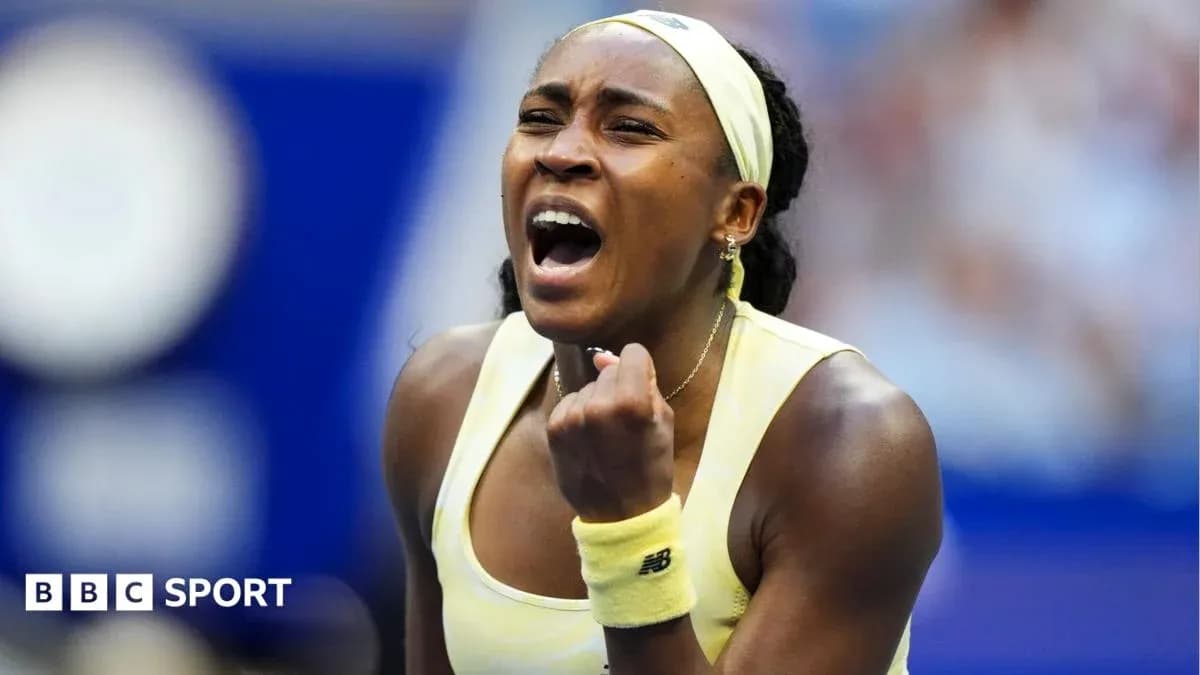
Coco Gauff Advances to Fourth Round at US Open
Coco Gauff steadied herself, then surged. On a day when American hopes scattered across the grounds at Flushing Meadows, the defending champion did what the best players do at their home major: she absorbed the noise, the nerves, and the expectations, and walked off a winner.
The 22-year-old moved into the fourth round of the US Open with a 6-3 6-4 victory over Spain’s Cristina Bucsa, a scoreline that looks routine only on paper. She trailed 3-1 in the opening set, was broken to love early in the second, and still never let the match slip from her grip.
This is now Gauff’s fifth straight trip to the second week in New York. She has grown up in this stadium, under these lights, with the weight of “next great American hope” hanging over every swing. The difference now? She looks like she’s carrying it, not being crushed by it.
“I feel like I’m used to getting to the second week now. I woke up today and I was like ‘oh we’re already in round three’,” she said afterwards, a line that sounded casual but carried the confidence of a player who expects to be here. She knows the expectations. She also knows how they nearly swallowed her a year ago.
“Last year, I put so much pressure on myself. I’m enjoying the experience out here,” she added, and her tennis backed that up. When Bucsa jumped ahead in the first set, Gauff tightened her patterns, found her length, and reeled off five of the next six games. When she was broken to love in the second, she hit back immediately, ripping through the next game and restoring order.
This is the form player in the women’s game. Since lifting the French Open trophy earlier this year, Gauff has been on a tear; this win marked her eighth straight WTA Tour-level victory in straight sets. The only blemish on her New York record in recent seasons has been the fourth round, where her campaigns ended in each of the past two years. The way she handled the swings against Bucsa suggested she’s better equipped to push through that barrier now.
American Story
Around her, though, the American story was far less straightforward.
Madison Keys walked to the brink of a cathartic win, then watched it dissolve in front of a stunned Arthur Ashe crowd. Up 5-0 in the deciding set against Olympic champion Zheng Qinwen, holding a match point and seemingly cruising towards her first US Open fourth round since 2023, she froze. Zheng didn’t.
What followed was a collapse as brutal as the scoreline: 1-6 7-6 (7-3) 7-5 to Zheng, seven straight games slipping away from Keys as her lead, and her belief, evaporated.
The 31-year-old did not sugar-coat what happened.
“I obviously got off to a really good lead, and then I got really scared, like I couldn’t swing [the racquet],” she admitted. “I felt like I couldn’t play tennis anymore. It just felt like it was a much bigger deal than just playing a tennis match all of a sudden.”
For a former finalist here — she lost the 2017 title match to Sloane Stephens — the scene felt painfully familiar: Ashe Stadium, the stakes rising, the racquet suddenly heavy. Keys has been a regular presence in the latter stages of majors, reaching the fourth round at all three other Slams this season, but her words told the story of a player wrestling with more than just her opponent.
“I feel like I’ve been struggling for a while now. I’m going to have to make some sort of changes,” she said. “I just kind of keep putting it off because that’s how the tennis world works. It’s just to the point where I actually need to do something about it.”
On another court, Amanda Anisimova’s campaign ended with a quieter, but no less stark, disappointment. Last year’s runner-up in New York, beaten then by world number one Aryna Sabalenka in the final, she bowed out in straight sets to Anastasia Potapova, the Russian-born Austrian 24th seed.
Anisimova never found any real rhythm. She dropped serve twice in the first set, then four more times in a chaotic second, her frustration visible as each chance slipped away. For a player who rode a wave of shotmaking and belief to the final 12 months ago, this was a harsh reset.
So the American ledger on day five read like this: one standard-bearer marching on, two established names out, and a field that still holds serious home interest.
Iva Jovic will try to join Gauff, Jessica Pegula, Taylor Townsend and Emma Navarro in the last 16, a cluster of US women who have quietly built a strong presence in the draw. On the men’s side, the picture looks even more crowded with stars and storylines. Ben Shelton, Frances Tiafoe, Tommy Paul and Alex Michelsen are already through, with Learner Tien and Michael Zheng still to play and the possibility that Americans could feature in six of the eight fourth-round matches.
For now, though, the centre of gravity remains with Gauff. She is the most recent American singles champion in New York, the first home teenager to win the title since Serena Williams in 1999, and she returns to the fourth round not as a surprise package but as the standard.
Two years running, this stage has stopped her. This time, she arrives with a major title in her pocket, a streak of straight-sets wins behind her, and a calmer voice in her own head.
The draw will get tougher. The nights will get louder. The pressure, inevitably, will rise.
Gauff looks ready to meet it head on.