.svg&w=384&q=75 "logo")
Carlos Alcaraz Eyes Historic Title Defense at US Open
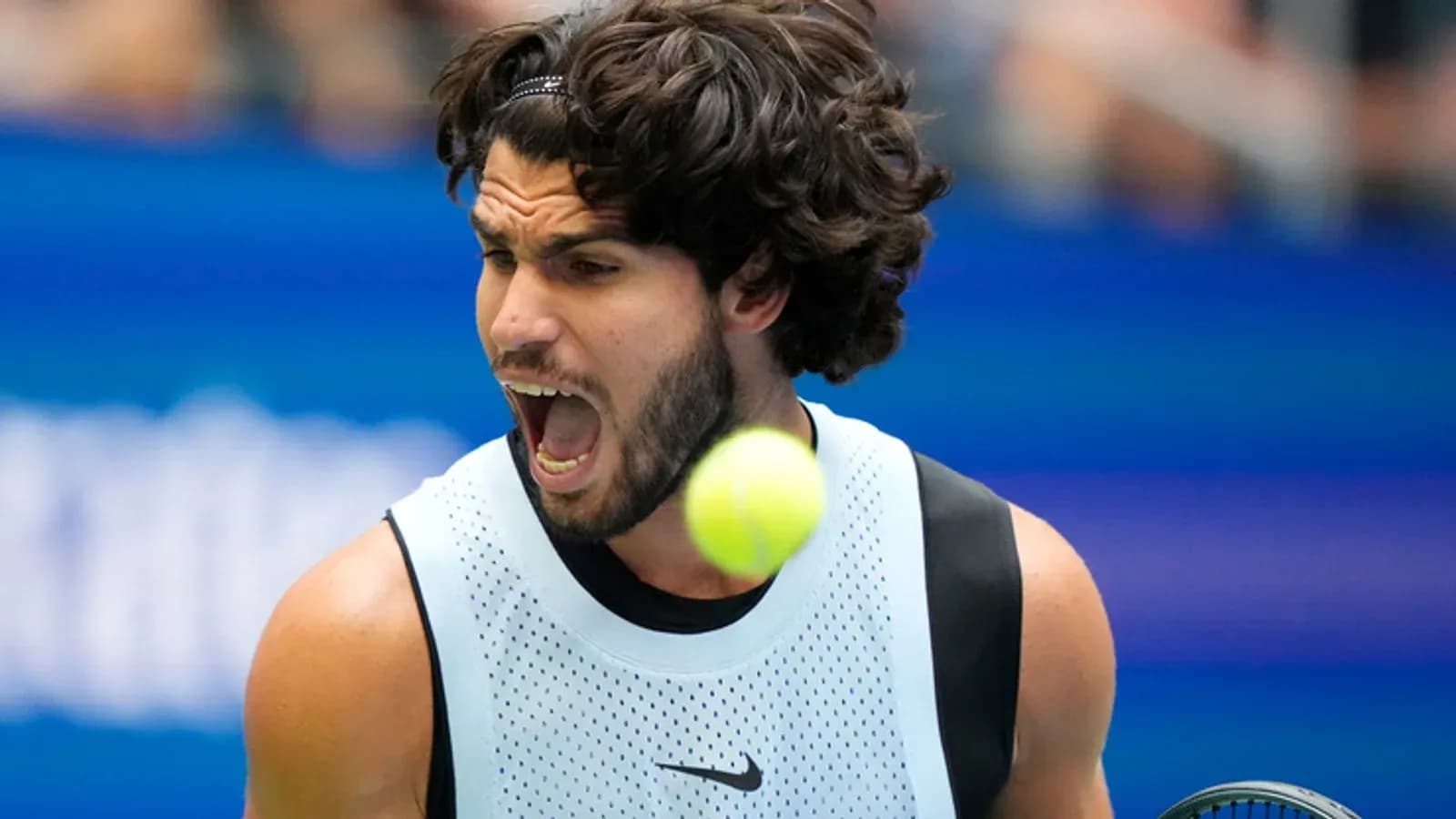
Carlos Alcaraz is starting to treat history like a to-do list.
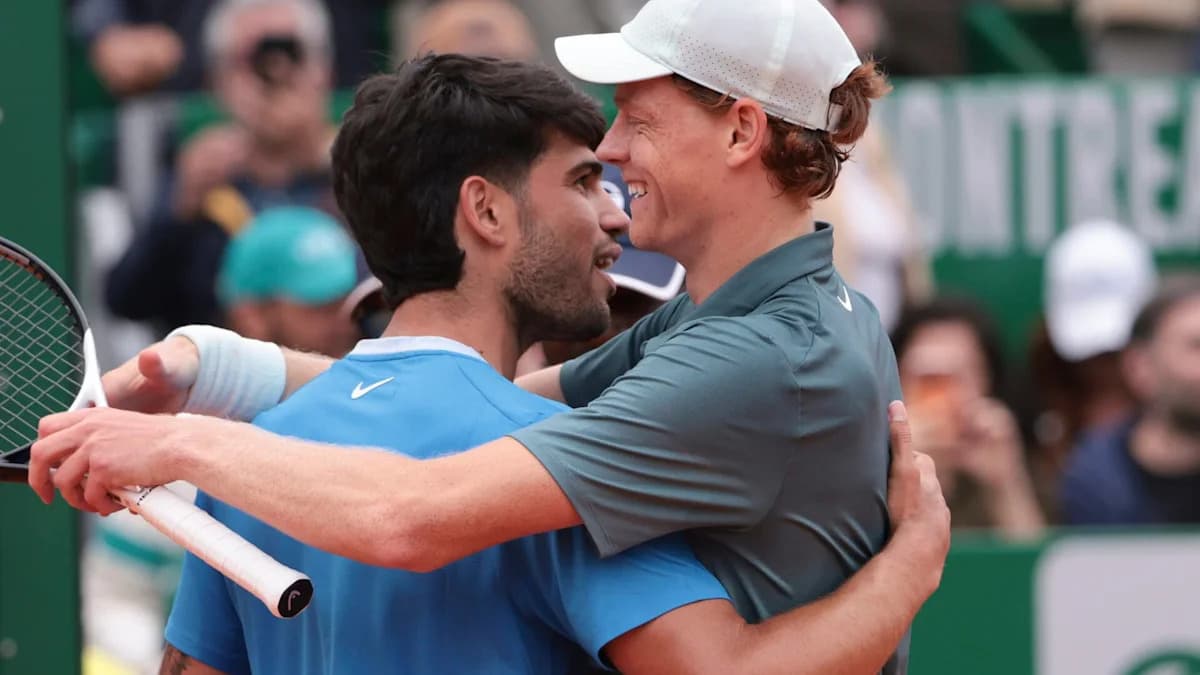
On a warm night in New York, the defending US Open champion dismantled Tommy Paul 6-4 6-3 6-4, brushing aside both the home hope and any lingering doubts about the wrist injury that kept him out for more than four months. Two hours and 21 minutes, job done, quarter-final secured, and another stride taken towards a slice of tennis history no man has owned before.
Alcaraz hunts a new kind of history
Alcaraz is already the youngest man to complete the career Grand Slam. That alone would be enough for most careers. He isn’t interested in “most careers”.
If he lifts the trophy again at Flushing Meadows next Sunday, he will become the only man in the Open Era to successfully defend major titles on all three surfaces. The grass of Wimbledon in 2023 and 2024, the clay of Roland Garros in 2023 and 2024, and now the hard courts of New York lie in front of him, waiting to be added to an astonishing run.
He looks in a hurry to get there.
Paul, the 20th seed, arrived talking up his chances, insisting he always backs himself against the elite. On this evidence, belief alone is nowhere near enough. Alcaraz has now beaten the American six times in a row, taking the last 14 sets they’ve played. The rivalry is beginning to look brutally one-sided.
A champion in full flow
From the start, Alcaraz imposed his game. He stepped in on returns, took time away from Paul, and refused to let the American settle into any kind of rhythm. Whenever Paul tried to stretch the rallies, Alcaraz simply ran more, hit harder, and found more angles.
“I played my game. I tried to put my style on today’s match,” he said afterwards, and that style is suffocating. Heavy forehands, early strikes on the return, constant pressure. “Tommy is such a talented player and his shots are dangerous and hard to control, so I just tried to be ready for the battle, ready to run if it mattered.”
The pressure told in every key moment. Alcaraz attacked Paul’s second serve relentlessly and kept him pinned behind the baseline. “I tried to be aggressive all the time and tried not to let him stay on the court,” he explained. “I put so much pressure on the return game. It helped a lot to play relaxed, calm and to think clearly.”
The only wobble came at the end, and even that felt like a reminder of his ruthlessness. Serving at 4-5 in the third, Alcaraz faced two set points. Paul had a glimmer. It vanished in a blur of forehand violence: two clean winners, two statements. Moments later, the handshake.
‘Back to full power’
For a player who missed four-and-a-half months with a wrist problem, Alcaraz looks frighteningly sharp.
“I’m really happy with the performance today. Am I back to full power? I think so,” he said. “I play well every time I come here, and I just try to enjoy it. It doesn’t matter I was out for four-and-a-half months; every time I come here I play my best.”
From courtside, the verdict was even stronger.
Tim Henman, watching for Sky Sports Tennis, called it a privilege to see Alcaraz “go through the gears”, noting how the Spaniard has “just got better and better as this tournament has gone on”. Paul, he said, “gave it everything he had but, at the end of the day, Alcaraz was different class.”
Henman reserved particular praise for the Alcaraz forehand. “The forehand was firing. I’ve seen plenty of good forehands over the years, but I think Alcaraz’s might be the best. It’s unbelievable how he hits it so hard and doesn’t look like missing.”
Martina Navratilova went even further, calling his rise “really crazy” and marvelling at how quickly he has mastered such a wide-ranging game. “Normally, when people have that many options to their game, it takes a while to figure out how to play the game. But not Carlos, he’s just in another stratosphere.”
Right now, the draw looks like it belongs to him. The rest of the field will have to drag him back to earth.
Sabalenka survives strange night to keep No 1 dream alive
On the women’s side, Aryna Sabalenka did not produce her cleanest tennis. She didn’t need to. She just refused to let go.
The defending US Open champion beat Taylor Townsend 6-4 6-3 in a chaotic, compelling match on Arthur Ashe Stadium that featured 11 breaks of serve in 19 games. It was scrappy, tense, and at times downright bizarre, but Sabalenka walked off with what she came for: her title defence intact, and her chase for a 100th week as world No 1 still alive.
Sabalenka has already spent 99 weeks at the top of the rankings. To reach triple figures, she must win a third straight US Open and hope current No 2 Elena Rybakina falls before the semi-finals. The equation is simple. The path is anything but.
Townsend, roared on by the home crowd, forced Sabalenka to work. The American went up a break in the second set, charging the net and trying to disrupt the Belarusian’s rhythm. For a moment, the upset felt possible.
Sabalenka’s response was blunt. “I was like ‘okay, you are down the break, just try to return the serve and put as much pressure on her as possible’,” she said. “I was just trying to stay focused on myself, not only point by point but ball by ball. I’m happy I was able to turn around the second set, I think it was a key moment.”
Once she broke back, the energy shifted. She roared, clenched her fist, and hammered her way to the finish line.
Raw power, rough edges
This was not Sabalenka at her most polished. Martina Navratilova, assessing the performance for Sky Sports Tennis, called it “good enough” and “pretty solid”, pointing out that Townsend actually finished with more winners.
Sabalenka’s strength came in the reply. “Aryna did really well returning serve and with passing shots,” Navratilova said. Townsend’s forays to the net, a central part of her game plan, were repeatedly picked off. “Townsend tried to come into the net more, but she wasn’t successful there, that’s how well Sabalenka played from the baseline.”
The grade? A measured one. “Overall, I would give Sabalenka a ‘B’ because she lost her serve so many times, but she played really well when it mattered.”
Annabel Croft saw something else: theatre. “There was a lot of ferocious intensity to what Sabalenka brought onto this court,” she said. When Sabalenka broke back in the second set, “she really galvanised herself. When she got back on track, she let out the most enormous shriek and you just knew she meant business.”
Croft called her “a great showwoman” who understands that “this isn’t just sport, it’s entertainment as well.” The aura, the personality, the roar – it all fed into the sense that Sabalenka, for all the double breaks and broken service games, still carries a champion’s presence.
“She is going to take some beating,” Croft added. “She doesn’t look as vulnerable as I was expecting. So far, she hasn’t dropped a set and looks in very good shape.”
Noskova awaits after epic
Waiting for Sabalenka in the quarter-finals is Wimbledon champion Linda Noskova, who survived a marathon of her own against Marta Kostyuk.
Their match, a repeat of their semi-final at SW19, turned into another nerve-shredder. Noskova eventually prevailed 7-5 5-7 6-4, but only after Kostyuk saved five match points – two at the end of the second set and three more in the decider. The Czech finally broke through, but not before the contest had turned into a test of nerve as much as shot-making.
Now, Noskova brings that resilience and fresh Grand Slam pedigree into a collision with Sabalenka’s raw power and big-stage experience.
On one side of the draw, Alcaraz is chasing a record that would redraw the boundaries of men’s tennis. On the other, Sabalenka is fighting to extend her rule at the top of the women’s game. New York has seen plenty of champions, but it rarely sees two simultaneous defences of this magnitude.
The next few nights on Ashe will decide who keeps their crown.