.svg&w=384&q=75 "logo")
Carlos Alcaraz Returns with Dominant Win at US Open
Carlos Alcaraz didn’t just return to Arthur Ashe Stadium. He stormed back into it.
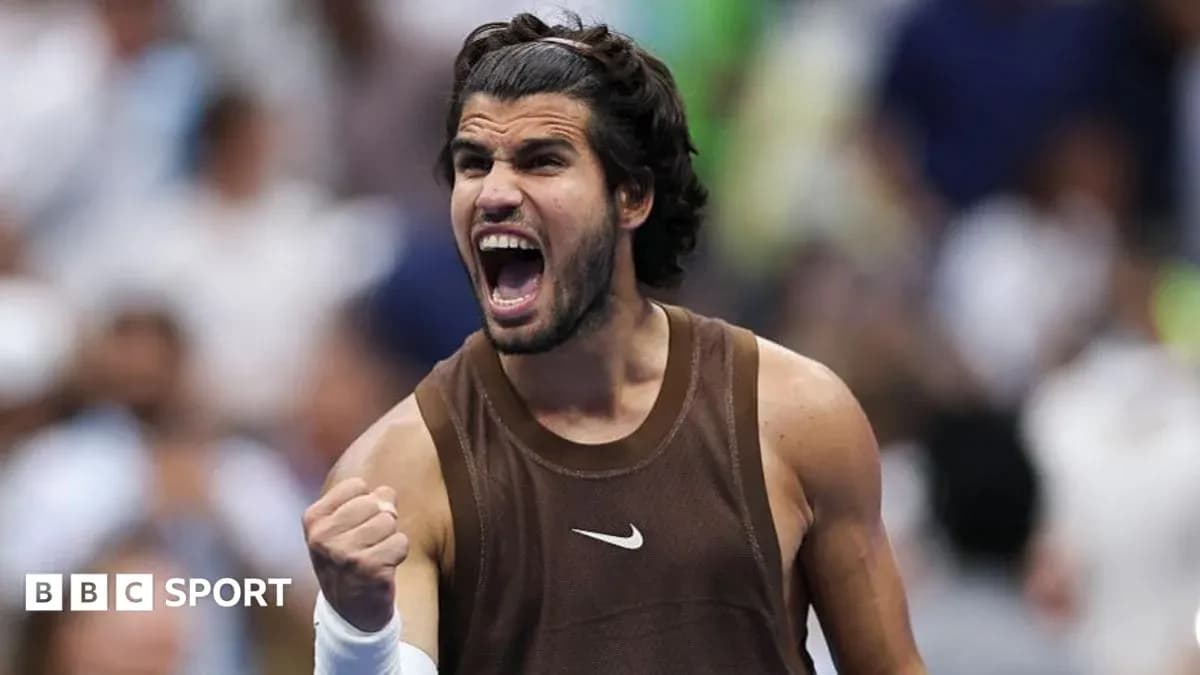
After 139 days out with a wrist injury, the defending US Open champion walked into the arena he owns as much as anyone in the sport right now, sleeve on his right arm, grin on his face, and that familiar crackle of electricity in the air. Ninety minutes later, he walked off with a straight-sets win and something even more important: the feeling that he is truly back.
He beat Russia’s Roman Safiullin 6-4, 6-4, 6-4, a clean, controlled, occasionally spectacular performance that looked far more like a continuation of his New York story than the tentative first step of a man who hasn’t played singles in over four months.
The show returns to Ashe
If there were any nerves, they were buried beneath the showman.
From the first game, Alcaraz leaned on his trademark forehand, the shot that has already carried him to seven major titles. The compression sleeve did nothing to dull it. That whippy, elastic motion produced the bulk of his 28 winners, ripping through the court with the same violence that made him a champion here.
He didn’t just hit the ball. He performed.
Every clean strike, every successful foray forward, came with a clenched fist and a barked “vamos” toward his team. He smiled after points. He laughed with the crowd. At one changeover he even sang along to a Michael Jackson track, a player so at ease in tennis’ biggest stadium that it felt less like a comeback and more like a homecoming.
The moment that truly summed up the night came late in the third set. Locked in a fierce rally on his final service game, Alcaraz feathered a sublime drop shot that died just over the net. Ashe erupted. He raised his fist to the sky, then cupped his ear and waved his arms, demanding more noise. The crowd, starved of him for months, gladly obliged.
“What I really want to do is enjoy every time that I’m going to walk into the court, feeling the energy from the people,” he said afterwards. “That’s what I’m going do this tournament. The results, it’s going to come after all.”
For a player who spent the summer watching Alexander Zverev and Jannik Sinner collect the French Open and Wimbledon titles, this wasn’t just about a scoreline. It was about feeling alive again.
“I missed the crowd, the energy, the competition – I missed everything,” he said. “I’m just really, really happy that I was able to compete again.”
On BBC Radio 5 Sports Extra, former Wimbledon champion Pat Cash noted that it looked as if “every little win” was celebrated by Alcaraz. That was exactly the point. After 139 days of rehab, even the small victories mattered.
Rust, reality and a risky serve
Strip away the theatre and the numbers tell a more nuanced story.
The forehand? Lethal. The touch? Still there in those delicate drop shots that yanked Safiullin forward and opened the court. The movement? Sharp enough that he never looked in real physical trouble, even in the longer exchanges.
The serve, though, is a different chapter.
Alcaraz finished with just two aces and five double faults. Those are not the figures of a man serving at full capacity, and he knows it. He did land 68% of his first serves and won 66% of those points, but the usual free points were rare, the usual bite missing.
“The serve is the shot I was struggling [with] the most,” he admitted. He also revealed that part of the slower pace was by design, a tactical gamble to disrupt Safiullin’s rhythm rather than overpower him.
“I’m going try to serve better. The point is going to try to serve normal, but it’s a shot that I just always struggle [with]. But it will be back, for sure.”
The other question mark coming in was stamina. Best-of-five is a different sport, even for a 23-year-old.
“There were some doubts in the match, I’m not going to lie,” he said. “I’ve been thinking about ‘am I going to last the best of five, am I going to last playing four sets, five sets?’”
He didn’t need to find out on Monday night. Three controlled sets were enough. No tiebreaks, no extended marathons, no obvious physical drop-off. For a first match back, it was exactly the kind of outing a defending champion wants: competitive, but not punishing.
“I need more matches under the belt to get again into the rhythm of the tournament,” he added. “I’m pretty sure I’m going to get better and better every day.”
A draw that suddenly looks inviting
The win itself was expected. The context around it is what makes it feel bigger.
World number one Jannik Sinner is not in New York, sidelined by a knee problem. Novak Djokovic, the 24-time Grand Slam champion and the man who still casts the longest shadow over any major, is already out, stunned in the first round by Argentina’s Mariano Navone.
French Open champion and top seed Alexander Zverev sits on the other side of the draw. As second seed, Alcaraz cannot face him before the final.
Even the dangerous floaters are thinning out. French 10th seed Arthur Fils, fresh from his Cincinnati Masters title and widely tipped as a serious threat here, fell earlier on Monday to Stefanos Tsitsipas. That result quietly removed another potential landmine from Alcaraz’s path.
As it stands, the only top-10 opponent he can encounter before the semi-finals is American Ben Shelton, a possible quarter-final opponent and a man whose serve and swagger fit this tournament perfectly.
Next up, though, is Portugal’s Jaime Faria, ranked 72 in the world. On paper, it’s another step Alcaraz should handle. On the court, it’s another chance to harden the body, sharpen the serve, and push those lingering doubts about his five-set resilience further into the background.
Alcaraz has made it clear he came here to enjoy himself first and trust that the results will follow. On Monday night, New York enjoyed him right back. If the wrist holds and the serve catches up with the rest of his game, this opened-up draw may yet belong to him again.