.svg&w=384&q=75 "logo")
Carlos Alcaraz's Impressive Return to Grand Slam Tennis
Carlos Alcaraz didn’t so much ease back into grand slam tennis as announce his return with a flourish that felt instantly familiar.
Four and a half months without a singles match, a surgically repaired wrist, no warm‑up tournaments, best-of-five from a standing start – the script was supposed to be complicated. At 5-4, 30-15 in the opening set against Roman Safiullin, it became very simple.
Wide serve. Forward surge. A dipping backhand return at his shoelaces. Then that touch.
Alcaraz bent down, softened his hands and feathered a half‑volley over the net for a clean winner, the kind of improvisation that separates him from almost everyone else on tour. He flashed the broad grin that has been missing from the game since his layoff, held serve, and never really looked back in a 6-4, 6-4, 6-4 win that felt as important for how it looked as for what it meant.
The forehand roars back
The doubts coming in were real. No matches since his injury. A wrist that had needed careful management. A five‑set format that offers no place to hide if the body or timing falter. Across the net, Safiullin, one of the heaviest ball‑strikers around, prepared to test that wrist with every savage cut from the baseline.
Alcaraz answered all of it with his biggest weapon.
From the first games, he hit the forehand like a man intent on proving a point. He stepped in, ripped through the ball, and dictated from the back of the court. Twenty forehand winners flew off his strings, against just nine unforced errors on that side – a ratio that tells its own story. When he did face trouble on serve, he didn’t back off. He simply hit his way out of it.
“It’s pain-free right now,” he said afterwards, speaking about the wrist that has dominated his season. “I felt great. I don’t know how it looked from outside but, from inside, my feeling was that I was hitting normal. I was playing pretty normal, playing my style, and the arm, the wrist, everything felt great. I’m going to still take care of it, obviously, these days and before the matches and everything, but I’m just really happy it’s pain-free finally.”
That was the headline for him: not just the win, but the freedom with which he swung.
One big question mark
There is, however, a wrinkle in the story of this comeback – the serve.
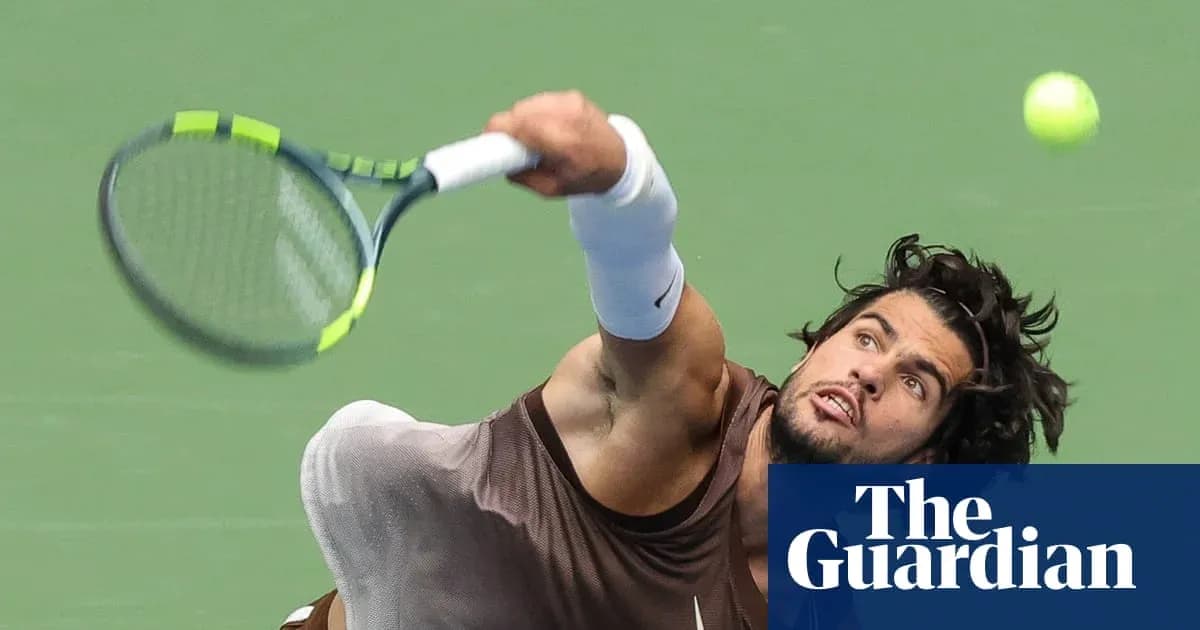
Alcaraz has clearly chosen caution over bravado on that front. His first‑serve speed sat at an average of just 113mph, a notable drop for a player capable of far more. Tape showed under his arm sleeve, a visible reminder that the wrist remains a work in progress, no matter how cleanly he struck his forehand.
The logic is obvious. After months out, there is no sense in cranking up maximum velocity on serve in the opening round of a major. Protect the joint. Build up gradually. Live to swing the forehand another day.
But the trade-off is clear too. Without a steady stream of free points, every service game becomes a little more physical, a little more demanding. Over two weeks, that can shape a campaign. How far can he go here if he has to earn almost everything the hard way?
That question will linger over his fortnight.
A nervous, beautiful day
For all the swagger on court, Alcaraz admitted the day had started very differently.
“It was a difficult day for me, to be honest, but at the same time, a really beautiful one,” he said. “Started the day really nervous. Really, really nervous, thinking: ‘I’m going to make it, I’m going to compete again.’ I had more nerves than usual, but just happy, because for me, my goal here is to compete, to enjoy, and let’s see how my body’s going to react after the matches, after the competition again.”
The scene around him underlined the occasion. His parents were there. His brothers. His team. Even rapper Travis Scott watched from his box, an unlikely but telling sign of the star power Alcaraz now carries into every arena he enters.
This wasn’t just a first‑round match. It was a reintroduction.
He made no predictions about how long it will last.
“I don’t know how far I’m going to go in the tournament. I didn’t know if I was going to lose this one, if I’m going to make the second round, final. I don’t know how far I’m going to go,” he said. “But what I just really want to do is enjoy every time that I’m going to walk into the court feeling the energy from the people, feel the competition, walking up, I’m thinking, all right, it’s match day. That’s what I’m going to do this tournament.”
On day one, with the forehand firing and the smile back, that sounded less like a cliché and more like a warning. If this is Alcaraz playing “just to enjoy,” what happens if the serve catches up and the fear truly disappears?