.svg&w=384&q=75 "logo")
Carlos Alcaraz and Naomi Osaka Highlight US Open Day 2 Matches
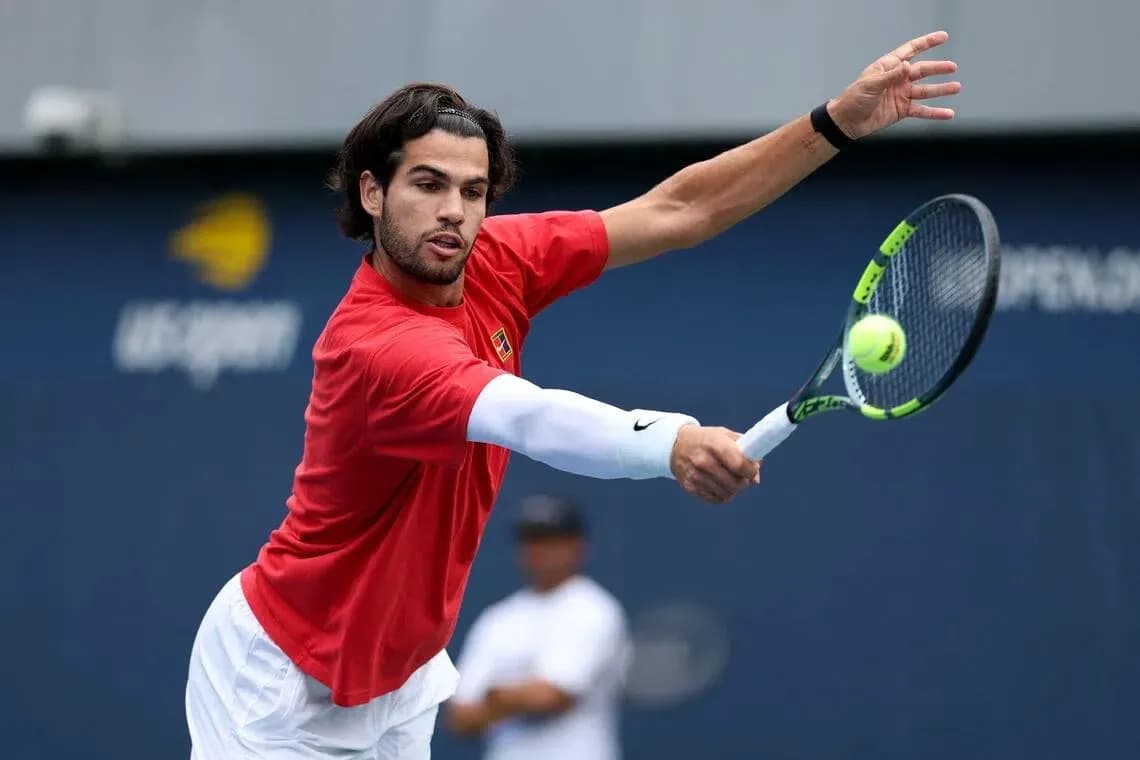
NEW YORK – Carlos Alcaraz returns to New York with a Grand Slam already in his pocket this season and a question hanging over his wrist.
The defending US Open champion steps into Arthur Ashe Stadium against Roman Safiullin on Aug 31 (Sept 1, Singapore time), his first competitive swing in more than four months after a right wrist injury halted his season in April. He opened the year by winning the Australian Open and becoming the youngest man to complete a career Grand Slam. Now he tries to close it by bookending 2026 with majors.
Day 2 offers no gentle easing-in. It’s stacked: two-time women’s defending champion Aryna Sabalenka, six-time major winner Iga Swiatek, four-time Slam champion Naomi Osaka and Wimbledon champion Linda Noskova all scheduled. But three matches frame the day’s intrigue.
Roman Safiullin v Carlos Alcaraz
Head-to-head: 1-1
This is not a tune-up. It’s a test.
Safiullin arrives with the kind of game that can drag Alcaraz into long, bruising rallies. The 29-year-old Russian hammered his way to the Wimbledon fourth round, taking out Andrey Rublev and Joao Fonseca before bowing to Novak Djokovic in four sets. From the baseline, he hits flat, hard and deep, the sort of ball that can pin even the most explosive mover behind the court.
He also carries a very specific memory: Paris, 2023. At the ATP Paris Masters, Safiullin stunned then world No. 2 Alcaraz, a result that underlined his threat on hard courts and exposed the Spaniard’s occasional lapses in focus late in the season. Alcaraz did not forget. He reversed the script at the Paris Olympics the following year, restoring order to their mini-rivalry.
Now comes the decider in New York, with an extra layer of jeopardy. Alcaraz insists his wrist has passed every internal test. He talks about “demanding” practice sessions, about being ready to “go 100 percent”. Training, though, is one thing. A best-of-five match against a clean ball-striker who has already hurt you is another.
If the wrist holds and the timing returns quickly, Alcaraz’s variety, his ability to change pace and height, should stretch Safiullin and open the court. If there’s any hesitation on the forehand, the Russian will see it, and he will swing.
Aryna Sabalenka v Camila Osorio
Head-to-head: Sabalenka leads 2-0
Sabalenka walks into this US Open with two trophies to defend: the title itself, and her status at the top of the women’s game.
Her spring and summer have frayed that second one. After a blistering hard-court swing that brought back-to-back WTA titles at Indian Wells and Miami in March, the Belarusian’s form dipped. She lifted the trophy in Brisbane and reached the Australian Open final in January, but the rest of the season has not followed that script: a quarter-final exit at Roland Garros, a fourth-round loss at Wimbledon, and a ranking now under threat.
Even if she becomes just the third woman – after Chris Evert and Serena Williams – to win three straight US Open titles, she could still surrender the world No. 1 spot. That’s the precarious arithmetic she faces.
On court, though, Sabalenka rarely looks like someone counting points. She has beaten Camila Osorio twice, once on the grass of Wimbledon in 2021 and again on the clay of Madrid in 2023. Different surfaces, same outcome: power dictating play. Osorio, ranked 59, brings variety and grit, but she has so far struggled to blunt Sabalenka’s first-strike tennis.
The Belarusian insists the mid-season wobble has not shaken her belief. “Throw tough challenges at me, I will come back stronger,” she says. The challenge now is not just the Colombian across the net, but the weight of history and the chase pack pressing on her ranking. If Sabalenka’s serve holds and the forehand finds its range early, Osorio could be forced into survival mode from the opening games.
Naomi Osaka v Anastasia Zakharova
First meeting
Naomi Osaka walks back into Flushing Meadows with something few players possess: proof.
Two of her four Grand Slam titles came on these courts, in 2018 and 2020. When she talks about “banking” that history, about drawing confidence from what she has already done here, it carries real substance. Hard courts are her natural habitat, and New York has often felt like her stage.
Her road back has been anything but straightforward. It has been five years since her last major title, at the Australian Open. In that span, Osaka has stepped away from the sport to address mental health issues and then taken a 15-month break for motherhood before returning in 2023. Every step since has been measured and public, her struggles as visible as her victories.
The results have begun to follow the work. She reached the semi-finals in Washington on hard courts, then pushed through to the quarter-finals in Toronto in August. On grass, she produced her best Wimbledon run, reaching the quarter-finals in 2026 and upsetting Sabalenka along the way, a win that signalled her capacity to trouble the very top again.
Now comes Anastasia Zakharova, ranked 101 and facing Osaka for the first time. The Russian will try to swing freely, to test Osaka’s movement and rhythm. But this is a surface and a setting that amplify Osaka’s strengths: a heavy, penetrating baseline game and a serve that can still dominate matches when it clicks.
Osaka wants a fast start. Zakharova wants time to settle. On Day 2 in New York, one of them will get it – and the tone of Osaka’s latest comeback chapter will be set under the lights she knows best.