.svg&w=384&q=75 "logo")
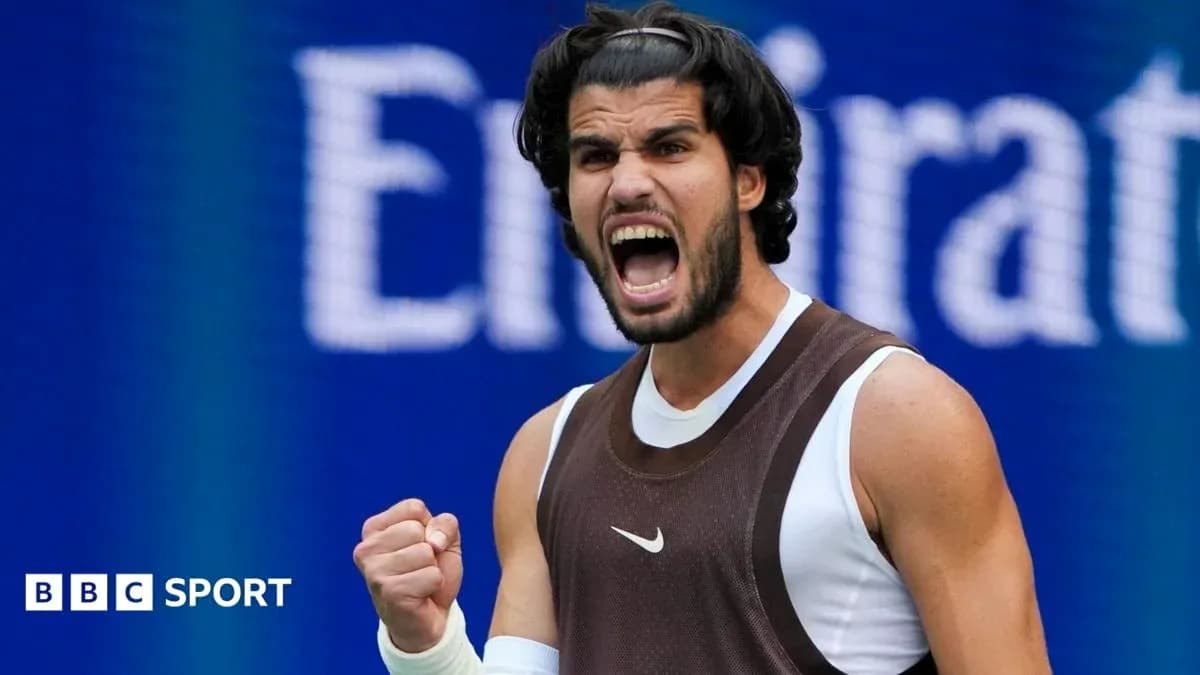
Carlos Alcaraz Dominates Wu Yibing to Reach US Open Fourth Round
Carlos Alcaraz barely broke stride.
On a warm New York afternoon, under the hard lights and harder expectations of a defending champion, the Spaniard dismantled Wu Yibing 6-3 6-4 6-1 to stride into the US Open fourth round and send a clear message: the lay-off is over, the rhythm is back.
Rust? What Rust?
This is a player who spent 139 days away from singles competition after a wrist injury in April. His first-round match at Flushing Meadows was his return to a one-on-one court, his first real test of timing and trust in that wrist.
He has wasted no time.
Alcaraz eased through his opener in straight sets, then had to dig against Portugal’s Jaime Faria, recovering from a set down in the second round. That kind of match can either expose lingering doubts or sharpen instincts. For Alcaraz, it did the latter.
Against Wu, the sharpening was obvious. The 23-year-old needed just two hours and 20 minutes to close out a contest that grew more one-sided with every game. Once he locked in, the gap in class and confidence widened quickly.
“To be honest, I'm better than I thought,” the seven-time major champion said afterwards. “Physically I thought I was going to be bad after the first match, but I am recovering really well. I am doing great things off the court to be in a good state.
“Right now, I think my level is really good. I think I have caught the rhythm of the competition.
“Every time that I step on the court I give it all. I'm just trying to improve, be better every match and I think I'm getting there.”
The scoreboard backed him up. The first set established control, the second set tightened the screw, the third became a procession. Wu, dangerous when allowed time, never truly got it.
A Draw Quietly Opening Up
Alcaraz’s performance alone would have been enough to turn heads. The shape of the men’s draw only amplifies the noise.
The defending champion arrived in New York as second seed, nominally behind world number one Jannik Sinner. Sinner is not here. Injury removed him from the equation before a ball was struck.
That left Alexander Zverev, the French Open champion and Wimbledon runner-up, as the highest-ranked man in the field. As the top seed, he sits on the opposite side of the draw. Alcaraz cannot see him before the final.
On paper, that sets up a collision course. On court, Zverev has been made to work far harder than Alcaraz. Twice he has been dragged into five sets. Twice he has been kept on court until 2am. Those miles matter in a two-week slog.
The chaos has not stopped there. Novak Djokovic, usually a permanent fixture in the latter stages of majors, went out in the first round to Mariano Navone. Canadian third seed Felix Auger-Aliassime followed him through the exit, beaten by Karen Khachanov in the second round.
Seeds have fallen. Paths have shifted. The defending champion has quietly moved through the rubble.
As it stands, only one other top-10 player can block Alcaraz’s way before the semi-finals: American eighth seed Ben Shelton. Should he get that far, seventh seed Daniil Medvedev could await in the last four.
Those numbers come with context. Alcaraz has beaten Shelton in all three of their meetings. Against Medvedev, he holds a 6-3 edge, though the Russian did land a significant blow at Indian Wells in March. Medvedev’s inconsistency keeps every potential clash laced with intrigue.
Familiar Foe, Familiar Stakes
Next up is someone Alcaraz knows well: Tommy Paul.
The American, seeded 20th, will bring the crowd and the pace, but he also brings an unwanted statistic from his perspective. Alcaraz has beaten him six times in a row. That kind of streak can sit in the back of a player’s mind long before the warm-up.
Paul, though, offers something Alcaraz will welcome: a proper examination of just how sharp his comeback really is. A home favourite in the second week, swinging freely on hard courts, is no soft landing.
On the other side of the draw, Zverev’s route is far less forgiving. Potential opponents before the final include Taylor Fritz, the American standard-bearer desperate for a deep run at his home Slam, and Flavio Cobolli, the Italian who reached the French Open final and has carried that confidence into the hard-court swing.
The tournament has already lost some of its biggest names. The defending champion is still here, moving smoother with every round, speaking like a man who feels his body again and playing like one who trusts every shot.
If this is Alcaraz still “getting there”, the question for the rest of the field is simple: what happens when he arrives?