.svg&w=384&q=75 "logo")
Carlos Alcaraz Returns to Arthur Ashe Stadium with Confidence
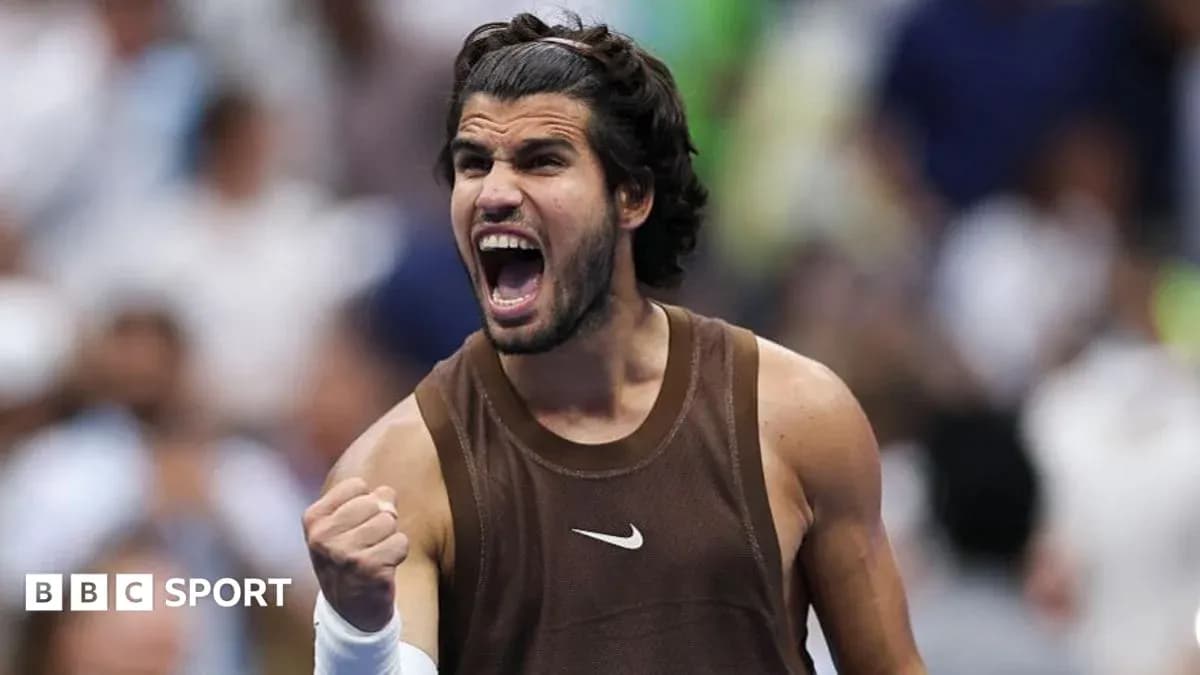
Carlos Alcaraz walked back into Arthur Ashe Stadium like someone reclaiming a stage, not just a title defence.
One hundred and thirty-nine days after his last singles win, with a compression sleeve hugging his right arm and questions hanging over his fitness, the Spaniard put four months of frustration behind him with a straight-sets victory over Roman Safiullin: 6-4 6-4 6-4.
It was not flawless. It did not need to be. It was loud, lively and unmistakably Alcaraz.
The show returns to Ashe
From the first step onto court, this felt less like a tentative comeback and more like a reunion tour.
He bounced to the baseline, grinning, feeding off the noise he had missed while Alexander Zverev and Jannik Sinner carved up the French Open and Wimbledon titles in his absence. This time, the seven-time major winner was not watching from a sofa or a physio table. He was back in the New York night, where his tennis has always seemed to glow a little brighter.
“I missed the crowd, the energy, the competition – I missed everything,” he said on court, smiling as if the result almost mattered less than the sensation of being out there again. “I'm just really, really happy that I was able to compete again.”
The crowd did not have to wait long for the full Alcaraz experience. The whippy forehand, the cat-and-mouse drop shots, the fist pumps, the “vamos” roars that ricocheted off the upper tiers. Safiullin, ranked 99 in the world, was solid and stubborn, but he spent most of the night reacting to the tempo Alcaraz set.
The numbers told their own story. Twenty-eight winners for the defending champion, most of them crashing off that right side that had kept him out for so long. The sleeve was there. The hesitation was not.
“I felt great,” Alcaraz said. “I don't know how it looked from outside, but from inside, my feeling was that I was hitting normal. I was playing pretty normal, playing my style, and everything felt great.”
Energy, not caution
If there were any lingering doubts about how much he had missed this, they vanished in the small moments between points.
He smiled after rallies. He chatted with his box. At one changeover he casually sang along to a Michael Jackson track drifting over the stadium speakers, as if this were a late-night hit with friends rather than the opening step in a Grand Slam title defence.
Every winner came with a clenched fist, often followed by that familiar bark of “vamos” towards his team. The more the crowd responded, the more he leaned into it. When he finished a fierce rally in his final service game with a feathered drop shot, he raised his fist to the sky, then cupped his ear and waved his arms, demanding more noise from a crowd already on its feet.
From the commentary box, former Wimbledon champion Pat Cash watched a player celebrating “every little win”. On court, Alcaraz made it clear that this was the point.
“What I really want to do is enjoy every time that I'm going to walk into the court, feeling the energy from the people,” he said. “That's what I'm going do this tournament. The results, it's going to come after all. That's why I enjoyed so much today, and it wasn't a surprise for me, because I came here to enjoy.”
One shot still lagging
Enjoyment aside, this was still a comeback match, and it showed most clearly in one department.
The serve.
The defending champion finished with only two aces and five double faults. The first-serve percentage – 68% in – offered a measure of control, and he won 66% of those points. The raw pace and bite, though, were not where they usually sit for a man who often uses his delivery to seize immediate command of rallies.
“The serve is the shot I was struggling [with] the most,” he admitted. Part of the drop in speed, he said, was by design, an attempt to wrong-foot Safiullin with variation rather than brute force. But he did not try to disguise that this remains the most fragile piece of his game right now.
“I'm going try to serve better. The point is going to try to serve normal, but it's a shot that I just always struggle [with]. But it will be back, for sure.”
The rest looked reassuringly familiar. The movement, the acceleration into the court, the willingness to take the ball early and finish points at the net all hinted at a player far closer to full flow than four months on the sidelines might suggest.
Doubts, then answers
If his body held up, his mind had done some wandering before this match.
“There were some doubts in the match, I'm not going to lie,” he said. “I've been thinking about 'am I going to last the best of five, am I going to last playing four sets, five sets?'”
He did not need a fourth set against Safiullin, let alone a fifth, but the way he finished – still sprinting, still chasing, still attacking – will soothe some of those private questions. The real test, as he knows, lies not in one match but in the accumulation of them.
“I need more matches under the belt to get again into the rhythm of the tournament,” he said. “I'm pretty sure I'm going to get better and better every day.”
New York has seen him grow in real time before. This fortnight may become another chapter in that story.
A draw that suddenly looks different
If Alcaraz needed any extra encouragement, it came from the draw board.
World number one Jannik Sinner is not in New York at all, ruled out by a knee problem. Novak Djokovic, the 24-time Grand Slam champion and perennial shadow over every hard-court Slam, is gone as well after a stunning first-round loss to Mariano Navone.
As second seed, Alcaraz sits on the opposite side of the draw from French Open champion and top seed Alexander Zverev. They cannot meet before the final. The other major threat from recent weeks, Cincinnati Masters winner Arthur Fils, fell at the first hurdle to Stefanos Tsitsipas.
It leaves one clear top-10 obstacle before the semi-finals: American Ben Shelton, a possible quarter-final opponent and a man whose serve can turn any match into a shootout.
Next, though, comes Jaime Faria, the world number 72 from Portugal. A different challenge, a different rhythm, but the same question hanging over the night session: how quickly can Alcaraz turn joy at simply being back into the ruthless edge of a champion?
On Monday, he answered the first part emphatically. The second will define whether this comeback ends with another trophy under the New York lights.