.svg&w=384&q=75 "logo")
Carlos Alcaraz Advances at US Open After Early Setback
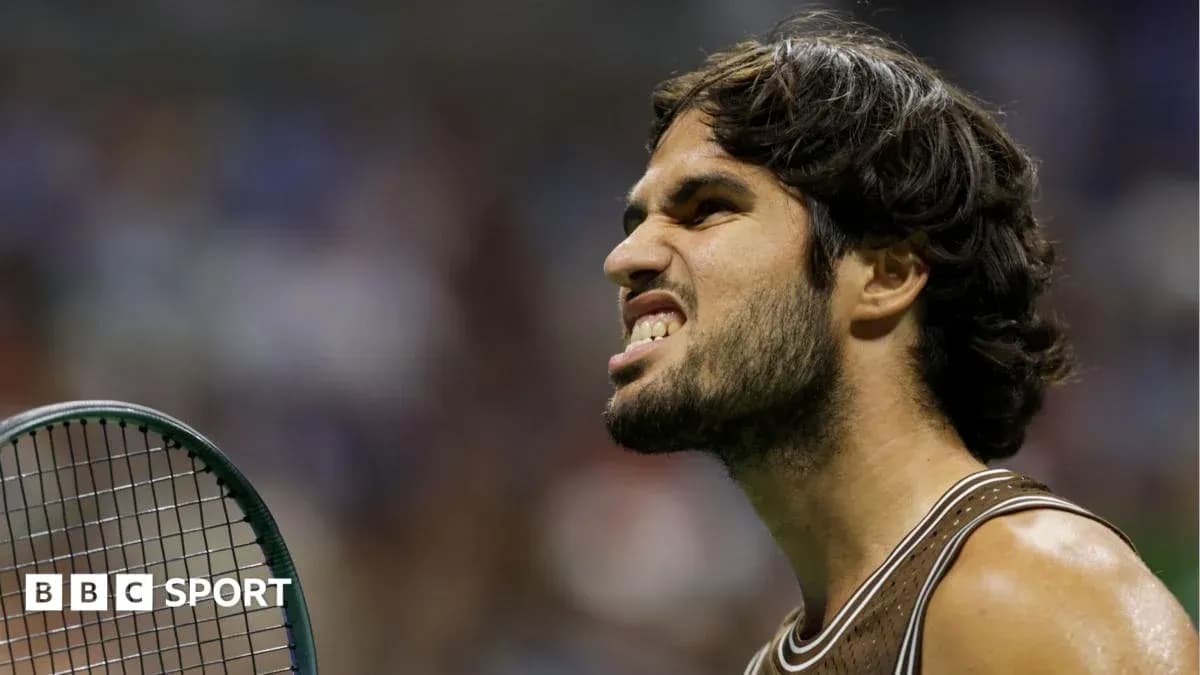
Carlos Alcaraz bends but does not break. Not under the New York lights. Not at the US Open.
The defending champion flirted briefly with danger on Thursday night, dropping the opening set to Portugal’s Jaime Faria before tearing through the gears to win 4-6 6-0 6-3 6-2 and reach the last 32.
For a set, Arthur Ashe Stadium watched something rare: Alcaraz searching for himself.
The 23-year-old, still working his way back from a long-term injury to his playing right wrist, looked a half-step slow and a fraction late on the forehand that usually dictates matches. Faria, ranked 72 in the world and playing with nothing to lose, took full advantage. He served with freedom, attacked short balls and pocketed the first set 6-4, asking a very real question of the two-time US Open winner.
The answer arrived in the opening game of the second set.
Alcaraz stared down two break points immediately. Lose that game, and a restless night might have followed. Instead, he dug in, held serve, and something in the match flipped. The defending champion later called that moment “pivotal”, and it showed in every point that followed.
The pressure finally told. Once Alcaraz escaped that game, he began to look like himself again. The feet got lighter. The forehand grew heavier. The returns started landing at Faria’s shoelaces. The Spaniard rattled through the second set 6-0, barely giving Faria a look at the scoreboard.
From there, the contest felt less like a scrap and more like a reassertion of hierarchy.
Alcaraz, the second seed, tightened his grip on every rally. He broke early in the third, managed the scoreboard with the assurance of a man who has already lived some of the biggest nights this stadium can offer, and closed it out 6-3. By the fourth, he was in full control, rolling through 6-2 to complete the turnaround.
“It was a tough match for me. I felt great in the first set, but I didn’t take time and that cost me,” he said afterwards, reflecting on the sluggish start. “After that I tried to be focused, stay calm and think the good things will happen.”
Those “good things” are starting to stack up again.
Coming into New York, the intrigue around Alcaraz had little to do with his record here and everything to do with his body. This is his first tournament since mid-April, his first serious test since that right wrist forced him off the tour. The question was simple: could he still swing freely when it mattered?
The early signs are encouraging. He described his first-round straight-sets win over Roman Safiullin as “normal”, and after dispatching Faria, he doubled down on the idea that the forehand is no longer under protection.
“I know once I step on the court, I’ve just got to go for it every time. I’ve got to feel normal,” he said. “I have to hit like I was hitting before the injury. I’m feeling great. There is no reason to be afraid and not hitting normal.”
The more subtle test, though, lies in how his body copes with the grind of a Grand Slam. Two matches in, he has already found a silver lining in being stretched to four sets.
“At the end, I realised that playing four sets was really good for me to test everything physically, to test my body, how I feel, and how I’m going to feel tomorrow after this match,” he explained.
The draw around him is opening up in a way that could tempt any champion to start thinking ahead. Jannik Sinner, his fiercest contemporary rival, is not in New York. Novak Djokovic, the 24-time major champion, is already out. The field feels looser, the path less crowded.
Alcaraz will not say it, but the opportunity is obvious.
Next up is China’s Wu Yibing, ranked 113 in the world, in the third round. On paper, it is a match the Spaniard should control, yet the real examination may come later in the week. The likelihood of facing higher-ranked opposition than Safiullin and Faria grows with every round, as does the strain of potentially playing multiple five-setters in quick succession after such a long layoff.
Lurking as a possible fourth-round opponent is American 20th seed Tommy Paul, who kept his own campaign moving with a 6-2 6-3 5-7 6-4 win over Croatia’s Dino Prizmic. Paul will first have to get past Kazakh 15th seed Alexander Bublik, who dismantled French veteran Adrian Mannarino 6-3 6-1 6-1 with his usual blend of flair and bite.
The American charge does not end there.
Eighth seed Ben Shelton continues to chase history, trying to become the first US men’s champion at Flushing Meadows since Andy Roddick in 2003. He battled past Poland’s Hubert Hurkacz 6-3 5-7 7-6 (7-3) 7-5, a statement of both power and nerve under pressure.
Two-time semi-finalist Frances Tiafoe added more energy to the home narrative, beating Japan’s Rei Sakamoto 6-3 7-6 (7-2) 7-5 in a performance that underlined his form and his comfort on these courts.
Not everyone survived the night.
Spanish 12th seed Rafael Jodar suffered the heaviest blow of the men’s draw on day four, losing 6-2 6-1 6-1 to China’s Bu Yunchaokete, the world number 124, in a ruthless display that sent a jolt through the tournament.
Amid all that chaos, Alcaraz stands where many expected him to be: in the third round, still swinging, still dangerous. The wrist has held. The game is sharpening. The arena that has already seen him crowned twice is beginning to hum again.
Now comes the real question: with the draw wide open and his body answering every test so far, who is going to stop him?