.svg&w=384&q=75 "logo")
Boulter's US Open Exit Amid Rain Disruptions
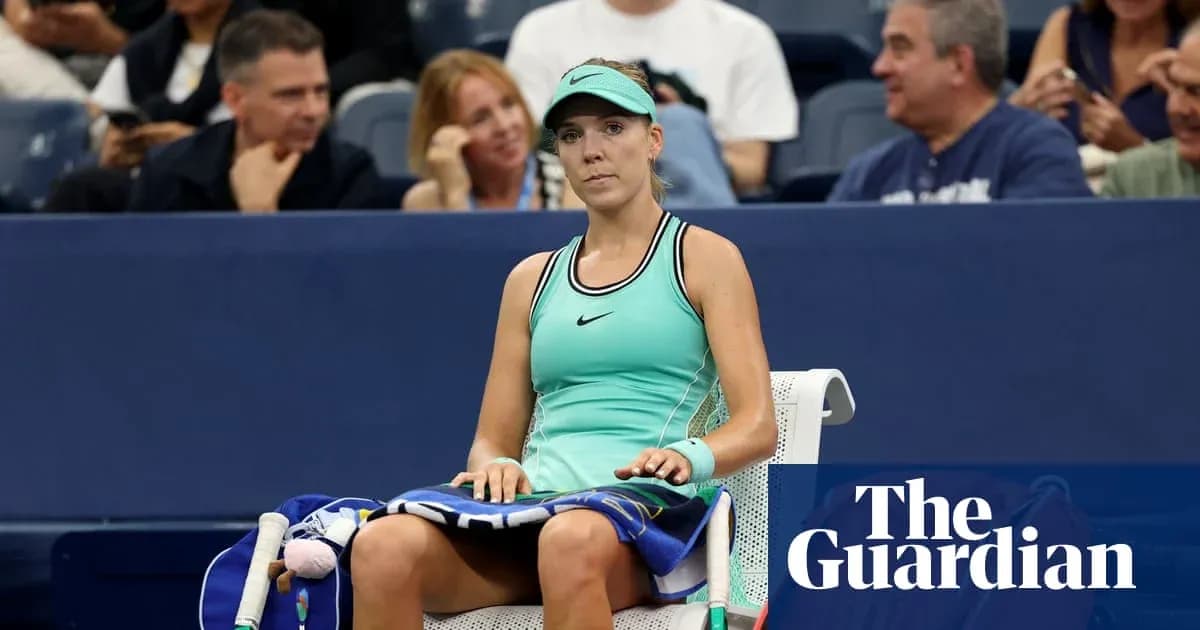
The rain lashed down on Flushing Meadows, driving thousands of spectators under cover and freezing play across the outside courts. Inside Louis Armstrong Stadium, though, there was no escape for Katie Boulter.
Under the roof, her grand slam season ended with a brutal jolt: a 6-1, 6-0 dismantling by the No 7 seed, Karolina Muchova, in the US Open second round. It was over in a hurry and it was ugly.
Boulter overwhelmed under the roof
Boulter and Muchova were originally pencilled in for Court 17, due to follow the men’s first-round match between Rafael Jodar and Yunchaokete Bu. Then the storm rolled in. With play suspended outside, the schedulers shuffled them on to Armstrong, one of only two courts still alive on a sodden New York afternoon.
The upgrade in stage offered no upgrade in performance. Muchova, all silk and disguise, carved Boulter apart with her trademark all-court game. The Czech mixed spins and trajectories, dragged the Briton into awkward corners, and never allowed her to settle. Boulter, by contrast, looked rushed from the opening game and never found a foothold.
“She was better than me today for sure,” Boulter admitted afterwards. She did not hide from the scoreline, but she did not pretend the surroundings hadn’t got to her either.
She spoke candidly about struggling with the abrupt change of court, the closed roof, and – most of all – the soundtrack. Louis Armstrong, notorious at the US Open for its constant hum of chatter and movement, never quietened.
“I struggled with the conditions. I struggled with the roof, I struggled with the noise,” she said. “I kind of let these little things distract me a little bit. But ultimately, at the end of the day, it was a bad day at the office.”
This was her first competitive outing on a New York stadium court, and she had only practised once on Armstrong. She expected the usual hush between points. It never came.
“I actually expected it to kind of die down a little bit, but it didn’t,” she said. “From the first point of the match I was expecting the crowd to go silent, which is normally how it works. But it never changed.”
She tried to adapt on the fly, telling herself to adjust, to accept the noise, to work it out as she went along. The plan never translated into execution. For a player who usually feeds off a charged atmosphere, the distraction felt alien.
“I always want to have an atmosphere. I always want to have noise. I love that. I normally relish that feeling,” she said. “So for me today it’s a very different feeling to feel slightly distracted from that. It was a little abnormal for me.”
A soaring summer stalls
The defeat lands at the end of what has been a transformative few months off the court and a stop-start one on it. Boulter married Alex de Minaur in July, a landmark moment in her personal life. Earlier in the year she had surged into form, winning her fourth WTA title in Ostrava and cracking back into the top 60 after a statement win over world No 2 Elena Rybakina at Queen’s.
Then the momentum slipped. Before a first-round win in Cincinnati last month, she had lost five matches in a row, including a straight-sets defeat in the opening round at Wimbledon that cut deep. Confidence, once flowing, has been in short supply.
In New York, the chance to reset on a big stage instead turned into a harsh reminder of the gap to the very top. Muchova’s authority under the roof only sharpened the contrast. On a day when the tennis world’s gaze narrowed to the two indoor show courts, Boulter was left exposed.
Jones digs deep in the rain
While one British story ended in frustration, another took an important step forward. On an outside court repeatedly battered by the same storm that had driven Boulter indoors, Francesca Jones fought through one of the most chaotic matches of the tournament so far to claim the biggest US Open win of her career.
The qualifier defeated former top-20 player Magda Linette 6-4, 1-6, 6-3 to reach the second round in New York for the first time.
The match spanned two days and several mood swings. Jones had played superbly on Tuesday to pocket the opening set, only for the rain to halt play for the night. When they returned on Wednesday, the weather intervened again, forcing them off court right after the warm-up. Once they finally resumed, Linette tore through the early stages of the second set, racing away and levelling the match with a run of blistering tennis.
“It was incredible how she was playing until about 4-0 and then started to equal out,” Jones said. “But, you know, in that situation, hats off if they can maintain that. I just tried to show my northern grit, stick in there and do what I can.”
That grit told in the decider. Jones steadied, absorbed Linette’s pace, and picked her moments to strike. For a player who has spent much of the year on the treatment table, the finish line meant more than just a place in round two.
Last season she broke into the top 100. This year she has been forced to endure a run of injuries and even a freak concussion that repeatedly stalled her progress. Only from July did she finally string together a solid training block, and the work quickly showed: back-to-back WTA 125 titles on clay restored rhythm and belief before she arrived in New York.
Three qualifying wins later, she walked into the main draw battle-hardened. Now she leaves the first round with one of the most significant victories of her career.
Mixed fortunes for the Brits, and a shock on Court 17
Elsewhere, the British men found little joy. Jan Choinski went down 6-3, 6-1, 7-6(5) to Botic van de Zandschulp, unable to turn a late push in the third set into a lifeline. Jacob Fearnley, a lucky loser, pushed Tomas Etcheverry in patches but fell 6-3, 6-3, 3-6, 6-3 to the 27th seed.
The day’s biggest jolt, though, arrived back on Court 17, where the rain had first ripped up the schedule. Rafael Jodar, the 19-year-old widely talked up in the build-up to the tournament, suffered a chastening reality check. Yunchaokete Bu dismantled him 6-2, 6-1, 6-1 in a one-sided contest that silenced the hype almost as quickly as it had built.
As the storm clouds finally began to thin over Flushing Meadows, British hopes had already been scattered across the grounds – some washed away under the Armstrong roof, others hardened by the rain. The question now is who can turn a bruising, weather-torn week into a springboard rather than a setback.