.svg&w=384&q=75 "logo")
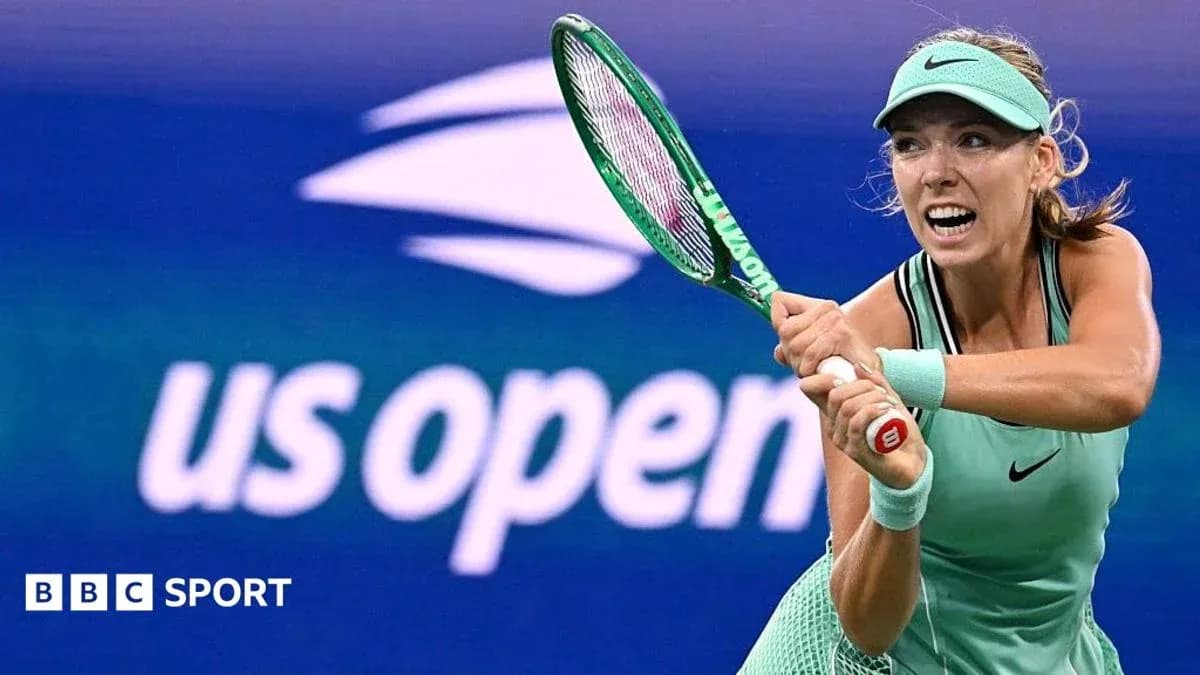
Katie Boulter Suffers Crushing Defeat to Karolina Muchova at US Open
Katie Boulter walked into Louis Armstrong Stadium with a promotion. She walked out with a bruising reminder of how unforgiving the top end of the game can be.
Upgraded from an outside court to the 14,000-seat arena after rain reshuffled the schedule in New York, the British number one lasted just 58 minutes as Karolina Muchova dismantled her 6-1 6-0 in a one-sided second-round defeat.
One game. That was all Boulter could cling to on a bleak afternoon that she later summed up as “a bad day at the office – times two.”
Big stage, harsh lesson
For fans who thought they had hit the jackpot with an extra match on their day-session ticket, the contest barely had time to breathe. Wimbledon runner-up Muchova imposed herself from the opening exchanges, while Boulter never found anything close to a foothold.
The numbers told the story with brutal clarity.
Boulter’s serve, usually a cornerstone of her game, collapsed under the Armstrong roof. She produced eight double faults, failed to hit a single ace and won just 33% of points behind her first serve. Every service game felt like a negotiation she was losing.
She faced seven break points. She couldn’t save one.
There was no escape in the rallies either. The 30-year-old sprayed 22 unforced errors and managed only four winners, her timing and footwork deserting her as Muchova dragged her around the court with sharp angles, disguised drop shots and flat, penetrating groundstrokes.
By contrast, the Czech seventh seed was clinical: 14 winners, nine unforced errors, and an air of calm control that never wavered.
“I struggled with the conditions. I struggled with the roof, the noise, I let things distract me,” Boulter admitted afterwards. “I let it get to me. I'm not usually aware of everything going on. It made me feel a little bit uncomfortable. I have to deal with it better.”
On this evidence, that adjustment can’t come soon enough.
Technical cracks laid bare
From the commentary box, former world number five Daniela Hantuchova didn’t sugar-coat what she had seen.
“I would be really humbled [if I was Boulter], I would sit down with my team and say 'OK, we need to change something big time',” she told BBC Radio 5 Live.
Her diagnosis was blunt and specific.
“First of all, it was very obvious today that it was the serve. I feel like it needs to be cleared up because she was losing the rhythm and not using her legs. That's the number one thing.
If I am Boulter, I would be on the practice court tomorrow. If she still wants to invest everything into her tennis then she needs to be on the court.”
It was the kind of defeat that doesn’t just sting. It forces a player to look in the mirror.
A bright summer, a flat season
Off the court, this has been one of the happiest summers of Boulter’s life. She married Australia’s Alex de Minaur, the world number seven, in July, a milestone that lit up her year.
On the court, the picture has been far less glowing.
Ranked 62 in the world, Boulter leaves New York with just two wins across the four Grand Slam events this season. Since her first-round exit at Wimbledon, she has won only two of six matches. The momentum she built earlier in her career-high rise has stalled, and days like this only sharpen the sense of drift.
This wasn’t a narrow loss to a top seed in a tight three-set scrap. It was a dismantling, and it arrived on one of the sport’s biggest stages.
Mixed fortunes for the Brits
The British camp’s day at Flushing Meadows did not improve much elsewhere.
Jacob Fearnley saw his run end in four sets, beaten 6-3 6-3 3-6 6-3 by Argentina’s Tomas Martin Etcheverry. Fearnley battled to extend the contest by snatching the third set, but Etcheverry reasserted control in the fourth to close the door.
There was at least one bright note. Francesca Jones returned to finish the job she had started before the rain, coming back to complete a first-round victory over Poland’s Magda Linette. On a day of interruptions and frustrations, her win offered a rare shaft of optimism for British tennis fans.
Where next for Boulter?
For Boulter, the questions now become sharper. The talent is not in doubt. Nor is the work ethic that carried her to British number one. But at 30, with the margins at the top growing ever finer, days like this can’t be written off as mere anomalies.
She called it a bad day at the office. The numbers suggest something more structural, especially on serve, where her mechanics and confidence both frayed under pressure.
The next few weeks will reveal plenty. Does this defeat become a turning point, a line in the sand that drives technical and tactical changes? Or does it fold into a pattern of missed chances and early exits?
The stadium lights went down quickly on Louis Armstrong. The scrutiny on Boulter’s response will last much longer.