Botic van de Zandschulp Survives Epic US Open Marathon
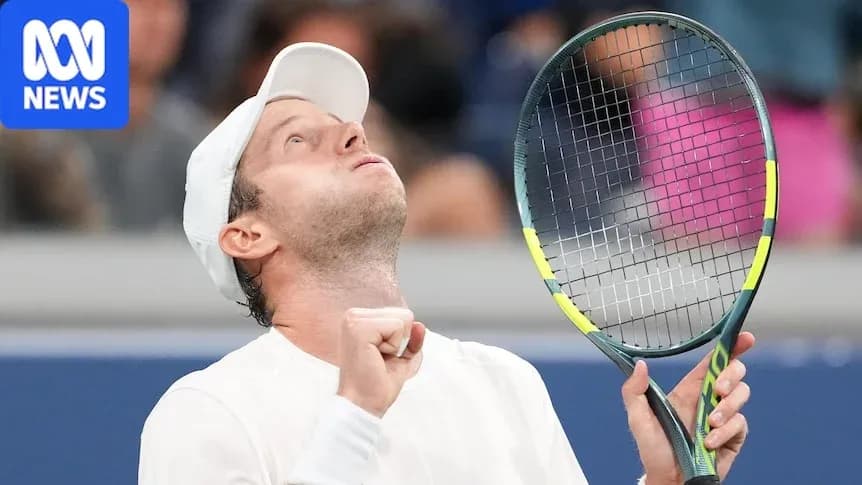
Botic van de Zandschulp walked off Louis Armstrong Stadium looking like a man who had emptied every last reserve. He had also just survived one of the great marathons in US Open history.
From two sets down, from match point down, the 30-year-old Dutchman dragged himself into a second career quarterfinal at Flushing Meadows with a 3-6, 6-7(0), 7-6(7), 7-6(3), 6-4 win over French lucky loser Arthur Gea in 5 hours and 13 minutes – the fourth-longest match the tournament has ever seen.
From the brink to a five-set epic
For most of the night, this was Gea’s story. The 21-year-old, who only slipped into the main draw when 2022 runner-up Casper Ruud withdrew with a back injury, stood on the edge of history. No male lucky loser has ever reached a grand slam singles quarterfinal. He was a point away from it.
Gea had seized the early initiative, taking the first set 6-3 and then silencing van de Zandschulp in a ruthless second-set tiebreak, 7-0. The Dutchman, who had already sent Australian Alex de Minaur packing in a second-round upset, looked headed for the exit.
Then came the moment that split the night in two.
Serving in the third-set tiebreak, Gea held match point. One more clean strike and the Frenchman would walk into the record books. Van de Zandschulp refused to let it happen. He saved it, clung to the breaker 9-7, and with it, cracked the match wide open.
The pressure finally told on Gea. The rallies grew heavier, the legs a little slower. Van de Zandschulp, sensing doubt on the other side of the net, began to dictate. He edged another tiebreak in the fourth set, 7-3, to drag the contest into a deciding fifth.
By then, the clock and the occasion had turned against the Frenchman. The Dutchman’s weight of shot and experience in these trenches – he reached the US Open quarterfinals in 2021 – carried him through the final set, 6-4, to complete a comeback that will sit comfortably among the most dramatic in New York.
“I think this is probably better than the first quarterfinal I made here,” van de Zandschulp said afterwards, still processing what he had just pulled off. “It hasn’t sunk in yet, but I think tomorrow it’s going to be a great feeling.”
Blockx makes Belgian history
Earlier in the day, Alexander Blockx carved out a slice of his own history.
The 28th seed beat 24th seed Francisco Cerundolo 6-3, 4-6, 7-5, 7-5 to become the first Belgian man ever to reach the US Open quarterfinals. It was a hard, disciplined win, built on timely breaks and nerve in the tightest moments.
Twice, with the third and fourth sets balanced on a knife edge, Blockx found a way. At 5-5 in each, he struck, broke, and served it out. No fuss, no wobble, just a clean step into uncharted territory for Belgian men’s tennis in New York.
His reward is a quarterfinal meeting with Karen Khachanov, a man who knows this stage well and had to claw through his own five-set test to get there.
Khachanov digs deep
Khachanov, seeded 14th, faced American Learner Tien and a crowd eager for a home winner. He left them quiet.
The Russian prevailed 7-5, 4-6, 6-7(6), 6-1, 6-4, grinding through the first three tight sets before tearing the match away in the fourth. Once he levelled at two sets all with a dominant 6-1, the pattern shifted. Tien fought to stay with him in the fifth, but Khachanov’s weight of shot and big-match experience carried him over the line.
The former US Open semifinalist now stands between Blockx and an even deeper run.
Zverev closes the night
Men’s number one seed Alexander Zverev was scheduled to close the day’s play against Italian 21st seed Luciano Darderi, a final act on a Monday that already felt heavy with storylines.
A historic Belgian breakthrough. A Russian survivor. And, above all, a Dutchman who stared down match point in a third-set tiebreak and turned it into one of the longest, wildest victories this tournament has seen.
At this US Open, the margins are thin. Van de Zandschulp found a way to live on them.