.svg&w=384&q=75 "logo")
Ben Shelton Triumphs in Epic U.S. Open Match Against Carlos Alcaraz
NEW YORK — By the time Ben Shelton collapsed into his roar at 3:33 a.m., Arthur Ashe Stadium felt less like a tennis court and more like the last round of a title fight that refused to end.
This wasn’t just a match. It was a five-set street brawl between two of the sport’s most electric forces, staged in the dead of night and stretched to the latest finish in U.S. Open history. One, an American showman with a cannon for a serve. The other, Carlos Alcaraz, a 23-year-old already carrying the weight and aura of a generational champion.
They finally walked on at 11:05 p.m., long after most of New York had given up on Tuesday. Nearly 24,000 people stayed. They knew what was coming. Or thought they did.
What they got was something else entirely.
Shelton outlasted Alcaraz 6-7(5), 6-1, 6-3, 1-6, 7-6(10-7), sealing it with a 146 mph ace — his signature weapon, delivered on the biggest point of his life. That serve had always been his calling card. It had never before carried him through a player of Alcaraz’s stature.
“This was a war. Epic match. So physical,” Shelton said afterward, still buzzing. He called Alcaraz “one of the greatest champions in our sport already at 23 years old,” and then, with a grin, labeled it “the most enjoyable match I’ve had in my career.”
It looked nothing like enjoyment. It looked like survival.
A first set that lied
For a while, it followed the script. Two young stars trading haymakers, neither landing a clean combination. Shelton matched Alcaraz shot for shot, leaning on that heavy lefty serve and explosive athleticism. Alcaraz, a seven-time Grand Slam champion, probed and countered, not quite at his sharpest but still dangerous in every rally.
At 5-5 in the opening set, the pattern everyone has seen with Alcaraz seemed to reappear. A loose stroke from Shelton here, a missed first serve there, and suddenly Alcaraz had the break. This is where he usually slams the door.
Except Shelton broke straight back.
Alcaraz shanked two forehands well off the court, a reminder that he’d been out nearly five months with a wrist injury. From anyone else, those errors would blend into the night. From Alcaraz, who had looked increasingly assured through his first four matches, they jarred.
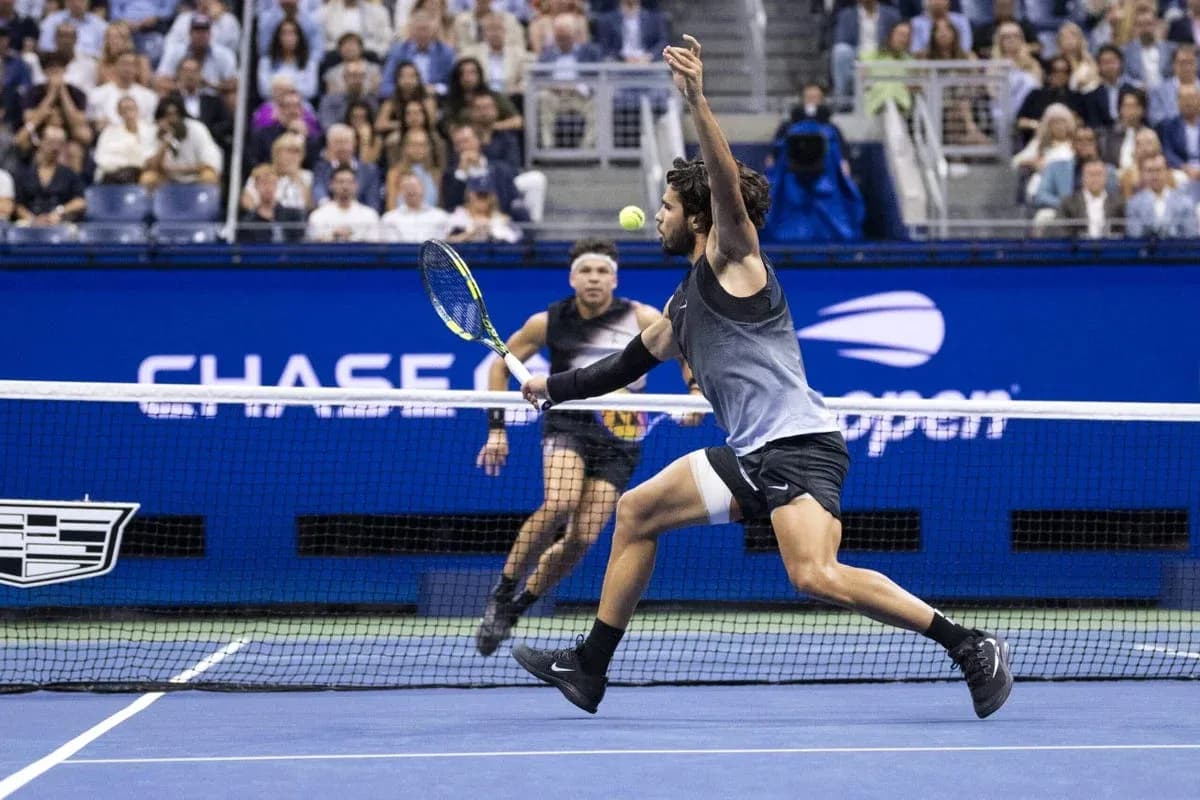
The tiebreak turned ragged, both men trading mistakes between flashes of absurd brilliance. The point of the set came when Shelton lunged, scrambled, improvised, and finally floated a perfect lob over a retreating Alcaraz, who slid with his back to the net. It put Shelton up 5-3.
Then Alcaraz did what Alcaraz does. He sprinted through four straight points, rushing Shelton into a routine backhand miss, ripping a backhand to the sideline, following with a forehand into open space, then finishing with one of those all-court, chaos-soaked exchanges that only he seems to control. Shelton even produced an outrageous tweener save, but it merely delayed the inevitable.
First set Alcaraz. A cross to the jaw. All that work from Shelton, and nothing on the scoreboard to show for it — a familiar story from his recent duels with Alcaraz and Jannik Sinner.
The story was about to change.
Alcaraz fades, Shelton surges
The next 80 minutes flipped the match on its head.
Alcaraz’s level sagged. His feet slowed, his timing frayed. The numbers told the tale: 17 unforced errors and just 8 winners in the second set. Shelton pounced, breaking once, then twice, then a third time. The scoreline — 6-1 — looked almost unreal. Had Shelton really just steamrolled Alcaraz? He had.
Shelton kept rolling into the third, stepping inside the baseline, hammering serves into the body and the corners, using his forehand to push Alcaraz around like a sparring partner. He grabbed another early break and refused to let go.
Alcaraz tried to wake himself, pumping his fist, urging his body to respond. At 5-3, as Shelton tried to serve out the set, they produced yet another point that belonged in a highlight reel: both men sprinting forward for wickedly angled drop shots, Alcaraz finally threading a twisting forehand winner while drifting toward the back wall.
That’s the kind of point he usually rides into a storming comeback.
Shelton knew it. He walked to his towel, and on the way his father and coach, Bryan, leaned over the video board and stuck out a hand. A simple message: You’re right there. Keep running.
Shelton slapped it. Then he unleashed three pumped-up serves, drew three errors, and took the set. From a set down, he now led by one. He was a set away from the finish line.
Across the net, Alcaraz sat with his head buried between his knees, drained. When he stood for the fourth, he looked empty. A forehand miss gave Shelton a chance for the knockout, but Shelton tugged a backhand long. Another Alcaraz error, another opening, another miss from Shelton, this time on the forehand.
He didn’t flinch. The chances kept coming. Surely there would be more.
There weren’t.
Alcaraz, who had spent most of the night looking dazed, suddenly found a way to re-enter the fight. He serve-and-drop-volleyed off a blazing return, coaxed one more error, and roared. The arena felt the shift.
Tennis can turn on a handful of points. A few minutes earlier, Shelton had been gliding toward what looked like cruise control. Now he couldn’t find the court. Alcaraz sensed the wobble and dragged him from sideline to sideline, finally breaking him for the first time since late in the opening set with one of those brutal, corner-to-corner rallies that leave both players gasping.
It was nearing 2 a.m. About 10,000 fans still clung to their seats. Shelton was on the ropes. The match was going the distance.
Into the deep end of the night
Fifth set. 2-2. Alcaraz ripped a forehand to earn break point. It felt like the moment the champion closes.
Shelton refused. He hopped back, rose, and smashed an overhead so violently that Alcaraz tumbled to the court. The crowd erupted. Shelton followed with more thunder on serve, held, then turned and waved his racket in the air.
Noise. He wanted all of it. “U.S.A.” rolled around Ashe.
By 2:51 a.m., Shelton and Alcaraz had pushed past the previous record for the latest finish in tournament history — a mark Alcaraz had helped set in 2022 against Sinner. That match had been billed as a glimpse into the future. This one felt like the future crashing into the present.
Shelton had chances to tighten the noose. Three of them. Three opportunities to move within a game of serving for the match. On one, he chipped a tentative approach instead of ripping through it, and as the ball landed, the net-post lights flashed red. Out.
On the next, Alcaraz lashed a running crosscourt pass. On the third, Shelton slapped a backhand into the net. The clock hit 3 a.m.
They arrived at a 10-point tiebreak at 3:20 a.m., nearly 14 hours after the first ball of the previous day had been struck in Ashe. Garbage trucks beeped in the background as workers prepared the Billie Jean King National Tennis Center for sunrise and another day. Inside the stadium, 10 points would decide everything.
“Let’s go Ben” rolled down from the upper decks. Fans clapped, shouted, willed their way through the fatigue.
Shelton jumped ahead 3-1, then wobbled. Three errors in four points, plus a heavy Alcaraz forehand, and suddenly the Spaniard had quieted the chants and snatched back control.
Then Alcaraz blinked.
A forehand drifted long. The noise swelled again. Shelton crushed another serve. The scoreboard tilted his way. At 8-7, serving, the match sat squarely on his racket.
He went body. Unreturnable. 9-7.
One more swing.
Shelton uncorked a 146 mph ace, the knockout blow on a night when neither man had wanted to stay down. He turned to the loyal few who had lasted until 3:33 a.m. and let out a roar that sounded less like celebration and more like release.
An American man hasn’t lifted a Grand Slam trophy in 23 years. On Sunday, one will stand in the U.S. Open final after Shelton meets Frances Tiafoe.
At this hour, in this city, it didn’t feel like a drought. It felt like the start of something.