.svg&w=384&q=75 "logo")
Ben Shelton Survives Hurkacz in US Open Thriller
Ben Shelton digs in, rain pours down, and the US Open finally breathes again.
Shelton survives Hurkacz in heavyweight scrap
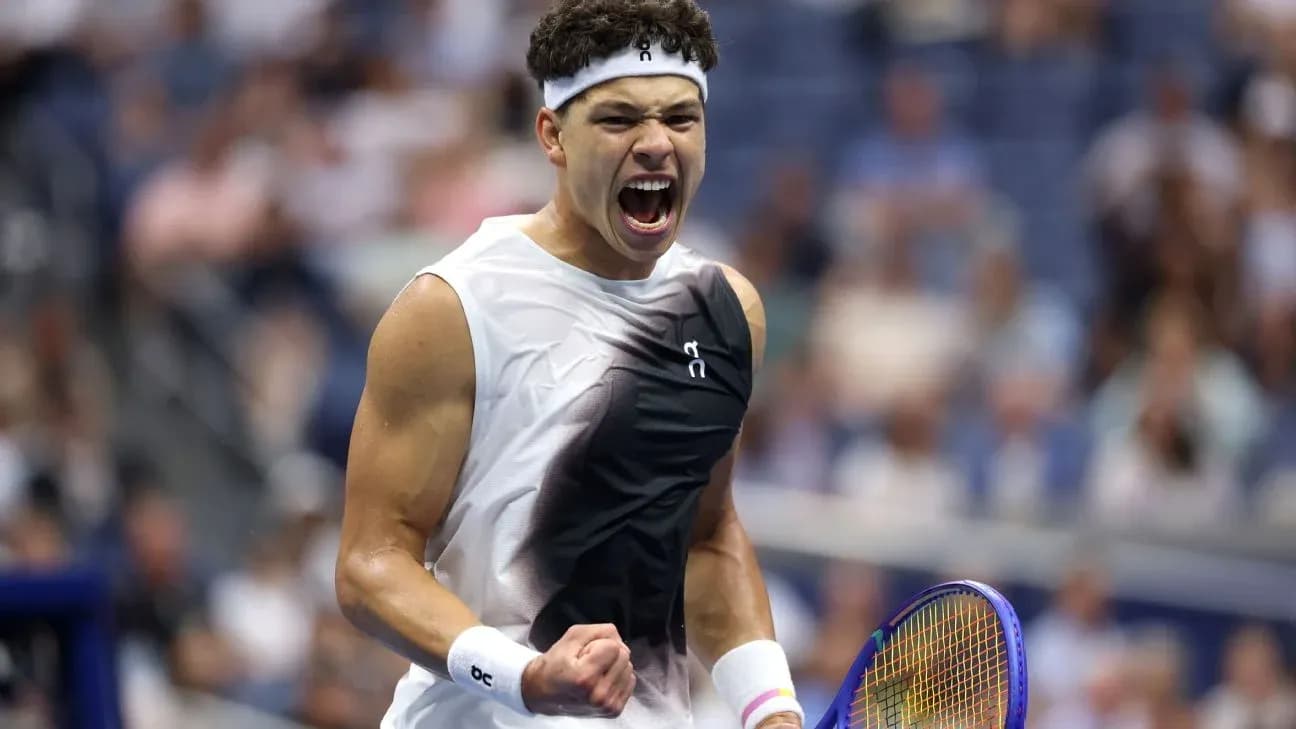
On a stop-start day in New York, American No. 8 seed Ben Shelton found a way to keep his US Open campaign on track, outlasting Hubert Hurkacz 6-3, 5-7, 7-6 (3), 7-5 to reach the third round.
It was rugged. It was streaky. It was exactly the kind of match Shelton insists he needs.
The 21-year-old, who also went four sets in the opening round, again took the long road. He burst out with the first set, absorbed a surge from Hurkacz in the second, then had to wrestle momentum back in a tight third-set tiebreak before finally closing in four.
Shelton has now reached the third round at eight straight hard-court majors, a quietly impressive run of consistency. At the US Open, he has only once gone beyond this stage, but that lone deep run was a big one: his breakout semifinal showing last year.
He knows the value of these early tests.
"I think being battle-tested is great," Shelton said, embracing the grind rather than lamenting it. He admitted he didn’t want to live in five-set territory every round and hinted he could have finished Hurkacz more cleanly. But he placed much of that on the Pole’s rising level as the match wore on, crediting Hurkacz for forcing him to sharpen his own game.
Shelton pointed to “so many things” he’d wanted to clean up from earlier in the week that, under pressure, began to correct themselves mid-match. The rally patterns grew smarter. The serve locations tightened. The forehand, at times wild, settled into a heavier, more reliable weapon.
"Playing a match like that definitely, you know, benefits me moving forward," he said, sounding less like a player relieved to survive and more like one satisfied with the scars.
Medvedev cruises, birds and all
While Shelton was grinding, Daniil Medvedev was mostly gliding.
The No. 7 seed swept past Sebastian Gorzny 6-3, 6-3, 7-5 under the roof, his progress interrupted only by one of those very New York moments that seem to find him at Flushing Meadows.
Two birds perched on the net mid-point, and chaos followed. Medvedev expected the chair umpire to stop play. He didn’t. They played on. Medvedev ripped a winner. Then came the call: replay the point.
"This would be definitely in the top five," Medvedev said when asked where the episode ranked among his odd New York memories. He recalled assuming the point would be halted when the birds arrived, only to see the umpire let it roll. Just as he struck the winner, he heard: "Stop, stop, stop."
He shrugged it off with a wry smile. "It's okay. It happens."
The brief dispute did little to slow him. Medvedev’s baseline command, his depth and his returning edge kept Gorzny pinned back, and even a more competitive third set never truly threatened to derail the former champion’s rhythm.
Rain, reshuffles and restless players
Outside the big stadiums, the story was water, not winners.
For the second straight day, rain pounded the grounds, shutting down the outside courts and leaving Arthur Ashe Stadium and Louis Armstrong Stadium to carry the schedule. The US Open’s Sunday start, designed to spread the first round across three days, should have delivered a clean slate of second-round action by Wednesday.
It didn’t. The weather tore up the plan.
Matches were bumped, shifted, and bumped again. Players warmed up, cooled down, then waited. Some began their tournaments while others were already fighting for spots in the last 32.
Alex de Minaur, the No. 6 seed from Australia, lived through the full shuffle. His match moved twice from its original court before he finally walked out on Court 11 to start his campaign. Once there, he wasted no time, dismantling Italy’s Andrea Guerrieri 6-2, 6-2, 6-4.
"It's been a couple tough days," de Minaur admitted. The delays, the uncertainty, the constant changes in schedule — all of it could have seeped into his performance. He refused to let it. "These tournaments, it's all about adapting and that's the name of the game," he said. With so much at stake, he wasn’t about to let the weather dictate his mood or his level.
For others, the wait ended far more harshly.
Jodar routed, Bu shines in delayed finish
No. 12 seed Rafael Jodar, the 19-year-old Spaniard who arrived on the back of a strong summer, finally stepped into his first-round conclusion and ran into a wall. Yunchaokete Bu of China blew him away 6-2, 6-1, 6-1, finishing off a one-sided affair once the skies allowed.
Jodar had spent long stretches in limbo, waiting across two days to complete the match. He knew the delays would complicate everything — rhythm, focus, recovery — but he refused to pin the loss solely on the elements.
"I knew it wasn't going to be easy because I was waiting a lot yesterday and today as well, but it is what it is," he said. "We cannot control the rain, so it's difficult for both players."
Bu simply handled the conditions and the restart better, dictating from the baseline and never loosening his grip.
Michelsen stuns Nakashima as first round finally closes
The tournament’s scramble to catch up produced a heavy slate: 25 men’s singles matches on Wednesday alone. At last, by nightfall, the first round was done.
One of the final results carried real weight for the American contingent.
Alex Michelsen delivered a clean, composed upset, ousting fellow American Brandon Nakashima, the No. 16 seed, 6-3, 6-4, 6-4. Straight sets. No wobble. On a day dominated by talk of rain and rescheduling, Michelsen carved out his own storyline, taking out a seeded compatriot with authority.
By the time the last ball was struck, the US Open had finally caught up with itself. The draw now holds shape, the second round set. Shelton is battle-hardened, Medvedev is purring, de Minaur is locked in, and new names like Bu and Michelsen have pushed their way into the conversation.
The weather has had its say. Now the question is simple: who uses this chaotic start as a springboard, and who finds that the early turbulence was just the beginning?