.svg&w=384&q=75 "logo")
Ben Shelton Defeats Carlos Alcaraz in US Open Quarter-Final
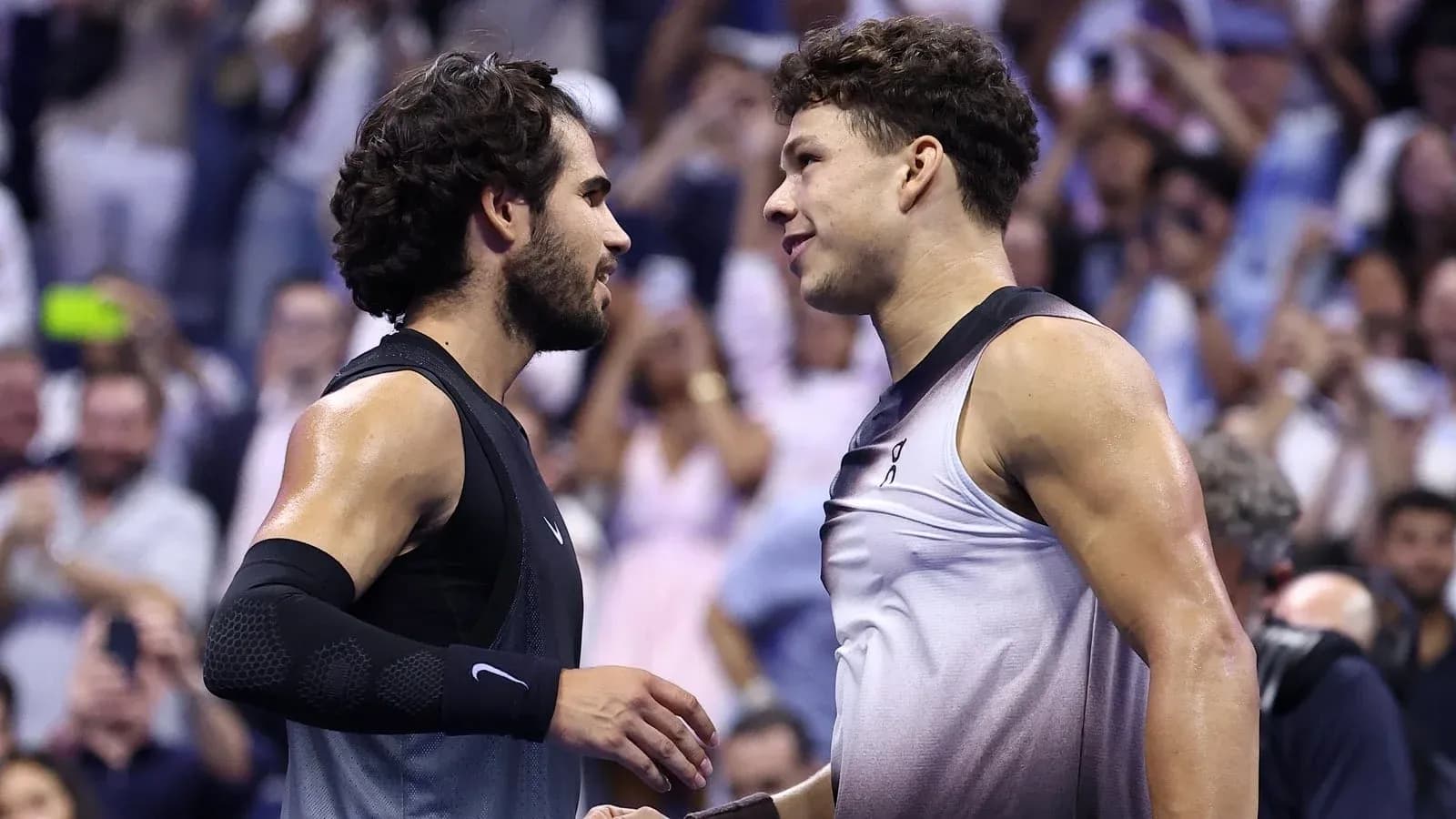
Ben Shelton didn’t just beat Carlos Alcaraz. He outlasted him, out-sprinted him, and out-roared him in a match that bled into tomorrow and rewrote the US Open’s late-night history.
Shortly after 3.30am in New York, with the last few thousand fans clinging to their seats and their voices, the American dragged the defending champion out into deep water and kept him there, sealing a 6-7(5) 6-1 6-3 1-6 7-6(10-7) quarter-final victory on Arthur Ashe Stadium.
It was chaos, it was theatre, and it was Shelton’s coming-of-age.
A night that wouldn’t end
Three long matches earlier in the day pushed the start time back until after 11pm. By the time Shelton and Alcaraz walked on court, it felt like a bonus show. By the time they walked off, it felt like a landmark.
The opening set set the tone: fast, furious, and razor-tight. Alcaraz, playing his first tournament since April after a wrist injury, edged the tiebreak 7-5, leaning on his big-match muscle memory and the kind of defensive sorcery that has already made him a two-time major champion.
Shelton didn’t blink. He punched straight back.
The 21-year-old American tore through the second set 6-1, his lefty serve exploding under the Ashe lights, his forehand cracking through Alcaraz’s defences. The Spaniard suddenly looked vulnerable, struggling for rhythm and, as the night wore on, for energy.
Shelton kept pressing. He snatched the third set 6-3, riding the crowd’s rising volume and his own momentum. At that point, with the clock pushing towards 2am, the defending champion looked in serious trouble.
Alcaraz digs in, but Shelton refuses to fold
Alcaraz, though, rarely goes quietly. Fighting visible fatigue and sickness, he summoned one more surge. The fourth set became a statement of defiance: 6-1 to the Spaniard, as he stepped inside the baseline, cut out the errors and turned the match into a sprint to the finish.
He later admitted how much it took out of him.
"It's been a pleasure to come here and compete, playing these kind of matches, being healthy," Alcaraz said. "It was close, it really was close, so I’m just a little bit disappointed about not getting the win at the end. But I’m just happy, I’m proud of myself about how I fought. Physically I was really tired, but I found a way to push myself up and physically give extra."
The decider became a test of nerve as much as talent. Both men traded breaks, both stared down break points, both leaned on the crowd in different ways. Shelton’s fist pumps grew bigger. Alcaraz’s glances to his box grew longer.
When the fifth set drifted inevitably into a deciding tiebreak, Ashe rose to its feet. One more burst of chaos. One more test of who could still swing freely after nearly four hours of tension.
Shelton answered.
He attacked the breaker, taking control early and refusing to retreat. At 10-7, as Alcaraz’s final ball missed, the American dropped his racket and soaked in the noise. A 10-7 tiebreak, a five-set win, and a place in just his second US Open semi-final.
“Greatest stadium in the world”
If Alcaraz’s words carried the weary pride of a champion pushed to his limit, Shelton’s reflected the pure rush of a breakthrough.
"I always say that this is the greatest sports city in the world. This is the greatest stadium in the world," he told the crowd, still buzzing despite the hour. Then he glanced into the stands and brought it back down to earth.
"I'm just hoping that my best friend and my sister over there don’t have to be at work at 6am, in three hours. It’d be huge from their employers to let them have the day off.
"Sharing the court with Carlos is an absolute honour and I cherish every moment that I have out here."
From the first ball past 11pm to the last roar after 3.30am, Shelton had owned the stage. The win knocks out the defending champion, confirms Shelton as a genuine force in New York, and leaves the night-session lore of Arthur Ashe with a new, wild chapter.
Tiafoe’s rescue act completes all-American surge
Earlier on the same court, another American had staged a different kind of escape.
Frances Tiafoe looked gone. Two sets down, a break down in the third, the 11th seed had lost the spark that had carried him through the early rounds. Across the net, 19-year-old Alex Michelsen played with the freedom of a man who didn’t know he was supposed to feel nerves on the biggest stadium in tennis.
Then Tiafoe found something.
He clawed back in the third set, wrestled control of the rallies and, with the noise in Ashe rising again, cracked a forehand winner to seal it 7-5. The crowd erupted. The match flipped.
Tiafoe rode that wave. He took the fourth set 6-3, tightened his patterns, and forced Michelsen into longer, more physical exchanges. The younger American refused to fold, dragging the contest all the way into a deciding-set tiebreak, but by then the veteran’s belief had returned.
Tiafoe edged the breaker 7-6(6), completing a 5-7 3-6 7-5 6-3 7-6(6) comeback and booking his place in the semi-finals for a third time. What began as a flat, faltering performance ended as a statement of survival.
On a single, sprawling day in New York, Tiafoe and Shelton turned Arthur Ashe Stadium into an all-American proving ground. Now the question hangs over Flushing Meadows: how far can this new wave of US firepower carry the home hopes in the final days of the Open?