.svg&w=384&q=75 "logo")
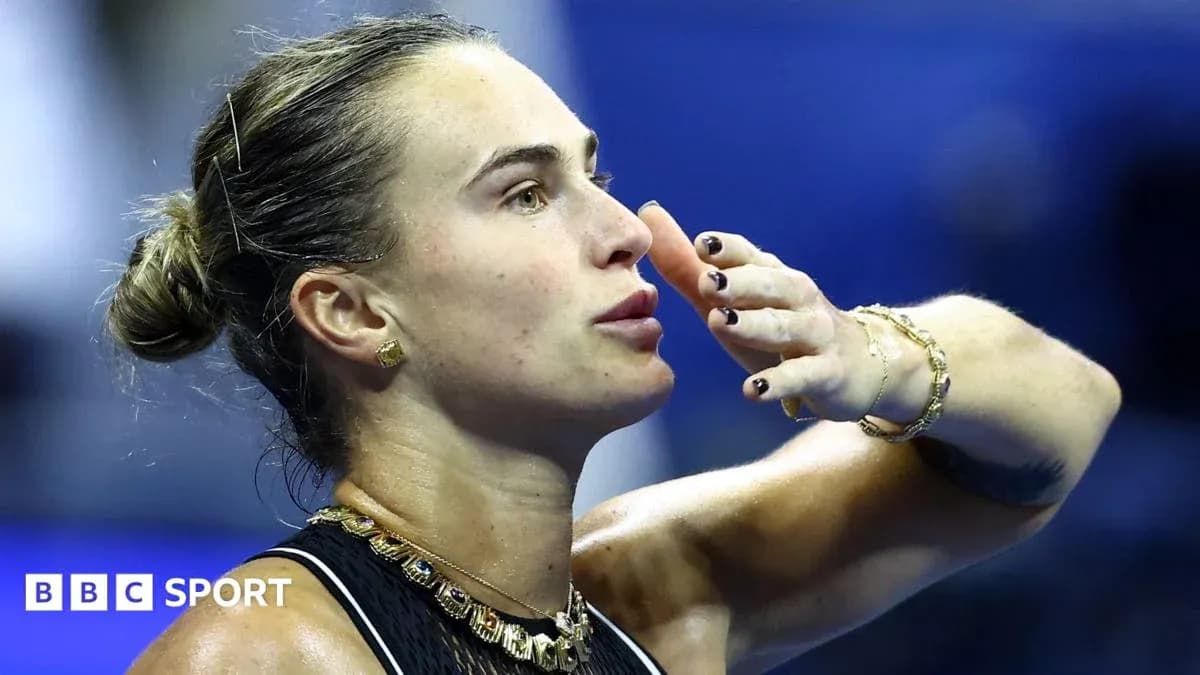
Aryna Sabalenka Dominates US Open Debut with Quick Win
Aryna Sabalenka needed just 53 minutes to remind New York how ruthless she can be. She walked off Arthur Ashe Stadium with a 6-1 6-1 demolition of US Open debutant Polina Iatcenko, a scoreline that barely flattered her. Yet the world number one’s expression told a different story. This was dominance with an edge.
A Quick Win, A Strange Season
On paper, this was one of the quickest Grand Slam wins of Sabalenka’s career. In reality, it felt like a tune-up rather than a test.
Iatcenko, a 22-year-old qualifier ranked 160 in the world, arrived for the biggest match of her life looking understandably tight. Three winners all match. Twenty-four flying past her from Sabalenka’s racket. The gulf was brutal.
Sabalenka ripped through the first set in 24 minutes. She broke twice, conceded almost nothing on serve, and allowed Iatcenko just a brief smile when the Russian finally held for 5-1. Any hint of a foothold vanished in under 90 seconds as Sabalenka held to love to close out the set.
This is the version of Sabalenka that has terrorised hard courts all year. The one who started 2026 with 26 wins in 27 matches, losing only to Elena Rybakina in the Australian Open final, then rolling through Indian Wells and Miami for the Sunshine Double.
Yet that blistering start has given way to something far more complicated.
Since Miami, Sabalenka’s win-loss record has slipped to 17-7 heading into New York. Just one WTA semi-final in the last five months. Before this US Open, she admitted she had been “dealing with several things” and that the level simply was not where she expects it to be.
This fortnight is supposed to be the reset. The launchpad for a first major title of a season that has somehow felt both wildly successful and strangely incomplete.
Ranking Pressure and a Three-Peat Chase
The stakes here go beyond the trophy.
Sabalenka knows the equation. To have any chance of holding on to the number one ranking, she has to win this tournament for a third straight year. Even then, it might not be enough. If Rybakina reaches the semi-finals, she will take the top spot regardless of what Sabalenka does.
Not long ago, that scenario felt almost unthinkable. Now it is very real.
The performance against Iatcenko will not answer questions about how Sabalenka will handle Rybakina, Jessica Pegula or Coco Gauff later in the draw. It does, however, restore a sense of authority. She hit through the ball, stepped inside the baseline, and bullied every short return.
“I’m happy with the level I played, happy with the focus and happy to be through this match,” she said afterwards. Next up is Kamilla Rakhimova of Uzbekistan in the third round, another match Sabalenka will be heavily favoured to control on her terms.
A Spiky Exchange
If the match was straightforward, the press conference was anything but.
Sabalenka bristled at a question she interpreted as a suggestion she had been spending too much time at “lots of parties” in the build-up to the US Open, based on social media posts with sponsors.
“What kind of question is that? Just because I posted some activities with brands, you think that I've been partying [and] not training?” she shot back.
When the same reporter followed up by asking if she was “getting serious” now that the tournament had started, Sabalenka’s sarcasm cut through the room.
“Oh yeah, I wasn't serious before that. Next question.”
The exchange underlined the tension around her campaign. This is a player under pressure to defend a title, protect a ranking, and prove that the mid-season wobble was just that — a wobble, not a slide.
Lessons and Paydays
On court, the mismatch continued into the second set. Iatcenko took a bathroom break after that first-set thrashing, officially to change her kit, though it looked every bit like an attempt to reset mentally.
It didn’t work.
Sabalenka stayed loose, hitting practice serves while she waited, then tore out to a double-break lead at 3-0. A sloppy service game gave one break back, but the reprieve was brief. Sabalenka broke twice more, shutting the door with the same ferocity she’d shown from the first ball.
For Iatcenko, the scoreline stings, but the occasion will linger. She played the world number one on the biggest court in the sport and leaves with experience, a clearer picture of the level required, and a sizeable boost to her career finances.
Coming into New York, she had earned $300,000 in prize money. This run adds another $190,000 to that total — money that can fund more travel, more coaching, more chances to come back better prepared for days like this.
Pegula, Gauff and the Quiet Threats
Earlier in the day, Jessica Pegula quietly did what she does so often: handled business with minimal fuss. The third seed beat fellow American Sofia Kenin 6-3 6-1, another clean step in her pursuit of a first Grand Slam singles title.
Pegula, like Gauff, has more than just the trophy in her sights. If Pegula wins the title, she too could climb to world number one. The same goes for the fourth seed Gauff, who also kept her hopes intact with a 6-3 6-1 victory.
They are not the only ones moving efficiently through the early rounds. Wimbledon runner-up Karolina Muchova advanced in straight sets, as did two-time major semi-finalist Marta Kostyuk and teenage American Iva Jovic, whose rise continues to gather momentum.
Two rounds in, the women’s draw has largely held firm. Few shocks, few upsets, the big names settling into their patterns.
For Sabalenka, that means the real tests still lie ahead. The three-peat, the ranking, the narrative of her season — all of it remains unresolved.
But on a humid New York afternoon, she delivered one clear message: if anyone wants to take her throne, they will have to go through her at full force.