.svg&w=384&q=75 "logo")
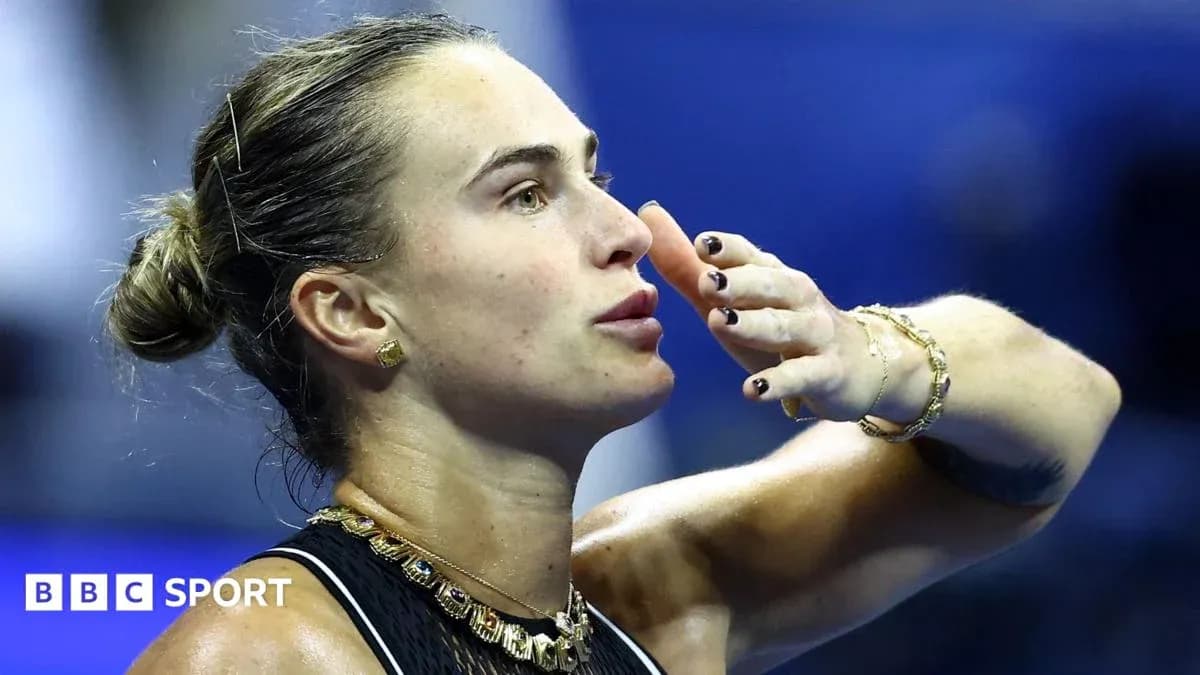
Aryna Sabalenka Dominates Polina Iatcenko in US Open Match
Aryna Sabalenka needed just 53 minutes to flatten Polina Iatcenko. She walked off Arthur Ashe Stadium with a 6-1 6-1 win, a third-round place, and the kind of scoreline that usually brings a broad smile.
She didn’t look remotely satisfied.
A ruthless win, a restless champion
On paper, this was a mismatch. World number one, two-time defending US Open champion, against a 22-year-old qualifier playing her first main-draw match in New York.
Sabalenka treated it exactly like that.
She ripped through the first set in under half an hour, striking 24 winners to Iatcenko’s three over the match. Her pace, her weight of shot, the depth off both wings – all of it simply overwhelmed the world number 160, who wore every nerve on her face in the early games.
At 5-0 down, Iatcenko finally held serve, grinning in relief as she got on the board. It was a small personal victory on the biggest court in tennis. Sabalenka responded by holding to love in less than 90 seconds to seal the set.
Even the changeover break underlined the gulf. After just 24 minutes on court, Iatcenko headed off for a bathroom break and kit change – as much a mental reset as anything else. Sabalenka stayed behind, casually knocking down practice serves to keep her engine humming.
The second set followed the same script. Sabalenka surged to a double break and a 3-0 lead, briefly dipped with a sloppy service game to hand one break back, then immediately slammed the door with two more breaks. No mercy, no drama, just a harsh education for a debutant.
The scoreline flattered no one. It simply confirmed what everyone already knew: at her best, Sabalenka operates on a different level.
A strange season, and a thin margin at the top
For all the dominance on court, the context around Sabalenka is far more complicated.
This is the world number one chasing her first major title of 2026 in what she herself has called a “strange” season. She opened the year like a runaway train – Australian Open final, then the Sunshine Double with titles at Indian Wells and Miami. Across her first 27 matches of the year, she lost once, to Elena Rybakina in Melbourne.
Since then, the brakes have screeched. Her win-loss record coming into New York over the past five months: 17-7. Just one WTA semi-final in that stretch. For a player who set a standard of relentless excellence, that drop-off has been glaring.
The ranking picture only sharpens the tension. Sabalenka knows the equation: to have any chance of staying at number one, she must lift the US Open trophy for a third straight year. Even then, it may not be enough. If Rybakina reaches the semi-finals, the Kazakh will climb to the top regardless of what Sabalenka does.
So every match here carries an extra edge. Every easy win is welcome, but also slightly deceptive. A 53-minute demolition of a qualifier doesn’t reveal much about where her level sits against the elite.
Sabalenka, though, took what she could from it.
“I'm happy with the level I played, happy with the focus and happy to be through this match,” she said, already looking ahead to a third-round meeting with Kamilla Rakhimova of Uzbekistan.
Fire on court, friction off it
If the match was straightforward, the press conference was anything but.
Sabalenka has already admitted she has been “dealing with several things” during this dip in form, acknowledging the past few months have been well below her standards. So when a reporter suggested she had been at “lots of parties” in the build-up to the US Open, she snapped.
“What kind of question is that? Just because I posted some activities with brands, you think that I've been partying [and] not training?” she shot back.
The line of questioning didn’t improve. Asked if she was “getting serious” now that the tournament had started, Sabalenka’s sarcasm cut through the room.
“Oh yeah, I wasn't serious before that. Next question.”
The exchange underlined the mood around her campaign: a player under scrutiny, defending not only a title and a ranking but also her professionalism, even after a routine, clinical win.
A harsh lesson and a valuable payday
For Iatcenko, this was a brutal introduction to the very top of the sport, but not a wasted one.
She faced the world number one on the biggest stage in tennis, felt the weight of a champion’s ball striking, and experienced the intensity of a prime-time US Open match. She also leaves New York with something tangible: $190,000 in prize money, a huge boost for a player who had earned $300,000 in her entire career before this tournament.
That money will stretch a long way – more travel, better support team, more chances to come back better prepared for days like this.
Pegula, Gauff and the quiet chase
Sabalenka isn’t the only one with an eye on the summit.
Third seed Jessica Pegula kept her own hopes of a first Grand Slam singles title alive with a composed 6-3 6-1 win over fellow American Sofia Kenin earlier on Wednesday. If Pegula wins the title, she too has a route to number one.
So does Coco Gauff. The fourth seed, already a US Open champion in doubles and a standard-bearer for the new generation, remains in the mix as another potential usurper if she lifts the trophy.
The rest of the women’s draw largely stayed on script. Wimbledon runner-up Karolina Muchova advanced in straight sets, as did two-time major semi-finalist Marta Kostyuk. Teenage American Iva Jovic added another brisk win to her fast-growing résumé. Through two rounds, the shocks have been scarce; the hierarchy has held.
Which leaves Sabalenka exactly where she expected to be: still standing, still swinging, still hunted.
The performance against Iatcenko showed the power is there, the focus is there, the ruthlessness is there. The real questions will come later in the fortnight – when the opposition stiffens, when Rybakina and the rest loom, and when a strange season either unravels completely or snaps back into the shape of a champion’s year.