Aryna Sabalenka Advances to U.S. Open Final with Victory Over Pegula
NEW YORK — On a thick, airless night in Arthur Ashe Stadium, Aryna Sabalenka walked back into her element.
The defending U.S. Open champion bullied her way past Jessica Pegula 7-5, 6-2 to reach a fourth straight final in New York, and move within one win of a remarkable three‑peat at the hardest Slam to defend.
Next up: Elena Rybakina, the woman who will replace her as world No. 1 on Monday. The title is gone. The territory is not.
Sabalenka, reset
For four months, Sabalenka had looked nothing like the force that tore through the early part of the season. The first quarter of the year, she was almost untouchable. Since April, she had been something else entirely — erratic, volatile, often beating herself as much as any opponent.
That version never made it through the gates in Queens.
“I feel confident and I feel mentally and physically really strong right now,” she said after the win, a simple sentence that matched the way she played.
Six matches in New York have stripped away the doubts. A week ago she was edgy, combative, still searching. Under the Ashe lights on Thursday, she looked like the liquid, flowing version of herself again, in the stadium she openly calls her favorite in the world — so much so that she named her cavalier King Charles spaniel Ash.
“I just love New York and I love being here, and I love the energy of the city,” she said. “I think that’s what drives me. That’s what really inspires me and pushes me to keep going.”
The ranking points say she is about to be No. 2. Her tennis says something else.
No way in for Pegula
Pegula walked into Ashe as the local hope, world No. 3, and one of the most reliable deep‑run players of the summer. Since a first‑round exit at Roland Garros, she had gone 22-5. She also owned a fresh, sharp memory: that 6-0 set she handed Sabalenka on the grass of Berlin.
This was not Berlin.
On grass, Pegula’s flat drives skid low and force the 6-foot Sabalenka into awkward, bending positions, robbing her of time and height for her heavy topspin forehand. On this hard court, with its pace and bounce, Sabalenka looked at home from the first ball.
“Fast courts, but also bouncy a little bit,” she said. “That really gives me more possibilities of, like, pushing her back.”
She did exactly that. Relentlessly.
The first set became a showcase in controlled brutality. Hard, crisp rallies. Eleven straight holds. Sabalenka offered only the briefest glimpses of vulnerability — a netted ball here, a Pegula winner there — but she never let the American see daylight on her serve. Pegula had just one break point; Sabalenka erased it with a big first serve and a heavier forehand.
Pegula’s plan was clear. Hit flat, hit through the middle, take away the angles Sabalenka loves to use to run opponents out of the court. If Sabalenka was going to win, she would have to do it through her.
She did.
At 5-6, Pegula finally blinked. Sabalenka’s weight of shot dragged two errors out of her. The tension spiked, Pegula double‑faulted, and suddenly Sabalenka had set point. She went straight at Pegula, hard down the middle again. Pegula’s reply died in the net.
Halfway to the final. The crowd, desperate for a home surge, never got one.
Second gear, then gone
The second set was even more ruthless.
Sabalenka didn’t put up eye‑popping serving numbers — just 55 percent of first serves in — but the damage came from the deliveries that did miss. Her second serve kicked, twisted, and bit. She won two‑thirds of those points, turning what can be a pressure shot into a weapon.
Pegula found herself trapped in a tactical box. Once Sabalenka locked onto her flat pace, the American couldn’t find a way out.
“I’m not quite a Rybakina where I can serve myself out of trouble, and I’m not quite a Coco that can rely on insane athleticism,” Pegula said, referencing Rybakina and Coco Gauff as the two contrasting threats Sabalenka might face in the final when she spoke.
The line summed up the night. Pegula, one of the tour’s steadiest players, had to talk herself down after running into a level she felt would have beaten anyone.
She had joked with Sabalenka’s team beforehand.
“We’re like, ‘Do you like us?’ Like, we’re good people, we’re pretty nice to you guys. Do you think that maybe one day she could be maybe off a little bit, so I could just, like, get a chance?”
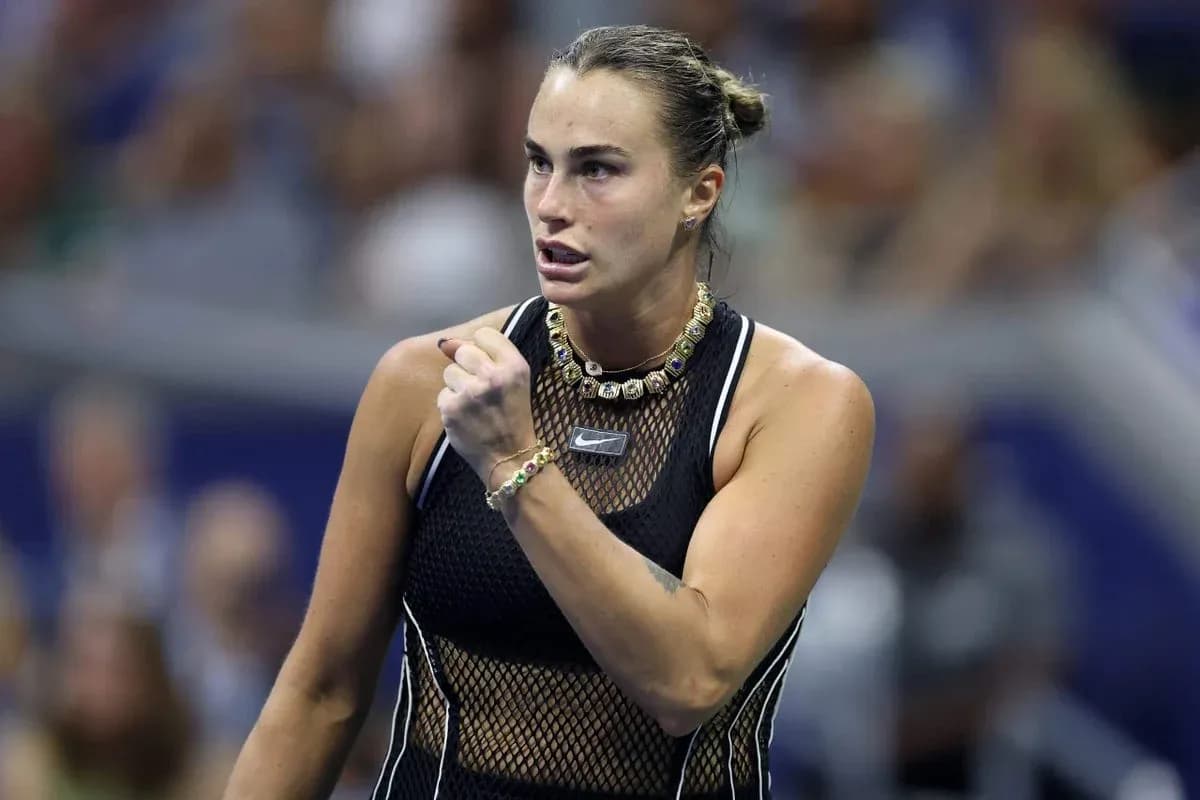
There was no such charity on Ashe. Sabalenka gave her almost nothing. A calm pump of the fist at the end told the story: job done, no drama.
Queen of the hard courts
Strip away the ranking math and the picture on hard courts is stark. Sabalenka has, in effect, owned the hard‑court majors for four years.
This is her fourth straight U.S. Open final. She has already won two of them. In Melbourne, she has reached four consecutive Australian Open finals and lifted that trophy twice. The third title in Australia has slipped from her grasp two years running. New York, she believes, can write a different script.
The U.S. Open asks the most of champions: late in the season, bodies aching, minds frayed, everyone carrying scars from the year. Defending it once is brutal. Defending it twice, in succession, against a field that knows your game inside out, would push Sabalenka into a different bracket of dominance.
Now it comes down to one night, one match, and an opponent who has taken her No. 1 ranking but not yet her New York crown.
Rybakina will walk into Ashe as the new statistical ruler of the women’s game. Sabalenka will walk in with the city, the court, and the memory of two trophies already won on this patch of blue.
One of them leaves with the title. The other leaves knowing this era runs straight through her.