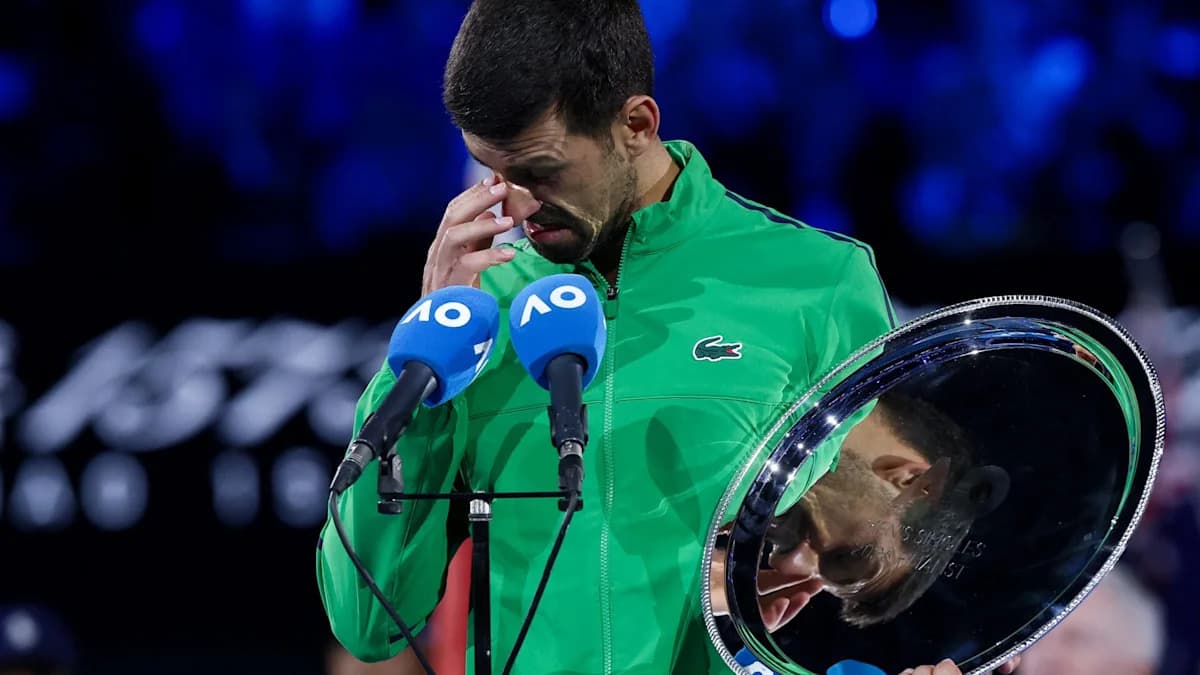
Andy Roddick Suggests Letting Players Skip Runner-Up Speeches at Grand Slams
Andy Roddick, the last American man to win a Grand Slam, faced the tough reality of losing four out of his five major finals during his tennis career. He won the 2003 US Open but then lost in three Wimbledon finals and one US Open final, all against Roger Federer.
Roddick's Grand Slam Final Record
- Win: 2003 US Open, Hard court, defeated Juan Carlos Ferrero, 6–3, 7–6(7–2), 6–3
- Loss: 2004 Wimbledon, Grass, lost to Roger Federer, 6–4, 5–7, 6–7(3–7), 4–6
- Loss: 2005 Wimbledon, Grass, lost to Roger Federer, 2–6, 6–7(2–7), 4–6
- Loss: 2006 US Open, Hard, lost to Roger Federer, 2–6, 6–4, 5–7, 1–6
- Loss: 2009 Wimbledon, Grass, lost to Roger Federer, 7–5, 6–7(6–8), 6–7(5–7), 6–3, 14–16
Thoughts on the Pressure of Runner-Up Speeches
On his Served podcast, Roddick talked about how difficult it is to give a speech right after losing such an important match. He recalled the 2009 Wimbledon final, saying he struggled to stay composed because breaking emotionally would have ended his chance to finish strong.
"Giving a speech in your worst moment… it’s not easy. The only time I really struggled was that 2009 Wimbledon final. If I got emotional, I wasn’t going to get through it. So you just kind of head down."
He acknowledged that if a player can deliver an honest, heartfelt speech after a loss, it can change how fans perceive them. He praised Ben Shelton for his post-US Open speech, calling it possibly his best public moment after a tournament.
"If you can get through it and deliver something authentic and emotional, I think it does a lot for how people see you. But maybe that’s just me being close to it."
Roddick's Simple Solution
Roddick believes the choice to speak should be left to the runner-up. He suggested letting players either thank their team or simply say they can’t do the speech at that moment.
"It should just be the option of the runner-up: ‘I’d like to say thanks to my team,’ or ‘I don’t think I can do it right now.’ Pretty simple. I know TV networks won’t like it, but it is what it is."
This idea makes sense considering how many players want to leave quickly after losing, and speeches often feel forced. It also addresses the awkward wait during court preparations and additional speeches by tournament officials.
Though practical, this change probably won’t happen soon since broadcasters prefer having these speeches. The issue isn’t exclusive to Grand Slams; runner-up speeches are common across both ATP and WTA events throughout the season.