.svg&w=384&q=75 "logo")
Alex de Minaur's US Open Exit: A Struggle for Consistency
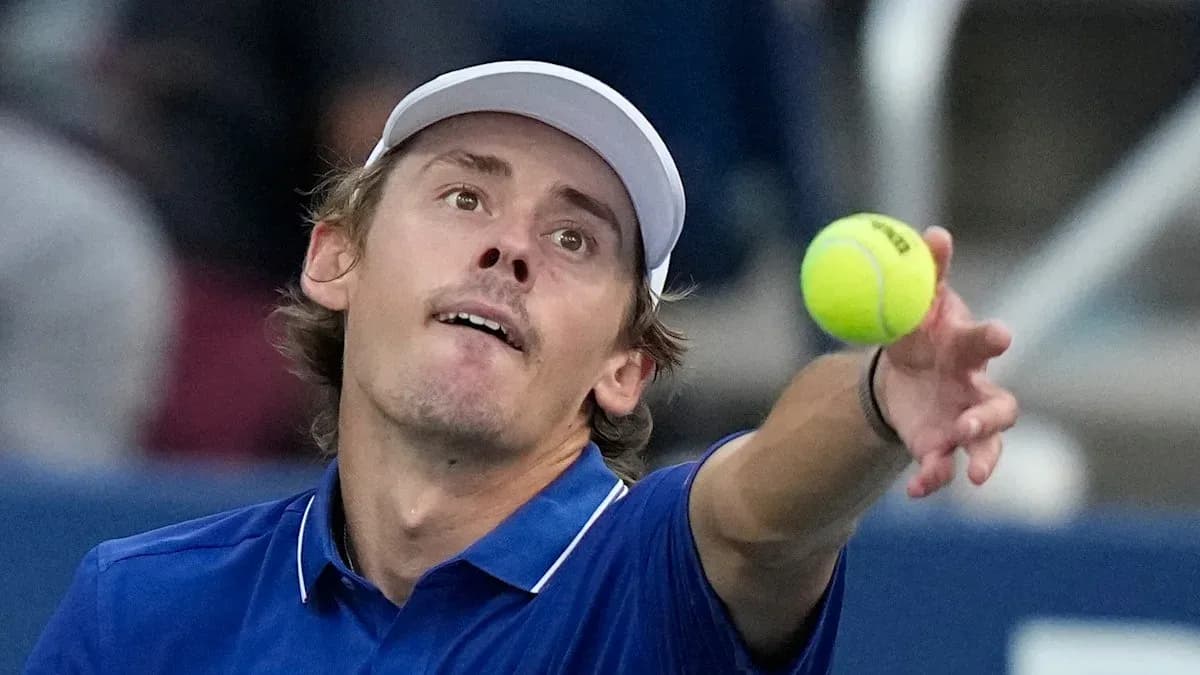
Alex de Minaur walked off Louis Armstrong Stadium with no racket smash, no glare at his box, no long list of grievances. Just a blunt verdict.
“My level today wasn’t good enough. It’s pretty straightforward.”
On Thursday in New York, the Australian who has built a career on reliability and relentlessness unravelled in straight sets, beaten 6-4, 7-5, 6-2 by Dutchman Botic van de Zandschulp in the US Open second round. A player he had beaten in all four of their previous meetings suddenly looked like a stranger across the net.
The context didn’t help. De Minaur was backing up barely a day after a delayed first-round win over Italian qualifier Andrea Guerrieri. His legs looked heavy, his timing heavier. The trademark baseline clarity that usually anchors his game deserted him from the opening games.
The forehand, normally a steady metronome, went wild.
He sprayed routine winners. Balls that usually skim the lines flew metres long. When he tried to step in and impose himself, the errors multiplied.
“It was just one of those days where just the feeling of the ball on the strings wasn’t there,” he said, speaking to AAP. “I was making a lot of errors, which is not really my normal game style.”
He kept fighting, as he always does. He chased, he barked at himself, he tried to raise the tempo.
“I gave myself every chance by being competitive, having a good mindset, a good attitude,” he said. “But… it felt like the more I tried, the more intensity, the more fired up I was getting, I just kept on making unforced errors.
“When those sort of things happen and the odd chance that you have, he comes out with some good tennis – it’s just a recipe for a tough day at the office.”
The pressure finally told in the tight moments. Van de Zandschulp, who has struggled for consistency himself, played clean when it mattered. De Minaur, unusually, did not. The Australian’s shoulders sagged in the third set as the scoreline ran away from him.
Yet there was no meltdown, no sense that the 25-year-old was about to spiral.
“Obviously would have loved to do better, as any competitor would, but it’s what happens in this sort of sport. Everyone loses matches,” he said. “Everyone is losing matches that maybe they would love to have back.
“It’s one I would love to have back, but we move forward and it’s not the end of the world.”
The loss continues a pattern that has quietly become a concern. After a seventh career grand slam quarterfinal at the Australian Open, de Minaur has stalled on the biggest stages. Third round at Roland-Garros. Fourth round at Wimbledon. Now out in the second round in New York.
Away from the slams, early exits have crept into his ATP Tour results as well. For a player who has climbed into the top five in the world, the plateau has triggered an uncomfortable conversation: is it time to change the voice in his corner?
De Minaur has worked with coach Adolfo Gutierrez for nearly two decades, since he moved to Spain as a nine-year-old. In modern tennis, such longevity is almost unheard of.
On Nine’s coverage, Jelena Dokic admitted she understood why some were questioning whether the partnership had run its course, even as she underlined what Gutierrez has helped build.
“Only Alex knows what he needs … a lot of players will change coaches quickly, especially if they feel like the results are not there,” she said. “That’s up to him to make those decisions and what he wants to do. Let’s not forget Adolfo has gotten him to such a high point in his career – to the top five in the world.”
The coach is only part of the equation. The player’s wiring matters just as much.
Dokic pointed to de Minaur’s perfectionist streak, which has been on display all season. After his Wimbledon exit, he looked close to tears as he dissected his form. Wins have started to feel like a release of pressure, not a reward. Losses have felt catastrophic.
“We know his mindset, we know what a perfectionist he is. He wants to get to the top and maybe not doing that in the last two years has affected him,” she said.
“For him, wins have become almost a relief and not so much satisfaction and joy, and that’s hard. Losses have almost been end-of-the-world type things. He’s been really, really hard on himself. I think he has to give himself a bit more of a pat on the back and a bit more credit.
“Whatever he decides to do with coaching, the way that he goes about things and the mindset around it is going to have to change. It’s very hard to keep this up, to constantly expect from yourself to win. That’s been an issue for him.
“When you’ve got the constant pressure of feeling like you want to win and get to the top, and maybe that’s not quite happening the way you want to, you can start to lose motivation, you can get really flat.
“I think that that’s what’s happened – he’s lost a little bit of that mojo to be out there.”
Her suggestion was not just about a new voice or a new tactic. It was about a different rhythm. A re-think of the schedule. Perhaps a lighter load. Space to reset.
For now, though, the US Open moves on without Australia’s No.1. De Minaur’s exit leaves Dane Sweeny, who stunned No.13 seed Lorenzo Musetti earlier in the day, as the last Australian standing in either singles draw.
One compatriot surging into the spotlight. Another, ranked among the very best in the world, searching for that lost feeling on the strings and the spark that once made every match feel like a chase he could win.