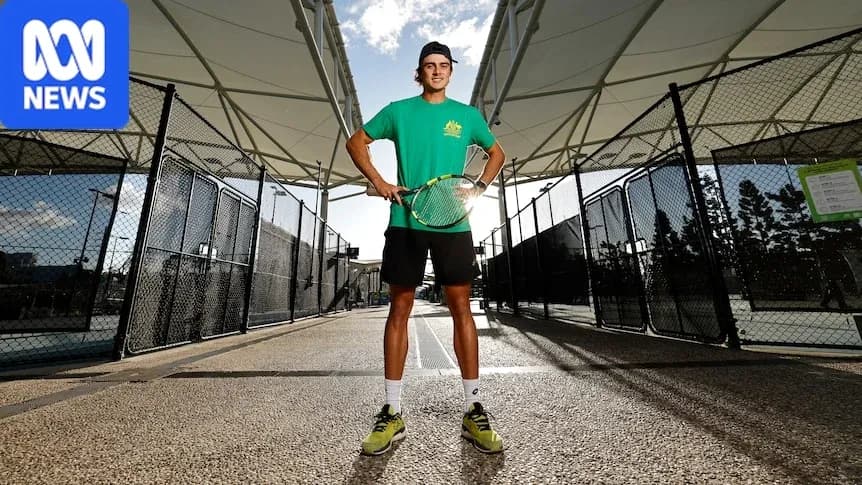
Adam Walton's Journey to Davis Cup Glory
By the time Adam Walton walks out for his Davis Cup debut, the journey will have already been the story.
Not the usual one. Not the polished prodigy, flying around the world as a teenager, hoovering up junior titles and posing with silverware on the lawns of Wimbledon or the clay of Roland-Garros.
His began on a tennis court wedged inside a race track in Home Hill.
From the race track to the world stage
Home Hill sits in North Queensland, about 1,200 kilometres north of Brisbane. It is small-town Australia, where sport is a language and kids learn it young.
Walton and his older brother Jack spoke it fluently.
Rugby league. Swimming. Whatever ball or game they could find. If there was a contest, they turned it into a battle.
"My brother is 15 months older than me; we were very competitive growing up. It wasn't just tennis; it would be any sport. We even 'scissors, paper, rock' for the dishes," Walton has recalled.
Tennis entered the picture when Adam was five. The setting could hardly have been more Australian: a court tucked inside the local race track. The boys would wait for the horses to thunder past, then dash across the course to squeeze in their hitting sessions, careful not to spook the animals.
It was hardly the grooming ground of a future top-100 player. And, crucially, that wasn’t the dream.
"As a little kid, I didn't really dream of becoming a tennis player. I was never a top Australian junior; I never travelled to the junior slams," Walton, now the world No. 93, said before this year’s French Open.
No junior Grand Slams. No ITF junior circuit grind. No label as “the next big thing”.
A late bloomer’s gamble
Where most aspiring pros chase points on the ITF World Tennis Tour Juniors, Walton went the other way. He waited.
He chose college.
He took a scholarship at the University of Tennessee in the United States, using the college system as his proving ground, not as a consolation prize.
"I would have been no good at 18, trying to play professional tennis," he admitted. "I've always been a bit of a late bloomer; I needed to grow up physically and mentally. Once I finished university, I was definitely ready."
That decision has become the hinge of his career.
By the time he left Tennessee, he had a fuller game, a stronger body and, perhaps most importantly, a clearer sense of who he was on a court. When he finally turned professional, he didn’t creep in. He arrived with intent.
Within two years, Walton cracked the world’s top 100 in ATP singles. The player who never featured in junior Grand Slam draws suddenly belonged in the sport’s elite tier.
Making a mark on the clay
The breakthrough wasn’t just about ranking points. It was about the calibre of opponents he could now beat.
In Paris this year, on the clay of Roland-Garros, Walton dragged former world No. 1 Daniil Medvedev into deep water and kept him there. Five sets. A statement win. The kind of result that forces the tennis world to learn your name properly.
By then, his résumé was already swelling: five singles titles and four doubles titles on the Challenger Tour, each one another step away from that race track in Home Hill and another step towards the sport’s main stages.
The climb felt steep. It also felt real.
The Davis Cup call
Now comes the honour that once felt so distant it barely qualified as a dream: Australia.
The Davis Cup call-up is the latest, and most emotional, validation of his unusual route. From the outside, it looks like a reward for ranking, results, momentum. For Walton, it runs deeper. It is the jersey he grew up watching, the competition that turned Australian tennis players into national figures.
"Whether I play or whoever plays, either way I'll do my best for Australia and I just can't wait to do it here in Brisbane, too," he said.
That last detail matters. The tie against Poland will be staged at Pat Rafter Arena, in Brisbane, the closest thing to a home cauldron for a kid from North Queensland. The stands will be packed with green and gold, the noise relentless, the expectations heavy.
For some, Davis Cup is a pressure cooker. For Walton, it is the culmination of a path that was never supposed to look like this.
No junior slams. No fast track. Just a boy crossing a race track, waiting for the horses to pass, chasing a ball with his brother.
On Saturday and Sunday in Brisbane, he steps into a different arena. The horses are gone. The stakes are higher. The dream, finally, is real.