.svg&w=384&q=75 "logo")
Warriors' Key Assets for Next Season
The rest of the league already has its shopping list ready for the Golden State Warriors. It’s not a long one.
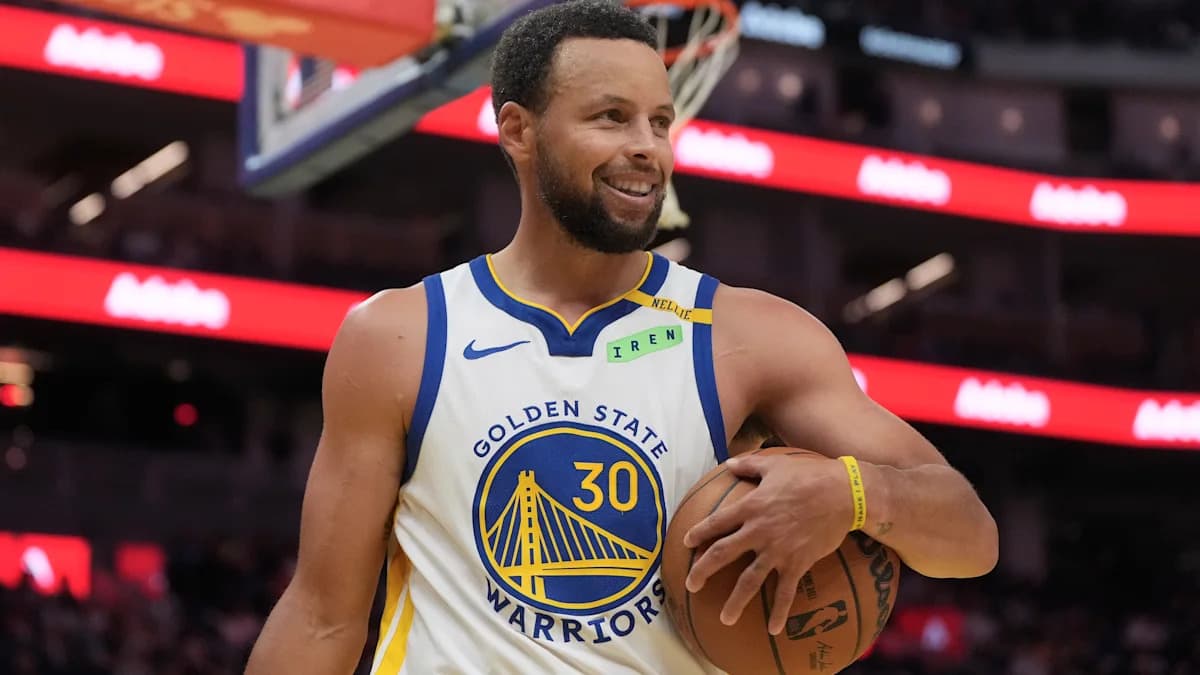
Stephen Curry’s name never even comes up. It doesn’t have to. As ESPN’s Brian Windhorst reported this week, there’s no real “negotiation” on his next deal — just a franchise waiting for a 38-year-old icon to decide how long he wants to keep writing their history.
Jimmy Butler and Moses Moody are off the board for a different reason. Mike Dunleavy made it clear back in August: neither will be available for the Oct. 21 opener, and there’s no timetable for their return. No health, no leverage. That strips the Warriors’ asset list down to three pieces that actually move the needle.
And each one says something very different about where this era of Warriors basketball is headed.
No. 3: Kristaps Porzingis and His Contract
Kristaps Porzingis arrived in February, the headline name in the Jonathan Kuminga deal with Atlanta. Four months later, Golden State doubled down. A two-year, $40 million extension, with a player option on the second season, signaled belief that he could still be a meaningful piece next to Curry.
John Hollinger of The Athletic noted the crucial detail: the agreement was structured as an extension, not a new contract, which means Porzingis is eligible to be traded immediately. No waiting period. No calendar games.
On the floor, the sample was small. He averaged 16.7 points and 5.2 rebounds across 32 games last season, only 15 of those in a Warriors uniform. Enough to tease the fit, not enough to define it.
The real value, for rival front offices, is on the spreadsheet. A $19.5 million salary is big enough to anchor a serious trade and clean enough to slide into a variety of cap structures. For a front office that chose continuity all summer, that number is the escape hatch if a star unexpectedly shakes loose.
Porzingis sits third on the list for a simple reason: a 31-year-old who has only played 15 games for his new team cannot carry a blockbuster by himself. He’s the matching money and the secondary talent in a major deal, not the centerpiece. At least not anymore.
No. 2: The Warriors’ Own First-Round Picks
The league just received a brutal reminder of what draft picks are worth. The Clippers lost five future first-rounders in the Kawhi Leonard punishment, a haul that underlined how powerful those distant, unknown lottery tickets can be.
Golden State still holds a surprisingly deep stash of its own. A May breakdown showed the Warriors retaining their first-round picks in 2027, 2028, 2029, 2031 and 2032. The 2030 pick is owed to Dallas, but only if it lands outside the top 20.
For a team built around Curry and a 36-year-old Draymond Green, that is unusual territory. Most contenders have already spent their future to prop up the present. The Warriors have kept just enough in the vault to tempt a desperate seller.
The mystery is the appeal. Nobody in the league can say with any confidence what Golden State will look like in 2029. Will Curry still be around? Will the franchise have transitioned into a full rebuild? That uncertainty drives up the price of those picks.
Dunleavy already showed his willingness to hold his nerve. He kept the No. 11 pick in June and used it on Yaxel Lendeborg instead of flipping it for immediate help. But the day this roster needs a serious upgrade, those far-off firsts will be the reason rival GMs pick up the phone.
No. 1: Brandin Podziemski
Brandin Podziemski is the name that comes up first in every serious conversation. He’s also the name the Warriors least want to hear.
At 23, he checks every box a modern front office craves. Young. Durable. Productive. He played all 82 games last season and averaged 13.8 points, 5.1 rebounds and 3.7 assists. On top of that, he’s cheap: $5.7 million in the final year of his rookie deal.
Dunleavy didn’t hide how the organization feels. In August, he said he would rather hammer out an extension now than let Podziemski drift into restricted free agency next summer.
“When he’s on the court, we’re a better team,” Dunleavy said.
The clock is ticking. Nothing is signed, and the extension window closes on Oct. 19. Until then, every front office knows exactly what Podziemski represents: a cost-controlled guard entering his prime, with restricted free agent rights attached. If he breaks out this season, the number on his next deal only climbs — and so does his trade value.
That combination makes him the most coveted piece in Golden State’s arsenal, and the one they can least afford to misjudge.
Golden State finished 37-45 last season, 10th in the West. That’s not a blip anymore; it’s a warning light. With Butler and Moody already ruled out for the start of this campaign, Dunleavy faces a hard deadline: by February, he has to decide whether these assets fuel the next great Warriors team or one last push around Curry.
The blueprint is clear enough. Keep Podziemski and those future firsts unless a true star with years left on his deal becomes available. Treat Porzingis as the flexible piece — the contract you move when the right name finally hits the market.
The dynasty years are gone. The question now is sharper, and far more unforgiving: are these the assets that buy Curry one more real shot, or the foundation of the team that comes after him?