.svg&w=384&q=75 "logo")
US Open Quarterfinals: Key Matches and Where to Watch
The US Open steps into its decisive stretch today, and the quarterfinal line-up reads like a roll call of the sport’s current power brokers and rising threats.
On the women’s side, top seed Aryna Sabalenka opens the day against Linda Noskova at 11:30 a.m. ET, a clash of raw force against fearless youth. Under the lights at 7 p.m. ET, American No. 3 seed Jessica Pegula faces compatriot Emma Navarro, a meeting that pits Pegula’s polish and experience against one of the most composed shot-makers of this new American wave.
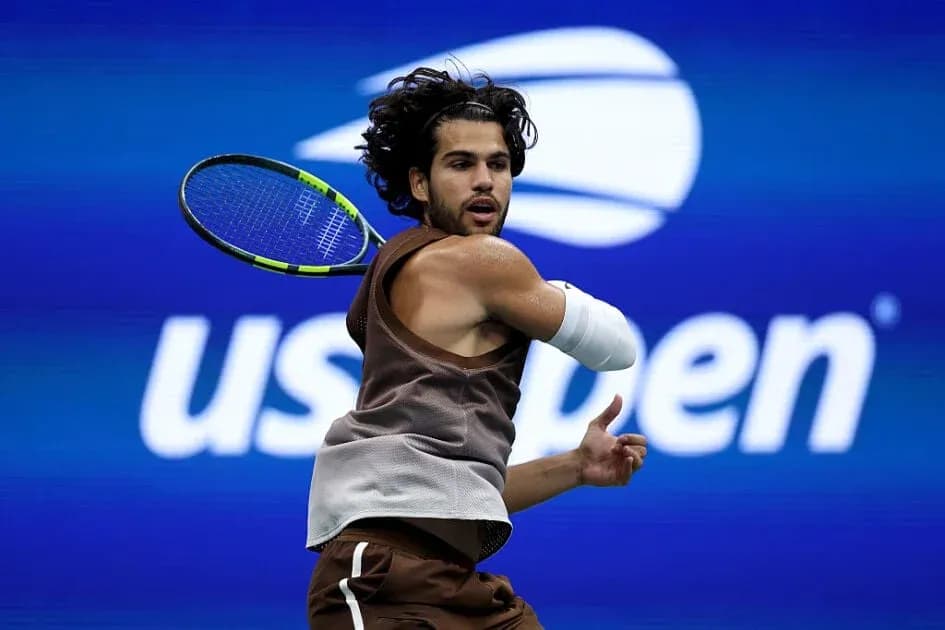
The men’s singles matches carry the same sense of urgency. At 11:30 a.m. ET, Frances Tiafoe, the heartbeat of the U.S. men’s contingent in recent years, takes on Alex Michelsen, a player many inside the game see as the next big American baseline bruiser. Then, at 7 p.m. ET, Ben Shelton squares up to Carlos Alcaraz in a blockbuster that feels less like a quarterfinal and more like a glimpse into the sport’s future. One of the biggest servers in the game against a generational all-court genius, in New York, under lights. It sells itself.
Around those headline acts, the schedule is packed. Mixed doubles, men’s and women’s doubles, and qualifying ties keep the courts at the USTA Billie Jean King National Tennis Center humming from late morning into the night. First ball is at 11:30 a.m. ET, and the day rarely lets up from there.
Where to watch in the US
For American viewers, ESPN remains the home of the US Open, with coverage spread across ESPN, ESPN2, ABC, and the ESPN app. Some matches move between those platforms, so the official schedule matters if you’re tracking a specific player or court.
If cable is long gone from your living room, the tournament still sits within reach via live TV streaming packages:
- DirecTV’s base package, priced at $59.99 for the first month, carries ABC and ESPN+.
- ESPN’s own streaming tier, ESPN Unlimited, starts at $29.99 per month and offers live sports and archived programming.
- Fubo’s Sports plan, at $65.99 per month, includes ABC, ESPN, and ESPN2, with a quarterly billing option for those who prefer to lock in.
- Sling’s Essentials plan brings ESPN and ESPN2 for $19.99 per month, and a Sling TV Day Pass at $4.99 offers a short, sharp option if you only want to drop in for key matches.
- YouTube TV’s Sports Plan, at $64.99 per month, also carries ABC, ESPN, and ESPN2.
Free access is still possible. New subscribers can lean on free trials from DirecTV, FuboTV, or YouTube TV to watch the tournament without an immediate bill, as long as they manage those trial windows carefully.
Watching for free via Australia’s coverage
Outside the U.S., the most attractive option sits thousands of miles away. In Australia, 9Now is streaming the 2026 US Open for free. For fans in the US, UK, or elsewhere who can’t tap into domestic free trials, a virtual private network (VPN) offers a potential workaround.
A VPN allows you to connect to a server in another country and access geo-restricted streams as if you were physically there. ExpressVPN, with its wide spread of global servers, is one of the services often used for this kind of location shift.
To watch the US Open via 9Now using a VPN, the process is straightforward:
- Subscribe to a streaming-capable VPN service such as ExpressVPN.
- Download the VPN app on your preferred device.
- Connect to a server based in Australia.
- Head to 9Now and start streaming the live coverage.
Most of the better VPNs are paid services, but many offer free trials to first-time users. Used smartly, that trial window can carry you through the tournament without paying for the VPN itself.
Once you’re set up, one final technical note: enabling motion-smoothing on your TV can make fast-paced tennis appear smoother, tracking serves and baseline rallies more cleanly. Just remember to switch it off afterwards unless you enjoy that soap-opera sheen on your films and series.
The shape of the 2026 US Open
The 2026 edition of the US Open stretches over three weeks in late summer, from Sunday, August 23, to Sunday, September 13, at the USTA Billie Jean King National Tennis Center in Queens, New York. It’s a full-scale operation, with every corner of the game represented.
The calendar breaks down as follows:
- Qualifying events: August 24–27
- Men’s and women’s singles main draws: August 30–September 13
- Mixed doubles: August 24–26
- Men’s and women’s doubles: September 3–12
- Junior events: September 3–12
- Wheelchair events: September 8–12
The business end of the tournament arrives in a tight, dramatic cluster. The Women’s Doubles Final is set for Friday, September 11. A day later, on Saturday, September 12, the Women’s Singles Final and the Men’s Doubles Final share the stage. The Men’s Singles Final, the traditional closing act in New York, rounds off the event on Sunday, September 13.
First staged in 1881, the US Open is the second-oldest of the Grand Slams, behind only Wimbledon. Its history is heavy, its atmosphere uniquely New York: loud, restless, unforgiving, and unforgettable for those who handle it best.
Who’s in the field?
This year’s draw is loaded with pedigree. Seventeen former Grand Slam singles champions are in the field, ten of them past US Open winners. It’s a line-up that blends proven champions with a generation that refuses to wait its turn.
On the men’s side, Jannik Sinner’s injury absence leaves a gap at the top of the draw and shifts the spotlight. Alexander Zverev comes in as the No. 1 seed, Carlos Alcaraz as No. 2, and between them they carry much of the expectation in the men’s event.
In the women’s draw, Aryna Sabalenka leads the field as top seed, with Elena Rybakina at No. 2 and Jessica Pegula, the American standard-bearer, seeded third. Each brings a different brand of power and control, and each has a legitimate claim to the trophy.
The United States dominates in numbers. Twenty-eight American players feature in the main draw, more than any other nation. Beyond Pegula and Navarro on the women’s side, Coco Gauff remains a central figure in the singles race. In the men’s draw, Tiafoe, Michelsen, and Shelton carry home hopes deep into the second week.
Quarterfinal day in Queens often separates the contenders from the dreamers. With Alcaraz hunting another New York crown, Sabalenka enforcing her status as world No. 1, and a deep American contingent sensing opportunity on home hard courts, the question is simple: who will still be standing when this city’s hardest stage reaches its final act?