.svg&w=384&q=75 "logo")
Uefa Takes Legal Action Against Fifa President Infantino
The words leap off the page like a legal red card.
“Criminal mismanagement.”
“A stunning dereliction of duty.”
“A fraudulently off-market price.”
This is Uefa, in black and white, turning its lawyers on the sitting president of Fifa.
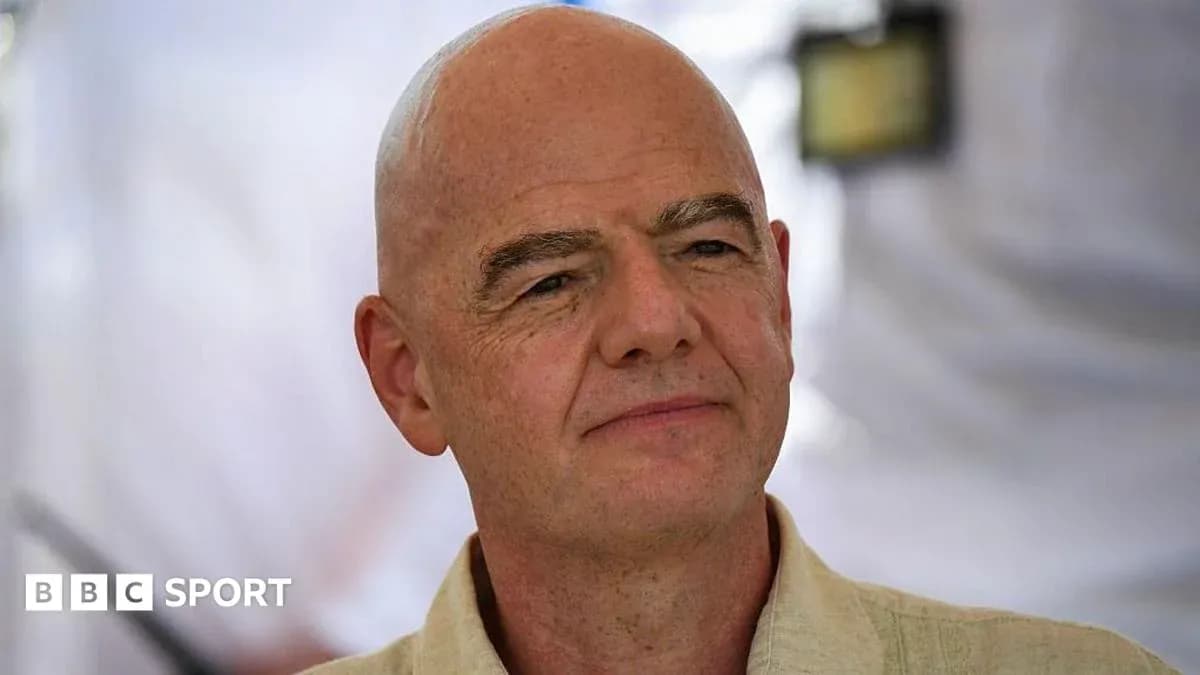
The target is Gianni Infantino and his now-abandoned Fifa Forward Enterprise (FFE) project, a plan to sell stakes in Fifa competitions to private investors. The venue is not Zurich or Nyon, but the United States, where Uefa has filed court papers seeking access to documents and testimony that could underpin criminal proceedings against Infantino in Switzerland.
For an organisation that once backed him to replace Sepp Blatter, Uefa is now accusing the Fifa president of presiding over a scheme that, it says, deliberately undervalued the World Cup at an “absurdly low enterprise value”, around £15bn. A deal, the filing claims, shrouded in “a veil of secrecy”, driven by “cronies” and “co-conspirators”, and harmful not just to Fifa but to all 211 of its member associations.
This is no routine governance spat. It is an open civil war at the top of world football.
Uefa loads the legal gun
The legal move has been coming. Almost a month ago, Uefa warned Fifa to preserve all “relevant materials” related to FFE. Now it has gone a step further, asking a US court to force disclosure of evidence from Fifa, venture capital firm Thrive Capital, its founder Josh Kushner, and former Formula 1 chief Greg Maffei, described in the papers as the “key commercial adviser” to the deal.
For Thrive and Kushner, Uefa’s lawyers are seeking subpoenas for documents, communications and deposition testimony. Kushner, brother of Jared Kushner, has kept his counsel so far. Legal specialists believe he could try to block the subpoenas by arguing that the details of the collapsed deal must remain confidential to protect his business interests and future investments. He has just agreed a record £9.3bn purchase of the Los Angeles Lakers, a reminder of the scale at which he operates.
How long this process will take, and how much Uefa will actually prise loose, is unknown. The governing body wants to show that the World Cup was intentionally undervalued and that Fifa’s leadership breached its duties. It also wants ammunition for a possible criminal complaint in Switzerland.
That, though, is a high bar. Football’s recent legal history in Switzerland is littered with failed prosecutions and dead ends. In 2002, several Fifa executive committee members filed a criminal complaint against Blatter. The Zurich public prosecutor declined to act, and Blatter denied wrongdoing. Last year, Blatter and former Uefa president Michel Platini were acquitted of corruption after a long-running investigation by the Swiss Attorney General.
Nick De Marco KC, one of the leading sports lawyers in the UK, spells out the first hurdle: “What Uefa have to show is that they have an arguable case for criminal proceedings to be brought against Infantino. If they can show that… then they ought to be given disclosure of a lot of the documents.”
He believes Uefa has a strong chance of securing that disclosure. Whether that ever turns into a Swiss criminal trial is another matter entirely.
Infantino under siege – but still standing
The legal broadside lands at a curious moment for Infantino. On the pitch of global politics, he has just enjoyed his most stable week since the FFE scandal exploded.
In Saudi Arabia, the powerful national federation offered what it called “qualified” support, backing his “continued efforts… to restore unity”. Uefa, after weeks of sabre-rattling, dropped its threat to boycott Fifa competitions once it received assurances that FFE would not be revived. For Infantino, that alone counted as a significant win.
The pressure, though, has not eased. Uefa’s legal escalation signals its intent to remove him from office, not merely clip his wings. Public criticism has intensified, from former players, politicians and supporter groups. Infantino has also had to swat away lurid allegations about his private life, including claims – which he insists are “categorically untrue” – that an alleged lover received a severance payment while he worked at Uefa.
In public, he has defended FFE as an attempt to unlock Fifa’s commercial potential, before apologising for “errors” in how the plan was handled. Since then, he has tried to project normality and control: trips to the Dominican Republic and Paris, a video of a “wonderful” visit to Vietnam, and a Fifa machine insisting it is focused on delivering the U20 Women’s World Cup in Poland next week.
It looks, and feels, like a global campaign tour. The message: business as usual, president in motion, nothing to see here.
Behind the scenes, Infantino will have known Uefa’s legal move was coming. The question now is whether the US courts will open the door to the documents and testimony Uefa craves, and what those papers might reveal about how the FFE deal was put together, who pushed it, and who stood to gain.
Governance on trial
Uefa’s public stance is not limited to legal filings and sharp adjectives. It has pledged to “secure fundamental reform, restore proper limits on presidential authority and ensure that Fifa is once again governed as an institution – not around one individual”, and is demanding “a genuinely independent external review of FFE”.
The language is reformist, but the politics are raw. Infantino retains strong backing in South America, Africa and parts of Asia. Those blocs carried him through previous storms and could yet deliver him a fourth term when Fifa holds presidential elections in March.
Uefa has already fired a warning shot: if he runs again, it will “join forces with its partner confederations to ensure that member associations are offered a credible alternative – one committed to integrity, accountability, development and genuine institutional change”.
That is an ambition, not a plan. Finding a unifying challenger who can cut across continents, interests and loyalties is a very different task.
Uefa vice-president Laura McAllister, speaking in Monaco, set out the scale of the job: “We would want to have a candidate, obviously, who would champion that agenda and be committed to a process of reform and change. I think there are lots of credible candidates out there, but it has to be a candidate that can unite that standpoint and somebody who has the credentials and the credibility and the buy-in to really champion that agenda.”
She talks about transparency, independence, critical challenge, due diligence. The vocabulary of modern governance, applied to a sport that has repeatedly struggled to live up to those ideals.
“We knew this wouldn’t be a simple process,” she says. “And we knew that change wouldn’t happen overnight.”
A calendar loaded with confrontation
The timeline is already set.
In October, Infantino will sit around the same table as some of his fiercest critics at the first Fifa Council meeting since the FFE rebellion. The atmosphere will be charged, the subtext obvious: can this fractured leadership still run the global game?
A month later, presidential candidates must be formally nominated. Then comes March, and an election that could either entrench Infantino’s power for another term or trigger a profound shift in how football is governed.
All the while, the legal process in the US will grind on. If Uefa wins its disclosure battle, “very interesting documents”, as De Marco predicts, could spill into view and reshape the political landscape. If it loses, Uefa will have to decide whether to press ahead with a Swiss complaint without the evidence it wanted, or recalibrate its strategy.
What is certain is the mood. Division, rancour, suspicion – they have become the soundtrack to Fifa’s corridors of power. The game’s most powerful institutions are locked in open conflict, trading legal blows and public barbs while claiming to act in the name of unity.
In a sport that sells itself on the idea of bringing the world together, the question hangs heavy: who, if anyone, can stitch this back into a single game?