.svg&w=384&q=75 "logo")
Standout Performers of the FIBA Women’s World Cup 2023
The FIBA Women’s World Cup has hit the business end, and while Team USA rolls on with its galaxy of stars, the story of this tournament is being written everywhere else.
Six nations are already through to the quarterfinals — USA, Hungary, France, Belgium, Spain, and Germany — and outside the American juggernaut, a different kind of brilliance is emerging. Veterans reminding everyone of their class. Young guards announcing themselves on the world stage. Captains dragging nations forward almost single-handedly.
Here are the standout non-USA performers so far — players who aren’t just putting up numbers, but bending the tournament around them.
1. Emma Meesseman, Belgium
The best player outside of Team USA right now? Emma Meesseman has a strong claim.
The WNBA Finals MVP is running this World Cup like it’s her personal showcase. She’s averaging 18.3 points on 50% shooting, with 8 rebounds and 6.3 assists per game, and she’s doing it with a calm authority that has defined Belgium’s perfect start.
Belgium went 3-0 in Group Play, including a statement win over a star-studded Australia. Meesseman didn’t just anchor them; she orchestrated everything. When Belgium needs composure, she provides it. When they need a big shot, she takes it. So far, she’s been the tournament’s metronome.
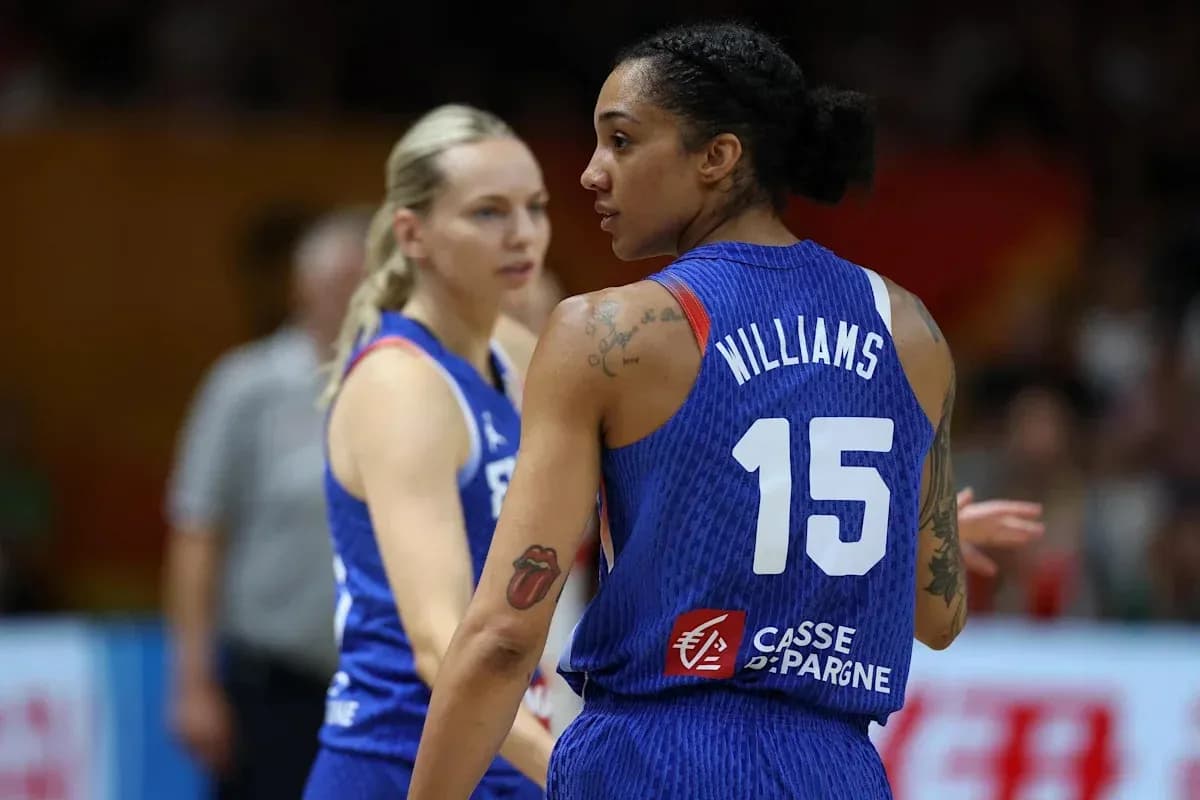
2. Gabby Williams, France
France has weapons all over the floor, but Gabby Williams is the engine.
Through three games, she’s leading all World Cup players in scoring at 18.7 points per game, hitting 58.8% from the field and a blistering 55% from three. Add 4.7 rebounds and 3.3 assists, and you get the definition of a do-it-all star.
Her impact goes beyond the box score. Williams sets the tone defensively, pushes in transition, and gives France a cutting edge in tight moments. France swept Group Play 3-0, and Williams sits right at the heart of it as they prepare for a quarterfinal against the winner of Puerto Rico vs. China.
3. Iyana Martin, Spain
Every World Cup has a breakout star. This one might belong to Iyana Martin.
The 20-year-old Portland Fire guard is playing with the swagger of a seasoned pro. She’s averaging 17.3 points per game, drilling 56.2% from the field and 43.8% from deep, while adding 3 assists a night.
The numbers are impressive. The history is better. Martin became the first under-21 player this century to score at least 20 points in back-to-back World Cup games. On a Spanish team that traditionally leans on experience, she has injected youth, pace, and fearlessness. Defenders know what’s coming. They still haven’t stopped it.
4. Julie Vanloo, Belgium
If Meesseman is Belgium’s anchor, Julie Vanloo is the spark that keeps lighting up games.
She’s averaging 16.3 points, shooting 51.4% from the field and 44.8% from three, with 4 assists per game. When Belgium’s offense starts humming, Vanloo is usually the one hitting the early shots, stretching defenses, and opening lanes for Meesseman and company.
Belgium’s 3-0 Group Play record owes plenty to that one-two punch. Meesseman controls games. Vanloo breaks them open.
5. Marine Johannes, France
Marine Johannes has long been known as one of the most creative guards in the game. At this World Cup, she’s added ruthless efficiency to that flair.
The New York Liberty guard is France’s second-leading scorer at 17 points per game, and she’s hitting an outrageous 52% from three. Give her a sliver of space and the shot is gone — and usually good.
Johannes brings experience and poise to a French side chasing gold. When defenses load up on Williams, Johannes punishes them. If France goes deep, her shooting will be one of the reasons.
6. Ezi Magbegor, Australia
Australia’s campaign has been turbulent, and the loss of Alanna Smith to a lower-leg injury has only raised the stakes. In the middle of it all, Ezi Magbegor has had to carry even more.
The Seattle Storm star is Australia’s captain and leading scorer, averaging 15.7 points on 59.5% shooting. She’s hitting 42.9% from three and pulling down 6.3 rebounds per game.
Magbegor’s role has shifted from key piece to indispensable. With Smith out, she’s the focal point at both ends, the player Australia leans on for stability, scoring, and leadership. If the Opals are to mount a serious run, it will be on her shoulders.
7. Dorka Juhász, Hungary
Dorka Juhász’s WNBA season with the Minnesota Lynx has had its bumps, but in a Hungary jersey she looks completely unleashed.
Across four games, she’s averaging 15.3 points on 50% shooting, along with a dominant 11 rebounds per game. That interior presence has powered Hungary into the quarterfinals.
She’s controlling the glass, finishing inside, and giving Hungary a platform to compete with anyone. For a team not always in the global spotlight, Juhász has been a statement of intent.
8. Xu Han, China
China’s hopes of advancing rest heavily on Xu Han, and she’s responding with towering performances.
The New York Liberty center is averaging 17.3 points, 11.3 rebounds, and 2.7 assists per game, shooting 52% from the field and a remarkable 54.5% from three. A 6-foot-9 center stretching the floor like that is a matchup nightmare.
China must beat Puerto Rico to reach the quarterfinals and set up a clash with France. If they get there, Xu will be the reason every opponent’s scouting report starts with her name.
9. Sevgi Uzun, Turkey
Turkey’s World Cup ended early at 0-3, but Sevgi Uzun refused to fade with it.
The former WNBA guard led the entire tournament in assists at 8.3 per game, while also scoring 17.7 points a night. She shot 53% from the field and 45% from three — elite numbers on any stage.
On a struggling team, Uzun still dictated tempo, created for teammates, and scored efficiently. The results weren’t there, but her individual campaign was a bright, undeniable beacon.
10. Djeneba N’Diaye, Mali
Mali are out, but they’ve left a mark on this World Cup — and Djeneba N’Diaye is at the center of it.
She averaged 17 points on 50% shooting across three games, hitting 45% from three. Her signature moment came in Mali’s stunning 82-73 win over Spain, only their second-ever World Cup victory and their first since an overtime win in 2010. N’Diaye poured in 19 points that night, leading one of the shocks of the tournament.
Mali may be gone from this World Cup, but that upset — and N’Diaye’s fearless performance — will linger long after the final buzzer.
Team USA still boasts the deepest talent pool, with Breanna Stewart, Napheesa Collier, Jackie Young, Caitlin Clark, Angel Reese, and Paige Bueckers headlining a roster built to win it all. Yet the heartbeat of this World Cup is global.
From Meesseman’s control to Martin’s youth, from Williams’ dominance to N’Diaye’s upset heroics, the quarterfinals are loaded with players who have already changed the shape of this tournament.
Now comes the real question: whose run turns a great World Cup into a career-defining one?