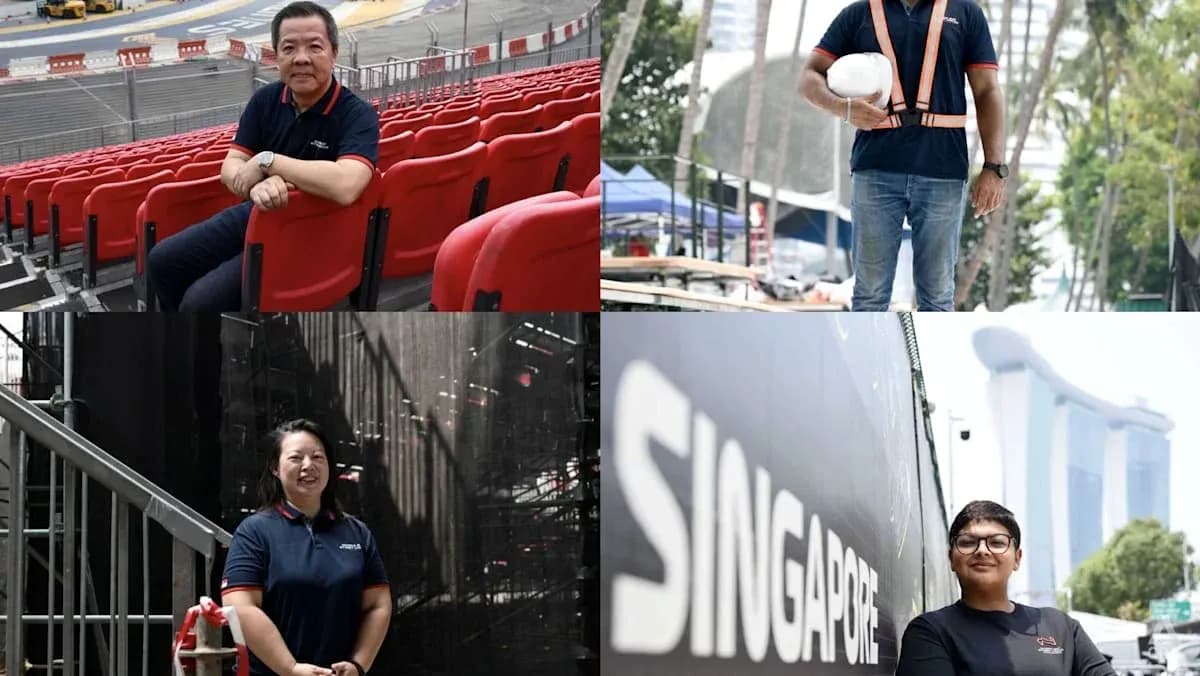
The Singapore Grand Prix: A Year-Round Race Behind the Scenes
By 1am on Monday, the music has died at the Padang and the last echoes of V6 engines have slipped off the skyscrapers around Marina Bay. The show is over. The race is not.
On the same strip of tarmac where drivers hurled their cars at 300 km/h a few hours earlier, Shiv Raj Panday and his technical crew step into their own version of parc fermé – a four-and-a-half-hour sprint to dismantle parts of the circuit and hand Singapore’s streets back to the city.
By 5.30am, Esplanade Drive and the surrounding arteries must once again belong to office workers, buses and taxis. No excuses. No delays.
This is the other Singapore Grand Prix. The one that runs 362 days a year.
The race that never really stops
For fans and teams, the Singapore Grand Prix is a three-night floodlit spectacle. For race promoter Singapore GP, it is a rolling, unforgiving cycle that starts almost as soon as the chequered flag falls.
Seventy full-time staff carry the weight of a global event that must look seamless on television and on the ground. Behind the scenes, it is anything but simple.
“We will take at least about two, three months to plan, before commencing set-up and build of the circuit,” said senior manager Shiv Raj, who oversees event facilities in the technical department. His year is a string of feasibility studies, layout tweaks and hard choices about how to squeeze more function out of limited space within the circuit park.
He knows the Marina Bay Street Circuit intimately. Before joining Singapore GP, he spent 13 years working for one of its contractors. Since the inaugural race in 2008 – interrupted only by the COVID-enforced cancellations in 2020 and 2021 – this post-race teardown and rebuild has been his annual mission.
This year’s edition, from Oct 9 to 11, will be the latest the race has ever been staged in the calendar. It sits inside a long-term picture: Singapore renewed its contract again in January 2022, securing hosting rights until 2028. The city has committed to F1’s long game. The operational team has to match that commitment, year after year.
Ticketing: a 12‑month grind for a three‑day seat
Walk into any grandstand and it looks straightforward: a seat, a view, a ticket. For Clarence Lai, director of ticketing and accreditation, each one is the end product of an “enormous” amount of work that never really stops.
Ticketing is a year-round operation. It starts with “super early bird” sales launched during race week the year before, and runs right up until the next Grand Prix, when the cycle resets.
His team controls access to the circuit – public tickets, vendor passes, contractor accreditation – and constantly recalibrates seating capacity. Do they need new grandstands? Different angles? Better experiences?
They also fight problems that most spectators never see. Singapore GP introduced mobile ticketing last year, a move Lai says has sharply reduced scams. Previously, fans risked being duped by duplicate PDF tickets sold on third-party platforms. A small tweak in tech, a big impact on trust.
The physical seats themselves add another layer of complication. Some grandstands go up one and a half months before the race. Even if a stand returns to the same location each year, the layout can shift slightly when it is rebuilt.
“We do our best to really make sure that all the seats are there, there're no missing seats and the seats are properly labeled,” Lai said. His team also checks the condition of each seat, which spends months exposed to wind, rain and tropical humidity.
Unlike a permanent arena such as the National Stadium, nothing at Marina Bay is guaranteed. Every year, the venue is effectively rebuilt from scratch. Every year, Lai has to make sure the seating map on a fan’s phone matches the reality on the ground.
Selling the same race, differently, every year
While one team counts seats, another counts eyeballs.
Senior director for marketing and partnerships, Sasha Rafi, has been with Singapore GP since October 2007. She remembers when Formula 1 felt alien to many Singaporeans, an “elitist sport” in the eyes of some.
Back then, the job was basic education: explain what F1 is, persuade locals to care, and convince the world to fly in for a brand-new night race.
The race is no longer an unknown. The challenge has flipped. Now, in a calendar crammed with 24 Grands Prix, Sasha’s team must persuade fans to come back – and to choose Singapore over Las Vegas, over Silverstone, over Suzuka.
“Even before the race takes place, we are already planning for next year,” she said.
Her group dissects each edition as soon as it ends: what worked, what did not, across marketing, sustainability, and stakeholder engagement with government and private sector partners. They then spend months looking for fresh angles.
That means scanning for the latest tech that makes sense for the event, tracking entertainment trends, and understanding where people are actually spending money. It also means keeping one eye on the world. Wars, economic shocks, global crises – all of it can hit demand for a race that relies on international travel and discretionary spending.
This season, Singapore hosts one of six sprint races on the F1 calendar. Sprint qualifying lands on Friday, the sprint itself on Saturday – a 100 km, 30-minute dash with no pit stops, separate from Sunday’s main Grand Prix.
The format has opened a new ticketing play. Singapore GP has rolled out a two-day sprint bundle, one of the rare times it has moved away from the usual three-day or single-day packages.
The idea is simple: capture fans who do not want to commit to all three days but still want to feel the intensity of a sprint weekend. It is also part of a broader strategy that has defined Singapore’s approach from the start – make the race accessible to different types of visitors.
“We were the first circuit in Formula 1 to actually inject entertainment into the racing experience that you get over the weekend,” Sasha said. Product categories now stretch from hardcore motorsport fans to corporate guests and locals who come as much for the concerts as the cars.
She also confirmed that the super early bird tickets for the 2027 race will go on sale this year. The carousel keeps turning.
Engineering a circuit around a living city
Away from the marketing decks and ticket dashboards, the physical race infrastructure has to coexist with a city that never really shuts down.
The Marina Bay Street Circuit wraps itself around offices, theatres, hotels and major roads. That creates some of the most dramatic images on the F1 calendar. It also creates a logistical puzzle.
“Sometimes when there're events going on for certain stakeholders, we have to work out the timing as to when is the earliest they can hand over the space to us,” said Shiv Raj.
The Connaught Grandstand, at the end of Esplanade Bridge, is a prime example. It sits along a live road, still open to public traffic. His team can only close the road in the early hours of Wednesday in race week. They then have a narrow window to build before the morning commute demands the road back.
The same brutal timetable applies in reverse on Sunday night. Once the fireworks fade, crews rush in. High on the priority list: reopening key stretches such as Esplanade Drive by 5.30am on Monday.
Every delay has a consequence. Every minute counts.
Training a small army and moving a city-sized crowd
If the circuit is the skeleton of the event, the people are its nervous system.
Operations director Melissa Phua has been with Singapore GP since 2008. Her remit stretches from safety planning to education. Each year, the race offers training and employment opportunities to nearly 1,000 students from the Institute of Technical Education and Republic Polytechnic.
They become grandstand officials, gate staff, and welfare teams for spectators scattered across the circuit park. For many, it is a first taste of working inside a major international sports event.
Phua’s team also has to think about what happens when the show ends each night – especially at the Padang, where concerts spill out thousands of fans towards MRT stations and late trains.
“I think part of our KPI is also in making sure that they leave safely. We would hate to see complaints from patrons who were not happy after the event or we didn’t meet their satisfaction,” she said.
So operations staff fan out across the park, checking that gates are open, routes are clear and crowds move along the paths mapped out in advance. Those routes do not always match the way spectators came in, which can cause frustration.
“It's about making sure that ushers are there and we are there on the ground, making sure that nobody gets yelled at or gets crushed,” Phua said.
The geography adds to the challenge. When the track is closed and fences go up, familiar city streets twist into something unfamiliar – for tourists and even for local staff.
“Even for ourselves, when we close up the track, it can be unfamiliar at times as the path isn't as straightforward,” Phua admitted.
Then there are the curveballs. In 2022, heavy rain delayed the start of the race by an hour, forcing the entire operations plan to flex while tens of thousands of people waited.
Rebuilding capacity, rethinking views
The circuit itself has evolved. In 2023, the track was rerouted to run behind the Floating Platform as one of F1’s largest grandstands made way for the development of NS Square. The modification underlined a simple truth: Singapore’s infrastructure keeps changing, and the race must adapt with it.
For ticketing, that has been a headache. The removal of the Bay Grandstand stripped out a large block of seats that Singapore GP has yet to fully replace.
Lai and his team have had to get creative. This year, the Turn 2 grandstand – just after the exit from the pit straight – will be merged from two structures into one larger stand, with extra viewing platforms added alongside to claw back capacity and improve vantage points.
The goal is not just to sell more tickets, but to protect the quality of the experience. A night race lives and dies on sightlines and atmosphere. Lose too many prime spots, and the event loses some of its edge.
Staying relevant in F1’s busiest era
The Singapore Grand Prix of 2026 will look very different from the pioneering edition of 2008. The skyline has changed. The track has shifted. The sport itself has exploded into new markets and new formats.
What has not changed is the core tension that drives the people behind the scenes: how do you keep a mature race fresh in a championship that now stretches to 24 stops, many of them with deeper pockets or newer toys?
Singapore’s answer remains rooted in what made it a standout from day one – a street race under lights, wrapped in concerts and city buzz, engineered with almost obsessive attention to detail.
By the time most of the city wakes up on the Monday after race day, the cars are gone, the roads are open and the circuit is already dissolving into memory. For Raj, Lai, Sasha, Phua and their teams, that moment is not an end.
It is the first lap of next year’s race.