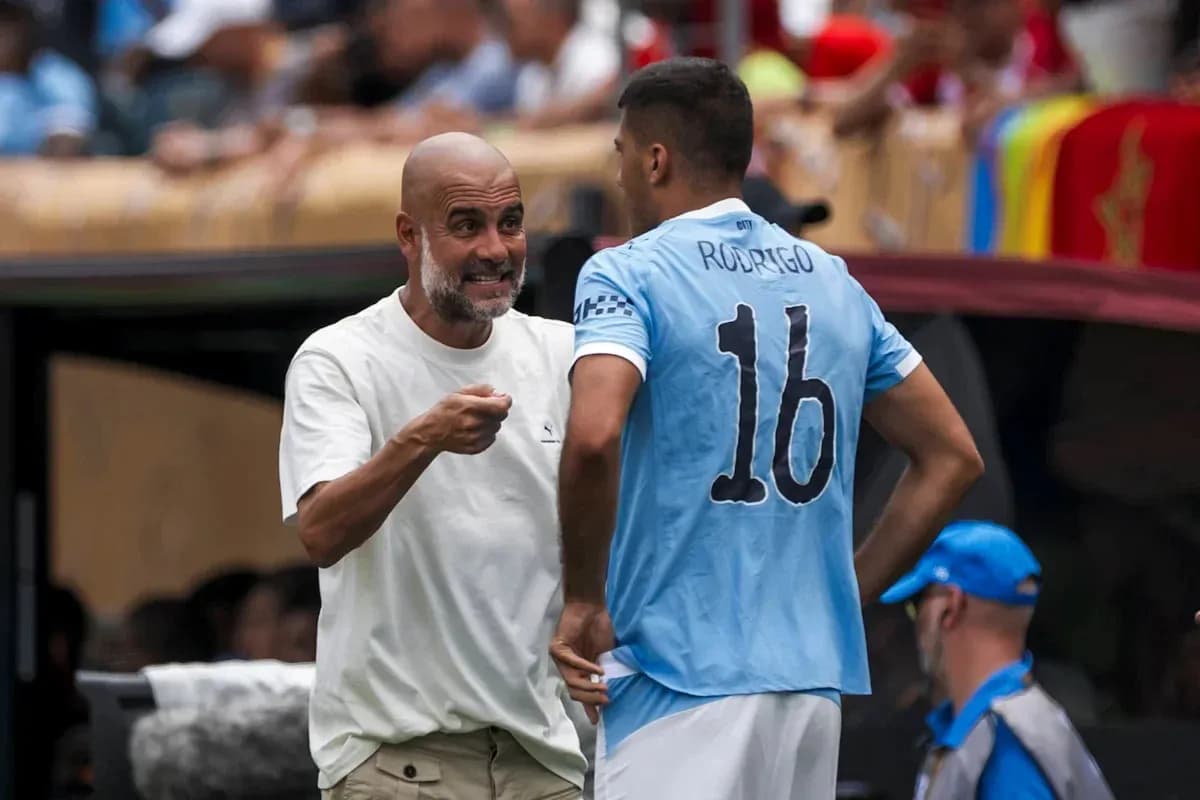
Rodri Chooses Barcelona: A Strategic Move in El Clásico Era
Rodri’s decision to join Barcelona is more than a headline transfer. It is a statement. A shift in power, or at the very least, a reminder that Barcelona can still win the biggest arguments in European football – and win them directly against Real Madrid.
This was not a nostalgic homecoming or a romantic leap into Catalan mythology. According to MUNDO DEPORTIVO, the Spain midfielder sat with offers from both Barcelona and Real Madrid on the table and treated them as exactly what they were: two heavyweight projects, two different futures, one defining choice.
He chose Barça.
A Decision Built on Football, Not Noise
Rodri made it clear this was no spur-of-the-moment call. His summer was anything but calm, with both Spanish giants trying to pull him away from Manchester City. Faced with that level of pressure, he went back to basics: where would he grow more? Where would he win more? Where did the sporting project feel sharper, clearer, more convincing?
Barcelona, led by Deco and Hansi Flick, gave him those answers. They did not just sell him a badge or a brand. They laid out a plan. Role, responsibilities, evolution. The kind of detail elite players now demand before they move.
At this level, the margins decide everything. The clarity of the pitch presentation. The trust built in conversations. The sense that a club knows exactly what you are and what you can still become. Barcelona hit those notes. That is why he is theirs.
Turning Down Madrid Still Means Something
Rodri did not burn bridges on his way out of the Bernabéu boardroom. Quite the opposite. He spoke about Real Madrid with a respect that said as much about him as it did about them. He acknowledged how difficult it was to say no and highlighted the way the club handled the entire process.
In an era when players often posture for the cameras, that tone mattered. He understands the weight of refusing Madrid. He did not try to downplay it.
His comments about Mourinho, who personally tried to lure him to the capital, underlined that. Rodri said: "Bueno, no creo que sea lo suyo desvelar una conversación privada, pero evidentemente expresó sus ganas de que fuera y de lo que podía aportar al equipo. El trato fue muy bueno. Cuando tomé la decisión también le llamé para agradecer el interés y el trato. Me parece un grandísimo entrenador, ya lo ha demostrado allá donde ha ido en sus grandes etapas y el Real Madrid va a ser un duro rival para esta Liga."
Diplomatic. Honest. Grateful. In a sport that often chews up courtesy, he made sure to close the loop properly.
Barça Didn’t Just Benefit – They Convinced
One line from Rodri’s stance will resonate particularly strongly around Montjuïc. He did not frame his decision as an escape from Manchester City or as a rejection of Madrid’s politics. He framed it as a positive pull towards Barcelona.
That distinction is crucial. It means this is not a transfer born of chaos elsewhere. It is a footballer, at the peak of his powers, actively choosing Barça because their project spoke louder.
He also refused to dance around the off-field theories and speculation that always swirl around Madrid’s interest in a major player. No drama, no conspiracy, no feeding the circus. He stressed that his focus stayed on football, on Spain, on his own career path.
Then came the small but telling observation: in England, he said, football is largely kept to football. It hinted at a player shaped by the relentlessness of the Premier League, but one who now wants a different kind of pressure. A different kind of spotlight. A different kind of noise.
El Clásico with a New Axis
If Rodri plays in Spain as he has played in England, this move changes games – and maybe seasons. Barcelona have not just signed a midfielder. They have imported control. Intelligence. Steel. The kind of presence that dictates tempo and drags a team through rough spells.
And they have done it by beating Real Madrid to him.
That matters. It sends a message about who can still attract the game’s most coveted operators. About who can still present a project that stands up to the fiercest scrutiny. About the enduring magnetism of the Barcelona name, even in a period of reconstruction.
For Madrid, there will be frustration but no humiliation. They moved decisively, they treated him well, they made their pitch. They lost out, but they did not lose face.
For Barcelona, the satisfaction runs deeper. They did not pick up a player who had run out of options. They landed one who knew exactly what the alternative looked like and still chose their shirt.
Manchester City Left with a Vacuum
From a Manchester City perspective, this story cuts two ways.
On one side, there is pride. Rodri is now openly discussed as the midfielder both Barcelona and Real Madrid wanted above all. That tells you where he sits in the modern game. At City, he became the calm in the storm, the organiser with the ball, the man who made a superteam feel balanced and complete.
On the other, there is that familiar irritation when Europe’s traditional giants circle a City player as if he naturally belongs in their orbit. Rodri became this version of himself in Manchester. He refined his game in the Premier League, carried enormous responsibility, and grew into one of football’s most influential midfielders under the brightest floodlights.
If his departure is confirmed, City supporters will likely wish him well while staring at the bigger problem: how do you replace that authority?
Who controls the rhythm now? Who slows a frantic match to walking pace with a single touch? Who restores order when games turn wild?
That is the real imprint Rodri leaves behind at City. He does not just vacate a position on the pitch. He leaves a void at the heart of their structure.
Barcelona have stepped into that gap. Real Madrid have taken note. La Liga has just gained another fault line in its greatest rivalry – and the next Clásico will ask a simple question: did Rodri choose the project that will define the next era, or the one that will have to chase it?