.svg&w=384&q=75 "logo")
Philip Shaibu Supports Igoche Mark's Vision for Nigerian Basketball
The Director General of the National Institute for Sports (NIS), Comrade Philip Shaibu, has thrown his weight behind basketball promoter Igoche Mark, urging him to stay the course in his drive to grow the sport in Nigeria.
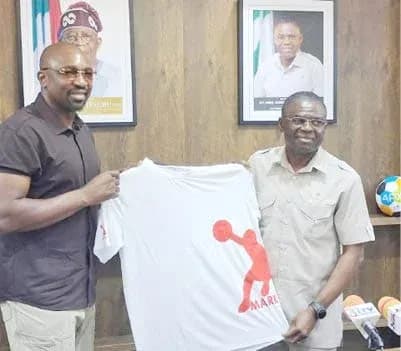
Shaibu delivered the message in Abuja on Monday when he hosted Mark, who visited the institute to motivate basketball coaches currently undergoing training under his sponsorship. It was a small gathering, but the subtext was big: Nigerian basketball needs its believers to keep going.
“I am told that you are sponsoring quite a number of them, and I am confident that this partnership will yield results,” Shaibu told Mark, after the pair met some of the trainees. He praised Mark’s investment in the game and then pushed him to stay in the fight. “I thank you for what you have done for basketball, and I plead with you: do not give up on basketball.”
The words carried weight. Nigerian basketball has lurched between promise and uncertainty in recent years, and the presence of private promoters like Mark has often filled gaps left by shaky structures. For Shaibu, now in charge of the country’s premier sports training institute, that kind of commitment is too valuable to lose.
Mark, the Initiator of the Mark D’Ball Basketball Championship, responded by turning the spotlight back on the NIS boss. He hailed the transformation at the institute, tying it to Shaibu’s track record in Edo State, where he previously played a prominent role in sports development.
“We were here in 2022, but coming here today and seeing the level of transformation, I am not surprised,” Mark said. “Having seen what you did in Edo, I know that excellence has always been part of you. With people like you in this country, there is hope because you turn things around.”
It was more than polite praise. The visit doubled as a statement that infrastructure and human capacity must move in step if Nigerian basketball is to grow beyond raw talent and street courts.
Mark explained that his main mission on the day was to encourage the coaches in training — many of them former players now attempting to make the difficult leap from the court to the touchline. That transition, he stressed, cannot be built on experience alone.
“They were once players, and now they are transitioning into coaching. Without proper certification, you cannot function on the international scene because you cannot sit on the bench if you are not certified,” he said.
That blunt reality underlines why the NIS–Mark partnership matters. For Nigerian coaches to stand on international benches, they must first sit in Nigerian classrooms. For Nigerian basketball to grow, promoters must keep writing cheques and institutions must keep raising standards.
On this evidence, neither side is planning to step back.