.svg&w=384&q=75 "logo")
NBA Imposes Historic Penalties on LA Clippers for Cap Violations
The NBA dropped a hammer on the LA Clippers on Wednesday — the harshest punishment in league history — and sent a message that will echo through every front office in the sport.
After a year-long investigation, the league ruled that the Clippers and owner Steve Ballmer circumvented salary-cap rules to steer millions of dollars in off-court money to Kawhi Leonard. The price is staggering: five first-round picks gone, a $30 million fine, and a one-year suspension for one of the richest and most visible owners in professional sports.
A historic penalty
The Clippers will forfeit their first-round picks in 2029, 2030, 2031, 2032 and 2033. Those are the kind of assets franchises hoard to survive downturns and fuel rebuilds. LA just watched a decade of flexibility vanish in a single ruling.
Ballmer, the driving force behind the franchise’s modern era, has been banned from team activities for a year. The NBA said he “knowingly” worked to help Leonard obtain off-court income, specifically pointing to a deal with Aspiration that Ballmer approved because he knew it was a precondition for the company to sign a sponsorship deal with Leonard.
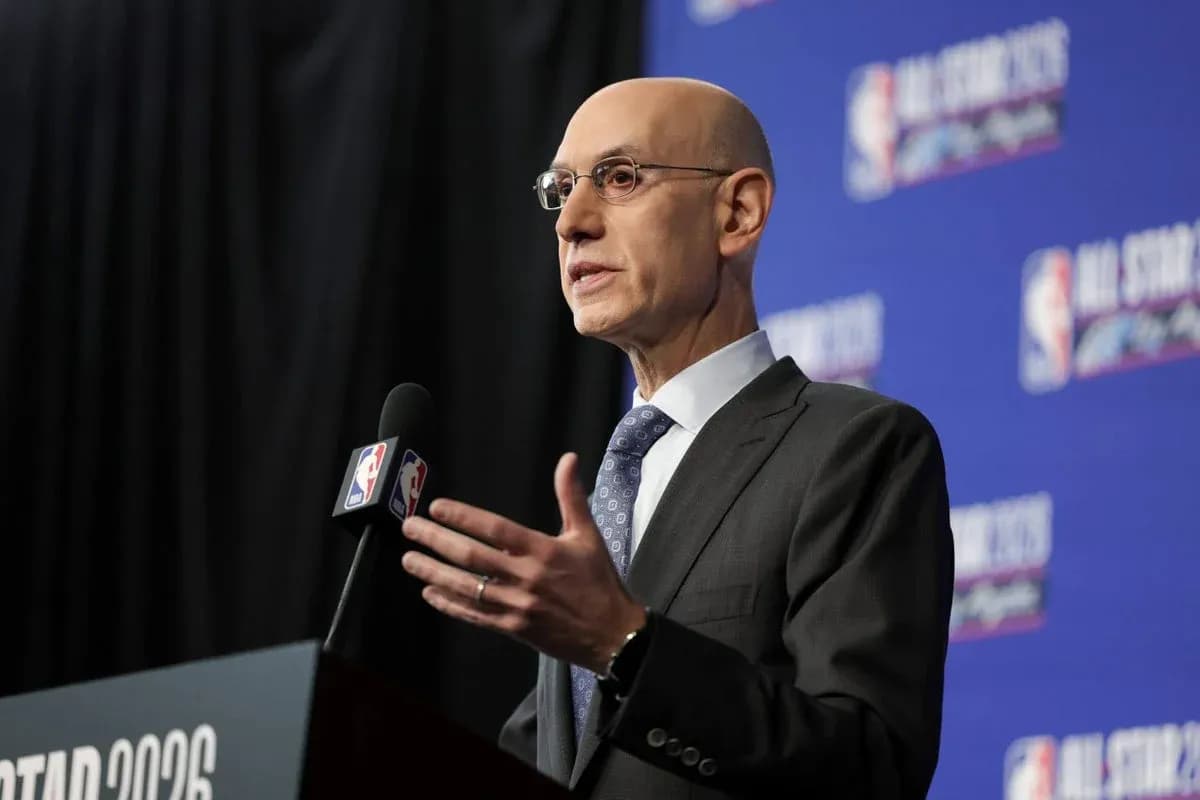
Adam Silver did not soften the blow.
“The NBA’s collectively bargained system for determining player compensation is a fundamental component of the basketball competition that the league oversees for the benefit of the teams and players and ultimately the fans,” the commissioner said. “I am deeply disappointed by the flagrant violations of our rules and by the Clippers’ institutional and leadership failures that led to this misconduct. The severity of the penalties reflects the seriousness of the violations.”
This was not framed as a technicality. It was framed as a breach of the sport’s economic backbone.
The scheme the league didn’t buy
Investigators said the Clippers tried to hide behind a “novel theory”: that it was acceptable to introduce business partners to players if the player or his representative asked for those introductions. The league didn’t buy it.
The NBA’s report describes Leonard, through his uncle and adviser Dennis Robertson, pressuring the organization “to assist him in obtaining off-court income opportunities, successfully obtaining those opportunities, and failing to reimburse payments by the Clippers for personal expenses.”
The investigation, conducted by law firm Wachtell Lipton, found the Clippers initiated deals with four companies tied to Leonard: Aspiration, Boingo Wireless, Daktronics and Lockton Insurance. The team didn’t just make introductions; investigators say it facilitated endorsement deals for Leonard with each of them.
The league’s conclusion: this wasn’t organic business networking. It was cap circumvention.
Leonard has been ordered to repay $700,000 to the NBA. Robertson has been banned from engaging with NBA teams for five years.
And yet the report leaves the door open.
“More information will likely surface over time,” it reads. “Investigators continue to receive information relevant to the subjects discussed in this report, including as recently as this week.”
The case is technically closed. The story is not.
Leonard’s future and a trade unblocked
Amid the wreckage sits Leonard’s career. His future with the Clippers was already in motion; the team agreed earlier this summer to trade him to the Toronto Raptors. That deal has been frozen while the league dug into his endorsement web.
With the findings now public, the expectation is that his move to Toronto can finally go through.
In a statement, Leonard accepted responsibility for the chaos around him, while insisting he did not knowingly participate in any cap dodge.
“I accept full responsibility for lapses in judgment by people within my inner circle and regret the distraction this situation has caused the fans and my family,” Leonard said. “I entered into my contract with the Clippers as well as the agreements in question in good faith, fully committed to fulfilling my obligations and with no knowledge of any intent on anyone’s part to circumvent the salary cap… As I return to Toronto, I am focused on what I can control, closing this chapter, and moving forward with a clean slate.”
The league did not accuse Leonard of designing the scheme. It did hold him financially accountable for his role in it.
Power at the top, penalties at the top
The fallout inside the Clippers’ hierarchy is sweeping.
Team president Lawrence Frank has been suspended for six months. The NBA’s report notes that Frank cooperated and was “open and honest” in his recollections. That helped him. It did not save him.
Gillian Zucker, the Clippers’ president of business operations, received a one-year suspension. Investigators described her as “evasive” and “inconsistent” in interviews, and the league drew a clear line between that behavior and the harsher penalty.
What emerges is a picture of an organization whose basketball and business arms both crossed lines, then gave the league very different levels of candor when asked about it.
The Aspiration deal that lit the fuse
This all started with a podcast.
On Sept. 3, 2025, the “Pablo Torre Finds Out” podcast reported that Leonard had accepted a $28 million “no-show” contract with Aspiration, a California environmental company that also served as the Clippers’ jersey-patch sponsor through the 2022-23 season.
The NBA began examining whether that contract was a vehicle to pay Leonard beyond what he could legally earn under the collective bargaining agreement. If the team, directly or indirectly, used Aspiration to funnel extra compensation to its star, that would be a clear violation of the cap rules.
Aspiration went bankrupt in March 2025. In its filings, the company listed Leonard among its leading creditors, alongside the Clippers. Through his LLC, KL2 Aspire, Leonard was owed $7 million, according to court documents.
Within days of the podcast report, the NBA hired Wachtell Lipton to investigate. The firm has handled some of the league’s most sensitive cases, including the 2014 probe into former Clippers owner Donald Sterling. The Leonard case quickly joined that list.
Silver vowed publicly that the league would “get to the bottom” of it.
“We will be thorough, but we will begin with a presumption of innocence, not a presumption of guilt … and then we will follow the facts,” he said last September.
The facts led well beyond one contract.
A tangled web of money and loyalty
Aspiration’s ties to Leonard, Ballmer and the Clippers ran deep.
Leonard didn’t just have an endorsement deal. Joe Sanberg, the company’s co-founder who later pleaded guilty to federal fraud charges, granted Leonard $20 million in equity. Ballmer, meanwhile, invested $50 million into Aspiration in 2021 as it prepared to go public.
That same year, the Clippers signed Aspiration to a jersey patch deal worth more than $300 million, making it a founding sponsor of the Intuit Dome. The team also agreed to pay more than $50 million in carbon-offsetting payments to the company as part of a push to brand the arena as carbon neutral, according to multiple people briefed on the arrangement.
Aspiration never went public. It began to struggle the next year. Ballmer kept writing checks anyway.
He participated in a $66 million fundraising round in the spring of 2023, investing another $9,999,997.92, even as the company bled cash and laid off staff. Most of the fresh money came from Sanberg, Aspiration board member Ibrahim AlHusseini — who also later pleaded guilty to federal fraud — and Ballmer. Only one new investor joined them: Dennis Wong, Ballmer’s longtime friend and the Clippers’ vice chairman.
Inside Aspiration, Leonard’s deal became a flashpoint. Sanberg championed the move and the decision to grant Leonard equity despite internal skepticism.
“I am personally contributing stock to Kawhi to make this partnership possible,” Sanberg wrote to his leadership team in a May 2022 email obtained by The Athletic. “Aspiration’s CEO judged the deal to be not worth doing. For avoidance of doubt, any and all benefit to Aspiration from the Kawhi deal is being subsidized by my contributing my equity to make this happen.”
Some executives questioned the logic of building a marketing campaign around Leonard, a famously private and reserved star. The contract gave him significant leeway to skip marketing activities. Staffers brainstormed commercial concepts, drew up visuals, and searched for ways to feature him. He never publicly promoted the company.
The scale of Leonard’s deal dwarfed Aspiration’s other celebrity relationships. According to a former executive, Leonardo DiCaprio and Robert Downey Jr. each received less than $2 million in equity. Drake invested $4 million and received carbon offsets in return. Leonard’s package sat in another universe.
The Clippers and Ballmer have consistently maintained that none of this broke league rules. Ballmer has said he merely connected his star with a key sponsor and that such an arrangement was permissible. Frank, who signed a multi-year extension last season, repeatedly denied any cap circumvention.
The NBA now says otherwise.
Beyond Aspiration: Daktronics and the Intuit Dome
As the probe widened, the “Pablo Torre Finds Out” podcast reported that Leonard also had a multi-million dollar sponsorship contract with Daktronics, the company that manufactured the massive video board at the Intuit Dome.
That relationship drew interest from both the NBA and the Securities and Exchange Commission, which questioned Daktronics about its ties to Leonard.
What began as a single red flag around Aspiration evolved into a map of overlapping business interests, personal investments and endorsement deals, all orbiting the Clippers’ best player and their billionaire owner.
A line drawn for the rest of the league
The NBA’s punishment ends a formal investigation that stretched over a year, but it does something more important: it draws a bright line.
Owners can invest in companies. Players can sign endorsement deals. Teams can sell jersey patches and arena naming rights. Those worlds have always overlapped in modern sports.
What the league made clear on Wednesday is that when those overlaps start to look like shadow salary, the cost will be brutal.
The Clippers now move forward without five future first-round picks, without their owner for a year, and with key executives sidelined. Leonard, headed back to Toronto, tries to restart his career on what he called a “clean slate.”
The question now is not whether the NBA will punish this kind of conduct. That’s been answered.
The question is which franchise will be the next to test how close it can get to that line.