.svg&w=384&q=75 "logo")
Mourinho's New Real Madrid Defense Takes Shape
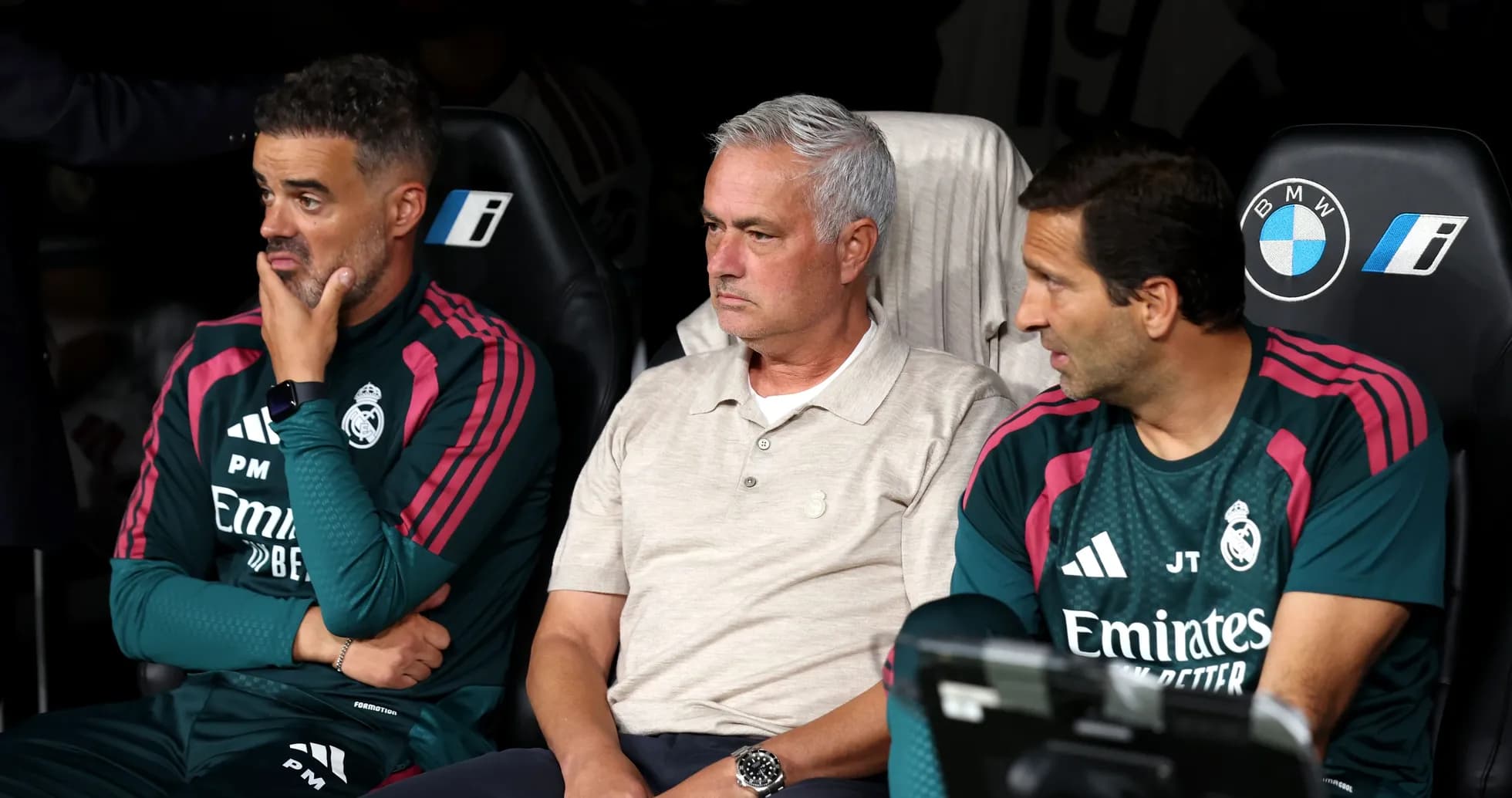
José Mourinho did not wait for a crisis to start building his new Real Madrid defence. He started in the 35th minute.
Up to then, Real Sociedad had barely laid a glove on Thibaut Courtois. The Belgian had dealt with Mikel Oyarzabal’s early effort in the tenth minute and then settled into a quiet afternoon at the Santiago Bernabeu. One swing of Sergio Gomez’s boot changed the mood. His powerful strike whistled close, and Mourinho snapped.
He demanded more focus from his back line, then turned to his bench and his long-time fitness lieutenant Antonio Pintus. Five players immediately broke into a warm-up: Cucurella, Camavinga, Brahim Diaz, Trent Alexander-Arnold and Asensio. No guessing games, no mystery.
“I always do that in the 35th minute. I like everyone to be inside during the break, because there are instructions for everyone,” Mourinho explained. It was routine for him, but it doubled as a warning: no one in this defence is safe yet.
A new back four takes shape
The match went into half-time level at 1-1, but the real shift came when the teams re-emerged. Cucurella replaced Alvaro Carreras, making his first appearance as a Real Madrid player at the Bernabeu. One change, big consequences.
Suddenly, the back four looked like a blueprint.
On the flanks, Dumfries on the right and Cucurella on the left. Inside them, Konate as the right-sided centre-back and Huijsen, signed last season, on the left. Three of the four were summer recruits; the fourth is still barely established. This was not a patchwork solution. It was a statement.
Mourinho was blunt about the trigger for the substitution: “The change of Carreras was because of the yellow card,” he said, referring to the booking the full-back picked up in the tenth minute for a challenge on Kubo. But the outcome went far beyond simple damage limitation.
Inside the club, the technical staff see this as the defensive line for the decisive stretch of the season. The idea is continuity, not rotation. At most, Rudiger will be the man to step in for Konate or Huijsen until Militao is fit enough to reclaim his place.
Dumfries over Trent, Cucurella to the fore
On the right, Dumfries has already shifted the hierarchy. Accustomed to operating in a five-man defence, he has adapted quickly and has moved ahead of Trent Alexander-Arnold as Mourinho’s first-choice right-back. On the opposite side, Cucurella offers the same aggression.
With those two pushing high, Madrid’s defensive line steps up. The team squeezes the pitch, defends 15–20 metres further forward, and the whole structure changes. Full-backs press, centre-backs hold their ground, and the midfield and forwards are liberated to hunt the ball in advanced areas in the way Mourinho demands.
The numbers back up the eye test. Opta recorded Dumfries as fifth for passes in the final third with 15. Only Guler (25) and Mbappe (22) finished clearly ahead, with Valverde level on 15 and Bernardo on 17. For a right-back in a supposedly conservative Mourinho system, that is significant volume in dangerous zones.
Konate imposed himself without fanfare. He led the tackling count with two successful challenges, matched only by Cucurella. Huijsen, meanwhile, turned the ball into a metronome. He completed 69 of his 72 passes, a 95.8% success rate that made him the most accurate player on the pitch.
Carreras, despite losing his place at the break, had not failed defensively. He recovered four balls, level with Huijsen, and helped set the tone in the opening exchanges. Across the 90 minutes, Madrid’s back line recovered 15 balls, seven of them in Real Sociedad’s half. That is Mourinho football with the volume turned up: defend by suffocating the opponent far from your own box.
Chasing Mourinho’s old standard
On paper, Real Madrid allowed only three shots on Courtois’s goal, matching the figure they conceded against Espanyol. For many coaches, that would be close to perfection. For Mourinho, it is still a touch high.
His benchmark is brutal. In the 2010–2011 season, one of the most defensively disciplined campaigns of his career, his team kept 30 clean sheets in 59 matches. Sixteen in 38 La Liga games, eight in 12 in the UEFA Champions League, six in nine in the Copa del Rey. More than half of all fixtures ended with the opposition shut out.
That is the standard he is chasing again. This new back four is not there yet, but the structure is clear and the roles are defined. Dumfries and Cucurella are tasked with dragging the line up the pitch. Konate and Huijsen must marry composure with aggression. The collective aim is simple: fewer shots, more control, and clean sheets that feel inevitable, not hard-earned.
The road ahead
Time is now their ally. Over the coming weeks, before the international break interrupts the rhythm, this unit will be tested and hardened. Malaga, Betis and the Champions League opener lie in wait, followed by Rayo and Elche.
Then comes the real examination: the derby against Atletico at the Metropolitano.
By that night, we will know whether this back four is just Mourinho’s latest experiment, or the foundation of another ruthless, season-defining defence.