.svg&w=384&q=75 "logo")
Monza: The Temple of Speed's Legacy of Triumph and Tragedy
The story of Formula 1 can be told through many circuits, but nowhere does the sport feel more exposed, more raw, than at Monza. The “Temple of Speed” has seen titles sealed, legends born, and lives lost – sometimes in the space of a single afternoon.
The First Crown at Home
It begins in 1950, in black-and-white grain and cigarette smoke. The Italian Grand Prix closes out Formula 1’s inaugural season, and Giuseppe Farina, in an Alfa Romeo, delivers history with a flourish. He wins the race and with it the first world championship, the only driver ever to clinch the title on home soil.
The scene is simple: an Italian in an Italian car, crowned in front of an Italian crowd. Formula 1, still in its infancy, already understands theatre.
Three years later, the cast has changed but the stage is the same. On the grid in 1953 stand Giuseppe Farina in a Ferrari, Juan Manuel Fangio in a Maserati and Alberto Ascari in another Ferrari, three men who will carve up the first eight world titles between them. Fangio wins the race, but Ascari leaves with the championship. Even then, Monza knew how to separate the glory of a single Sunday from the cold arithmetic of a season.
Banking, Bravery and Shared Cars
By 1956, the famous banking looms large over the circuit and over the photographs. Juan Manuel Fangio, Stirling Moss and Peter Collins sweep along the steep concrete curves, cars dancing on the edge of adhesion and nerve.
Maserati’s Moss wins that day, but the story sits behind him. Fangio and Collins, both Ferrari drivers, share second place after Collins hands over his car to the Argentine. It is a gesture from another era, one that helps Fangio secure the fourth of his five world titles. Monza rewards speed, but it also remembers sacrifice.
The banking would remain in use until 1961. The scars it left on the sport never really faded.
Triumph and Tragedy Collide
In 1961, the cost of that speed becomes brutally clear. Ferrari’s Wolfgang von Trips arrives at Monza on the brink of a world championship. He never leaves.
On the second lap, von Trips collides with Jim Clark’s Lotus. His car flies into a crowd on an embankment. Fourteen spectators die alongside the German. The photograph of von Trips before the race carries a weight it did not have when the shutter clicked. At Monza, the line between destiny and disaster has always been thin.
Six years later, the lens finds a different kind of family moment. Lotus driver Graham Hill stands in the pits before the 1967 race, adjusting his helmet and visor. Around him, his wife Bette and their children, including a six-year-old Damon Hill, cluster close. It is a quiet, domestic scene set against the roar of engines – and a reminder that behind every visor there are people who wait and worry.
Slipstreams and Photo Finishes
Before the chicanes arrived, Monza was pure slipstreaming warfare. Long straights, minimal downforce, and constant position changes. In 1969, that chaos produces one of the great finishes.
Jackie Stewart, in a Matra, crosses the line first. Jochen Rindt’s Lotus, Jean-Pierre Beltoise’s Matra and Bruce McLaren in his own car trail in his wake – but only just. The top four are split by less than two tenths of a second. At Monza, the stopwatch often needs a second look.
A year later, the atmosphere turns sombre again. Nina Rindt sits in the pits in 1970, timekeeping for her husband Jochen during practice. Not long after the photo is taken, the Austrian is killed on the approach to Parabolica, almost certainly because of a suspension failure on his Lotus. Weeks later, Rindt becomes Formula 1’s only posthumous world champion. The title he had all but secured is awarded to a man no longer there to receive it.
In 1971, the circuit delivers another astonishing finish. BRM’s Peter Gethin wins, but only by the width of a breath. Ronnie Peterson’s Lotus, Francois Cevert’s Tyrrell, Mike Hailwood in a Surtees and Howden Ganley’s BRM all cross the line within six tenths of a second. Five cars, one heartbeat. That is Monza at full volume.
Running, Scars and a Title Fight
Even away from the cockpit, competition spills onto the track. In 1973, team owner Frank Williams organises a race around the circuit for drivers and team members. James Hunt leads the pack visually, bare-chested bravado on display, but it is Williams himself who wins and pockets the £750 prize. At Monza, even the off-track antics carry an edge.
Three years later, the circuit hosts one of the most remarkable comebacks in sporting history. Niki Lauda, his face marked by the burns from his near-fatal crash at the 1976 German Grand Prix at the Nürburgring, returns to racing just six weeks after the accident. He climbs back into his Ferrari at Monza, still in significant pain, because the title fight with McLaren’s James Hunt demands it.
Lauda finishes fourth and extends his championship lead. In the end, he loses the title by a single point, but his drive at Monza stands as a statement of willpower that still resonates.
Two years on, the circuit delivers another dark chapter. At the start of the 1978 Italian Grand Prix, a multi-car accident erupts behind the leaders. Ronnie Peterson’s Lotus is left a wreck, the Swede trapped with serious leg injuries. Other drivers pull him free. The injuries do not initially appear life-threatening, yet delays in treatment prove fatal. Peterson dies the following morning from an embolism.
On the same day, his team-mate Mario Andretti secures the world title. His words afterward cut through the celebration: “Unfortunately, motor racing is also this.” Monza understands that better than most.
Ferrari’s Grief and Glory
By 1988, McLaren’s dominance looks absolute. The team wins every race of the season – except one. At Monza, with two laps to go, Ayrton Senna moves to lap Jean-Louis Schlesser, standing in for Nigel Mansell at Williams. Schlesser clips Senna and punts him off.
The error hands Ferrari a one-two, Gerhard Berger leading Michele Alboreto, and the tifosi explode. The victory comes just weeks after the death of team founder Enzo Ferrari. The joy on the pit wall is real, but so is the sense of something missing. Monza, again, mixes celebration with mourning.
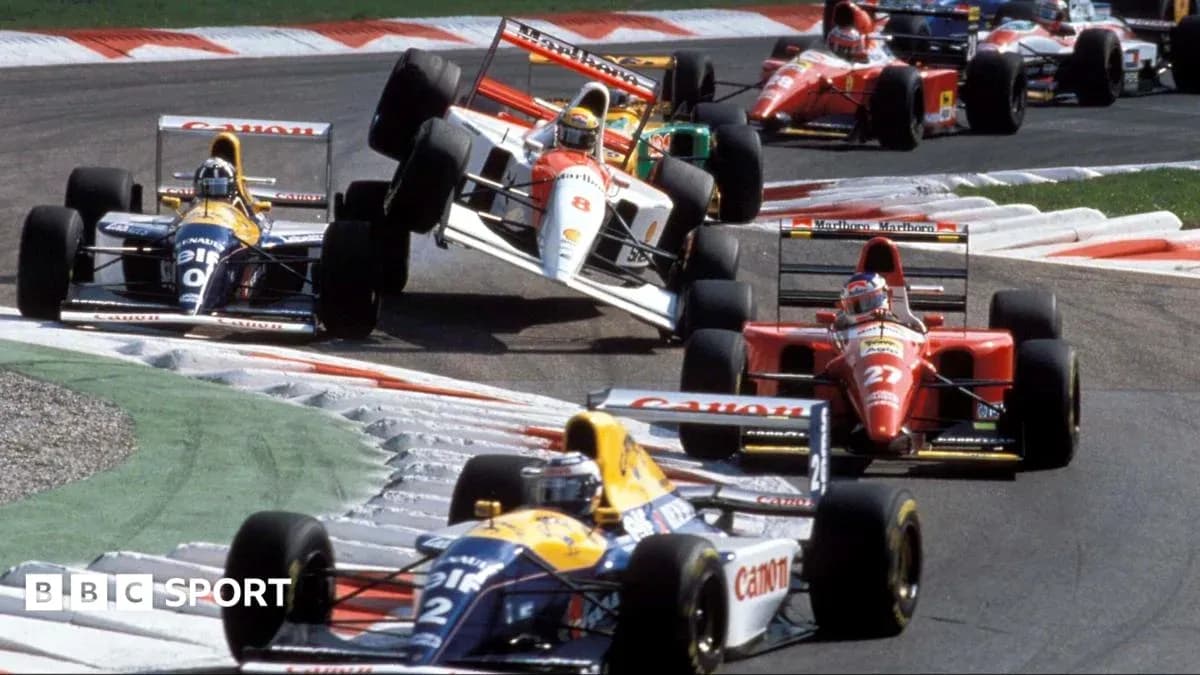
Five years later, the first chicane tells another Senna story. At the start of the 1993 race, the Brazilian tangles with a Williams once more, this time driven by Damon Hill. Both continue. Hill regroups, recovers, and wins. The same corner, the same driver, a different outcome – and a hint of the generational handover that will define the next decade.
On that same 1993 afternoon, Monza produces an image that still looks surreal. Christian Fittipaldi’s Minardi somersaults through the air after colliding with his team-mate Pierluigi Martini on the run to the line. The car flips upside down, rotates, then slams back onto its wheels, still sliding forward. Both drivers escape unhurt. Fittipaldi’s momentum carries him across the finish line in eighth, one place behind Martini. Only at Monza does a car crossing the line upside down feel almost in character.
Tears, Titles and Tifosi
The late 1990s bring a different kind of drama. In 1999, Mika Hakkinen spins out of the lead and out of the race. He walks away from his McLaren and breaks down in tears, convinced he has thrown away the championship. The vulnerability of a double world champion, exposed on the grass at Monza, becomes one of the enduring images of that season. Yet he regroups and ultimately beats Ferrari’s Eddie Irvine to the title. Monza bruises, but it also hardens resolve.
A year later, the circuit belongs to Ferrari. Michael Schumacher wins the 2000 Italian Grand Prix, and the tifosi flood the start-finish straight in a red tide of flags and flares. The victory proves pivotal on his path to the first of five consecutive drivers’ titles with the team. For Ferrari fans, Monza is not just another race; it is the annual pilgrimage. In 2000, their faith is rewarded.
Chaos, Contact and the Halo
As modern Formula 1 evolves, the first chicane at Monza becomes a magnet for chaos. In 2011, the opening seconds of the race look like a demolition derby, cars facing all directions as drivers jostle for position and run out of road. The speed, the bottleneck, the refusal to yield – Monza compresses everything into that first braking zone.
In 2021, that same stretch of tarmac becomes the centre of a title fight that grips the sport. Max Verstappen and Lewis Hamilton, locked in a ferocious battle for the championship, collide at the first chicane. Verstappen’s Red Bull rides up over Hamilton’s Mercedes, the rear of the car landing on the Briton’s cockpit. The halo head protection device takes the impact that might otherwise have struck Hamilton’s helmet.
The image is stark: a championship contender’s car perched on top of another, the halo bearing the scars. Safety has moved on since von Trips and Peterson, but Monza still tests the limits.
From Farina’s first crown in 1950 to the halo’s quiet heroism in 2021, Monza has remained the sport’s most honest mirror. It amplifies speed, exposes weakness, and never forgets its past. The question, as every new generation arrives at the Temple of Speed, is always the same: who will it bless next – and what will it take from them in return?