.svg&w=384&q=75 "logo")
Marseille and Bilbao: A Summer of Inactivity in Football
Olympique de Marseille and Athletic Bilbao reached the end of the summer window in a place no modern club wants to be: utterly alone.
Across Europe’s top five leagues, only two teams failed to register a single incoming player — no permanent deals, no loans, no options triggered at the last minute. Nothing. In a market defined by churn and constant movement, Marseille and Athletic stood still.
On the surface, the statistic lumps them together. The reality pulls them apart.
Bilbao’s choice, Marseille’s constraint
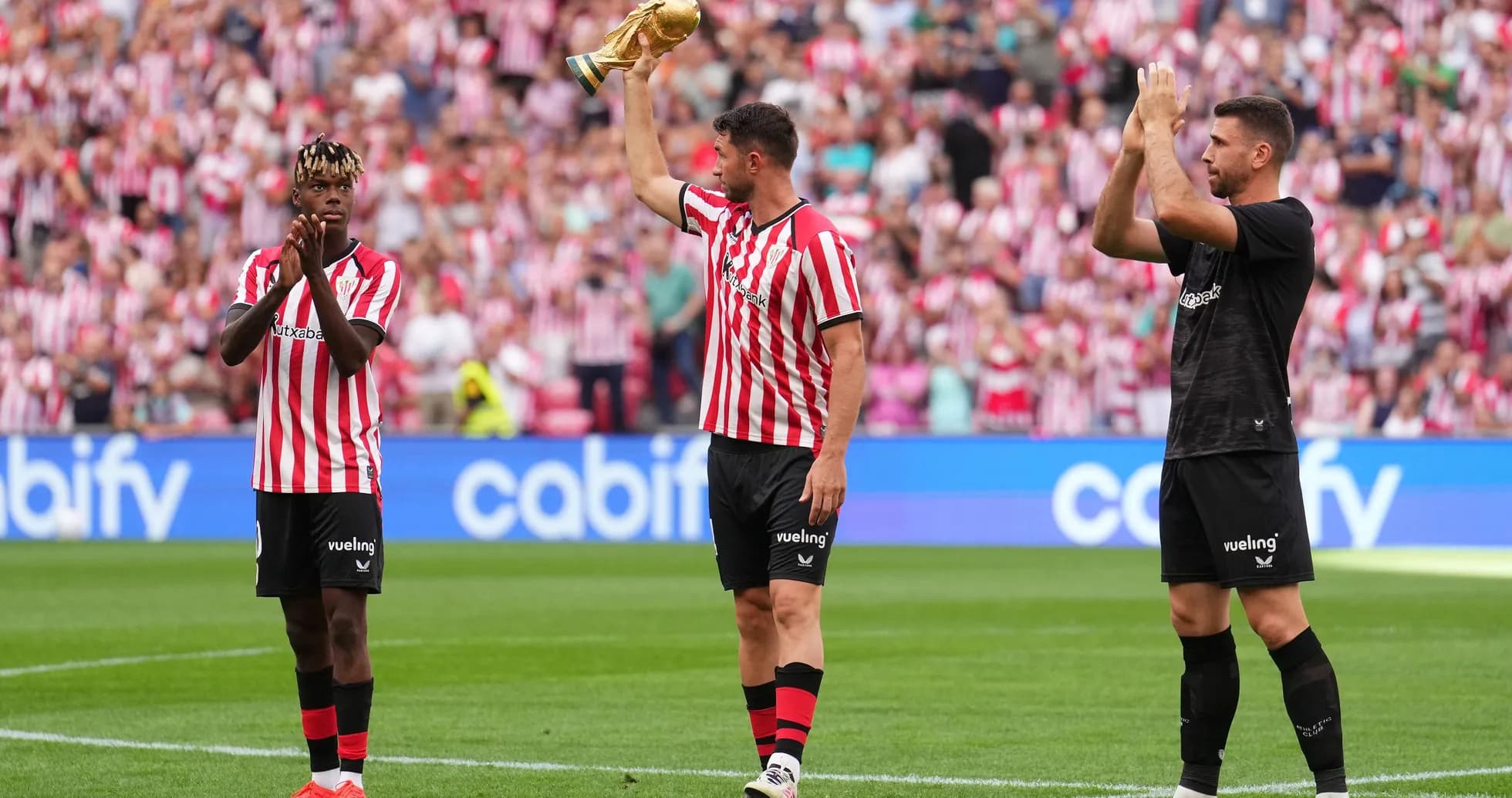
At San Mamés, silence in the market is almost a badge of honour. Athletic Bilbao’s inactivity fits a century-old identity: build from within, trust the Basque talent pipeline, lean on the academy and the region’s footballing culture. Their lack of signings is not a shock. It is policy.
In Marseille, the same outcome tells a very different story.
Here, the quiet window does not reflect a romantic philosophy but a financial squeeze. Severe constraints have gripped the Ligue 1 club all summer, stripping them of room to manoeuvre. Where other sides reshaped squads, Marseille watched the door swing one way.
Players left. Nobody came in.
A squad stripped back
The list of departures reads like a slow unravelling of a European contender.
- Mason Greenwood left for Fenerbahce.
- Facundo Medina went to Leverkusen.
- Quinten Timber headed to Crystal Palace.
- Geronimo Rulli moved to Manchester City.
- Pierre-Emerick Aubameyang departed for La Coruna.
- Leonardo Balerdi joined Roma.
- Bilal Nadir and Hamed Traore also exited.
Each move chipped away at depth, experience, or potential. Taken together, they have carved a hole straight through the spine of the squad.
This was not a summer of fine-tuning. It was a summer of subtraction.
An uphill season
The consequences are stark. Domestically, Marseille now stare at a Ligue 1 campaign where rivals have rearmed while they have thinned out. In Europe, where rotation and resilience decide seasons, a depleted group will be asked to survive a schedule that punishes any weakness.
There is no cavalry coming in January guaranteed, no marquee signing waiting in the wings. The solutions must come from inside the club.
Coaches and recruitment staff are left to mine every inch of the existing roster. Youth prospects, previously eased in, may be thrust into prominent roles. Established players will be stretched across multiple competitions, their durability tested from week to week.
The pressure will not just fall on the touchline or the boardroom. It will land in the dressing room, where those who stayed must carry the weight of those who left.
A test of identity in Marseille
For Athletic Bilbao, this kind of challenge is familiar. They have lived with self-imposed limits for generations and built an identity around them.
For Marseille, this is different. A club accustomed to noise, ambition, and big-name arrivals suddenly finds itself quiet, stripped back, and exposed. The financial reality has forced them into a position that looks like principle from the outside but feels like necessity on the inside.
Now comes the real question of the season: can this squad, untouched by the transfer market and weakened by exits, stand up to the demands of France and Europe, or will this window be remembered as the summer that broke Marseille’s momentum?