.svg&w=384&q=75 "logo")
Liverpool's Tactical Evolution Under New Coach
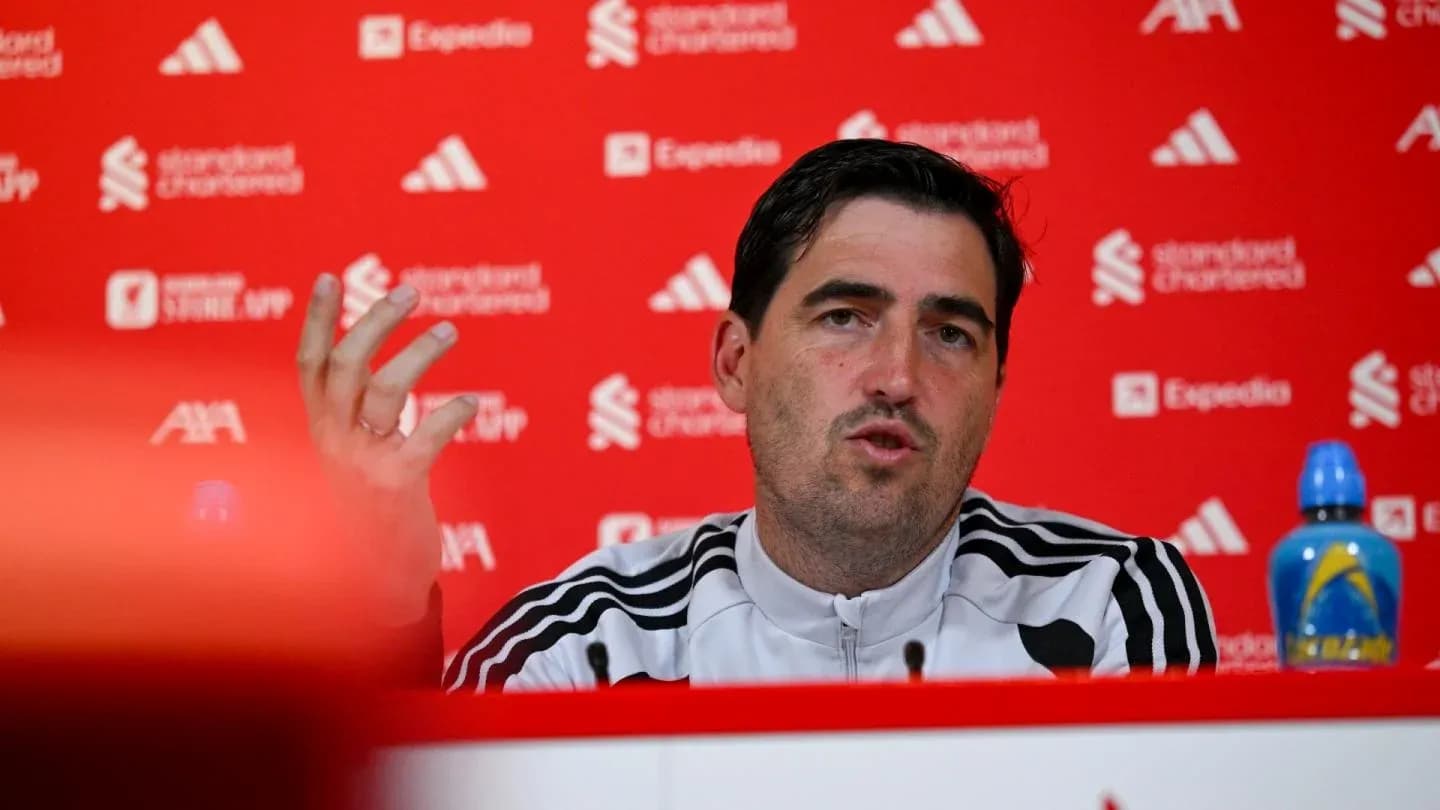
At the AXA Training Centre, on the eve of his first Premier League game at Anfield, Liverpool’s head coach cut a calm but unmistakably driven figure. The questions circled around the same themes – width, balance, control, transfers – and each answer revealed a manager trying to weld a new identity onto an old fortress.
Wingers wanted – and needed
He did not bother to disguise the obvious. Liverpool are short out wide and the club are working to fix it.
“As you know, we are trying to sign in that position,” he said, drawing a firm line at naming targets. “It’s evident that we are trying to improve or try to fill that position because we don’t have the numbers. I hope we can have good news soon but we are still not there.”
No drama, no public pressure on the hierarchy, just a clear admission of need. The plan is drawn. The deals, for now, are not.
Walking the tightrope between attack and defence
The conversation quickly moved to something more tactical and more immediate: the balance between Liverpool’s aggressive attacking play and the vulnerability that comes with it.
“Yeah, that’s the key – the balance,” he admitted. Liverpool’s fluid, number-heavy attacks are non-negotiable in his mind, but the first goal conceded “the other day” still stings. “We were punished… I think we don’t do a proper lockdown.”
This is not a sudden revelation born from one game. “It’s nothing new, like we’ve started this week. It’s something that we always want to control.”
He doesn’t want a team that suddenly swings from one extreme to the other – all-out attack one week, frozen and conservative the next. The nuance lies with the players.
“You cannot be with the joystick every time with the player,” he said, summing up the reality of modern coaching in one line. He wants footballers who can smell danger, who know when to go and when to stay, who can read a game in real time rather than wait for orders from the touchline. That, he insists, is also a quality – not of the system, but of the individual.
Transfer window: patience, then clarity
Four or five days. That is the timeframe he gave himself and everyone else.
“I don’t know what’s going to happen,” he said of the final stretch of the transfer window. “We have to be patient – even myself – for another four or five days and then we will know.”
His focus is on clarity rather than speculation. “I will be comfortable the first of September, or the second in this case, when they tell me, ‘OK, this is who we are, this is the options we have.’ And then we can really start thinking… But right now we don’t know.”
Inside his head, the squad is already shaped. Positions are identified, profiles agreed. “We’ve been talking not now but since the beginning with the club and they all know also what we want, and then it’s a matter of closing the deals.”
Until then, he works with what he has – and waits.
Anfield awaits
If he tried to play it down, it would not sound believable. The first Premier League game at Anfield as Liverpool head coach is different. He knows it. Everyone knows it.
“It’s definitely a special moment for me,” he said. Pre-season gave him a taste, but this is the real thing. The emotion, he feels, is not a distraction but a necessary part of the occasion.
“I’ve had to fight a lot to arrive to this place,” he reflected. On the day, his head will be full of structure, details, match scenarios. But he is not pretending the walk out, the noise, the sight of the Kop will pass him by. “I hope everything goes well and I can enjoy also the game.”
Reading Forest and respecting Glasner
Across the halfway line on matchday will be a coach he knows well. Oliver Glasner’s Nottingham Forest are already leaving a clear imprint on the league.
“I think he has been very successful,” the Liverpool boss said. Their meetings in England have given him a close-up view of Glasner’s work. “You can see straight away the shape, they don’t concede a lot of chances.”
He pointed to Forest’s narrow defeat to Leeds in the Premier League – decided by a 90th-minute free-kick – as a warning. “It was a very tight game, not a lot of chances and Leeds won because they scored a free-kick in the 90th minute. But probably Forest even had more chances than Leeds until that moment.”
Nothing will be handed to Liverpool at Anfield, he insisted. “We will have to earn every chance. They don’t give you for free.”
Patience on the ball, precision in possession, and vigilance on the break will be crucial. “They defensively are very solid… And after they have also very good players up front – like every Premier League team – and we have to control those situations, especially in the transitions because they also have good threats in the counter.”
Midfield freedom, with a line in the sand
The midfield, always the heartbeat of any Liverpool side, sits at the centre of his balancing act. He refuses to shackle his most adventurous players just to avoid the risk of a turnover.
“Obviously we cannot attack with everyone and then leave everyone at the back, but also there is a balance there,” he said. Ryan Gravenberch is the perfect example. “I don’t want to tell Ryan Gravenberch, ‘Don’t carry the ball and don’t arrive to the box.’”
He recalled a goal against Monaco: a slick one-two between Gravenberch and Dominik Szoboszlai, then the pass to Alex Isak to finish. Nobody questioned the structure then. “No-one asked me, ‘Why are you leaving Ryan Gravenberch and Szoboszlai there on the edge of the box both together?’ No, they said, ‘Incredible goal, lovely goal.’”
That’s the trade-off. To create those moments, he must accept a certain level of risk. The job now is to teach the team how to manage that risk collectively.
“Sometimes you have to accept it,” he said. He does not want players paralysed by fear of leaving a gap. Full-backs, midfielders, everyone must read the opposition’s position and intent. “Depending on the situation and depending on where is your opposition… If your opposition is also very low, we have the numbers at the back, then it’s probably safer to go. If they are kind of leaving players in behind, we have to be careful.”
Recognising those situations, he stressed, is the work in progress.
Control, and the illusion of it
The 2-2 draw with Newcastle has been used as a stick to beat Liverpool’s control with, but the head coach’s view is more nuanced.
“I felt we controlled the game, honestly, quite well the other day,” he said. Two transitions, two concessions – and with them, the narrative. “Obviously you concede two transitions and you can tell me, ‘No, but you conceded…’ and it’s true.”
Yet he saw something else in the performance. “I think we had a meaningful possession.” This was not sterile ball-hogging. “I felt like we were quite direct in our attack, we stayed most of our game very far.”
From the dugout, his sense was clear: “I was always feeling we are closer to scoring than Newcastle are in most parts of the game.” The scoreline, of course, cannot be rewritten. “It’s true that you don’t win, you draw 2-2 and you cannot change this, but I felt we did a lot of good things in the first game.”
The task now is to keep that attacking edge while cutting out the cheap transitions that flip control into chaos.
Jacquet’s baptism and the price of youth
Among the more encouraging notes from that opening game was the Premier League debut of Jeremy Jacquet. Thrown in with barely 45 minutes of pre-season in his legs, the young centre-back did not look out of place.
“I think overall he played very well, considering it’s his first game and also basically 45 minutes of pre-season,” his manager said. Fatigue eventually forced the change. “It’s true that he finished tired; we had to sub him because I was feeling the last five minutes on the pitch he was tired. You can feel it, especially with centre-backs.”
What mattered most was how Jacquet handled the ball and the occasion. “He’s been very confident on the ball, good without the ball and he’s very young, a new signing.”
There will be errors. That is non-negotiable with a player at his stage. “For sure he will make some mistakes, we have to accept this,” the coach added. The important thing, in his eyes, is that the defender is “performing and training very well.”
Anfield will judge quickly. The head coach, by contrast, is planning for the long haul – with a squad still being built, a style still being sharpened, and a first league outing at home that will say a lot about how ready Liverpool really are for what’s coming.