.svg&w=384&q=75 "logo")
Lewis Hamilton's Ferrari F40: A Dream Restored
There are fast cars, beautiful cars, even legendary cars. Then there are the ones that reach straight for the heart.
For Lewis Hamilton, that has always been the Ferrari F40.
Long before seven world titles, long before the move that finally took him to Maranello, the F40 was the shape and sound of the dream. It was the poster on the wall, the howl on old VHS tapes, the scarlet missile that summed up everything Ferrari meant to a kid who wanted to be a racing driver.
Years later, that dream would take a very specific form: a 1991 Ferrari F40 with a story almost too rare to believe.
A time capsule on four wheels
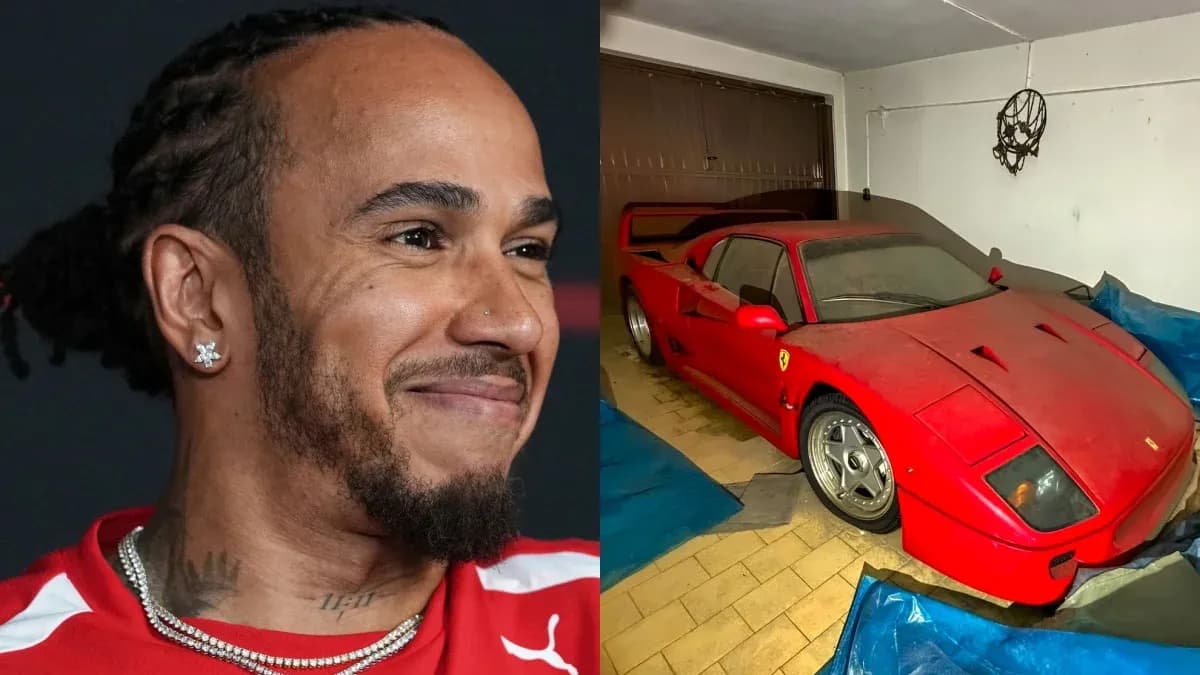
The car that eventually became Hamilton’s was more museum piece than used supercar. Tracked down in late 2025 by Azimut Automobile Heritage Enhancement, an investment fund that specialises in historically significant machines, it had lived a life of near-total stillness.
Delivered new, rolled into a private garage within days, and then left there.
For around 35 years.
It showed delivery mileage. The panels had never been taken off. No restoration, no modifications, no tinkering. According to those who inspected it, not even a single screw had been turned. Dust, dirt and the detritus of decades clung to its bodywork and grille, but beneath that layer of neglect, the car remained remarkably untouched. The original red paint still held its depth and sheen, preserved by the unusually kind storage conditions.
Azimut AHE secured the F40 first. Eventually, it found its way to Hamilton – the boyhood dream now parked in the garage of a seven-time champion.
The one car he wouldn’t let go
When Hamilton arrived for his first official day as a Ferrari driver in January 2025, he made sure the symbolism was impossible to miss. Beside him in the photo that announced his Ferrari era sat an F40, the car that had always meant Ferrari to him.
Months later, he made headlines of a different kind. Hamilton revealed he had sold off his multimillion-dollar car collection, explaining that his passion had shifted towards art. One machine, though, escaped the cull.
The F40 stayed.
He regarded it as art itself – a sculpture that just happened to breathe fire and fuel.
Back to Maranello, back to life
Owning a time capsule is one thing. Driving it is another.
Hamilton sent the car back to Maranello, home of the Prancing Horse, and entrusted it to Ferrari’s own engineers and mechanics. Their task was delicate: wake the car up without erasing what made it unique.
They removed major components, including the engine, and spent weeks going through the car piece by piece. The goal was not to make it “better” in the modern sense, but to make it safe and usable while preserving its originality – the untouched bolts, the factory finish, the authenticity that collectors obsess over.
Slowly, the F40 emerged from its long sleep.
A red flash through Maranello
Now the car is no longer a secret. It has been seen out on the streets of Maranello, Hamilton in the driver’s seat, the most recognisable racing driver of his generation guiding perhaps the most recognisable supercar silhouette of its era.
On a narrow two-way road, the scene is almost understated. Hamilton eases the car along, mindful of the traffic and the limits of the setting. A motorcyclist pulls alongside, offers a quick greeting. Hamilton answers, then rolls on.
People begin to notice.
Phones come out. Heads turn. The red wedge, the vast rear wing, the angry rasp of the twin-turbo V8 – even at low speed, the F40 dominates its surroundings. Hamilton cannot unleash its enormous performance on those cramped streets, but he doesn’t need to. The sound and shape alone do the work.
The car that once slept in silence for decades now steals every scrap of attention in Maranello.
The last Ferrari of Enzo’s time
The F40 carries a weight that goes beyond nostalgia and poster appeal. Introduced in 1987 to mark Ferrari’s 40th anniversary, it became the final road car approved during Enzo Ferrari’s lifetime, the last word from the man who built the myth.
Under its lightweight body sits a 2.9-liter twin-turbocharged V8, sending 478 horsepower through a five-speed manual gearbox. In its day, Ferrari claimed a top speed of 201 mph – a brutal, analogue figure that still commands respect in an age of hybrid hypercars and electronic driver aids.
Now, that same car – once abandoned to the quiet of a private garage – lives again in the hands of a driver who grew up worshipping it and now races in red for the team that created it.
For Hamilton, the F40 is no longer just a dream or a poster. It’s the most personal piece of his Ferrari story, roaring through the very streets where that story is still being written.