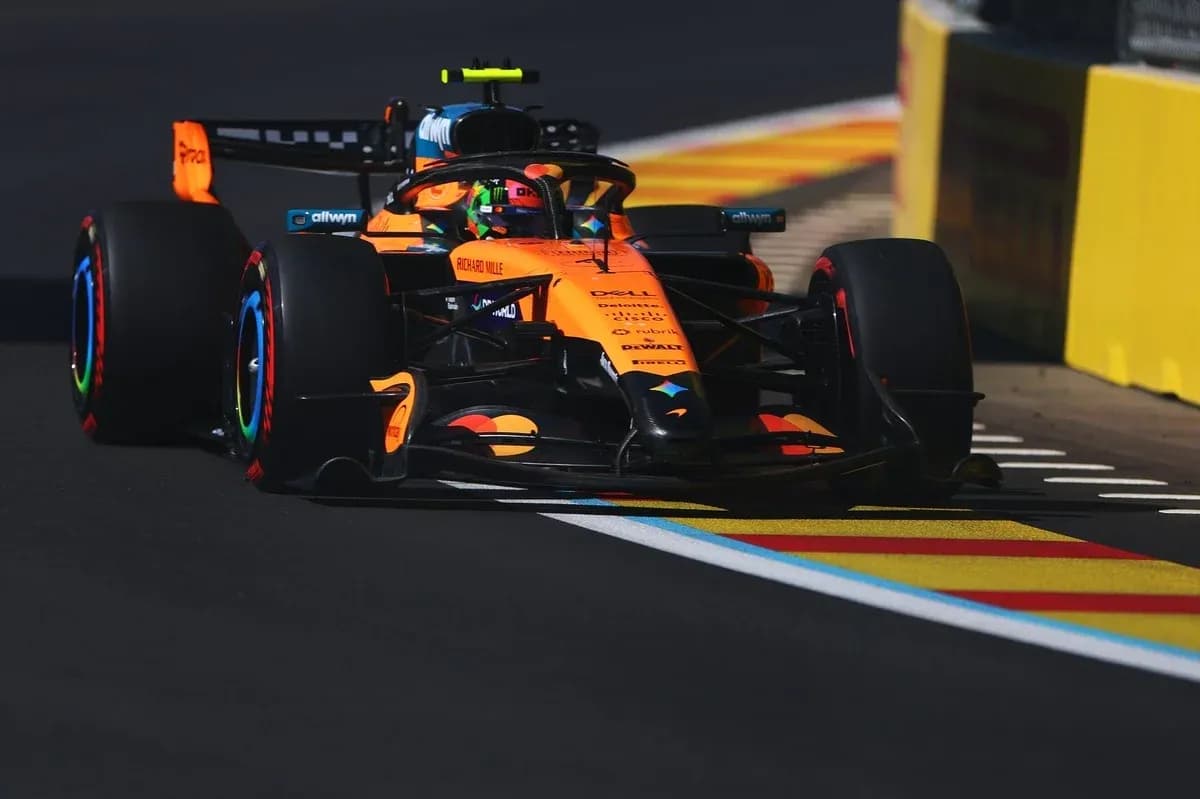
Lando Norris Takes Unexpected Pole Position in Stunning Q3 Performance
Lando Norris climbed out of the McLaren still half-convinced he’d blown it.
“Sorry, I fucked up man,” he told his race engineer Will Joseph over the radio, convinced that a wild snap of oversteer at the final corner had wrecked his shot. Joseph told him to wait. Norris called himself a “fucking idiot.”
Seconds later, the timing screens told a different story.
Pole position. By 0.011s. Torn from Kimi Antonelli’s grasp at the very last breath of Q3. A lap Andrea Stella would call “a masterpiece” and “one of the most impressive laps” he has seen in 450 grands prix of poring over telemetry.
A pole that came from nowhere
Nothing in the weekend’s build-up hinted at this.
Mercedes owned the practice sessions, Ferrari lurked just behind, and Red Bull still looked a threat when it mattered. In Q1 and Q2, the Silver Arrows were trading blows with Red Bull at the top. McLaren? Always a couple of tenths back, always a touch blunt in the first sector.
Stella was blunt too: “We were not honestly performing to the level of scoring a pole position. At no stage during the weekend we demonstrated that the car was performing at the level of being the best car.”
The numbers backed him up. McLaren struggled in low-speed corners, over kerbs, and in that fiddly first sector where confidence and compliance matter more than raw power. The car was quick in spells, but never complete. Oscar Piastri’s qualifying told the story: seventh on the grid, 0.470s down on his team-mate.
McLaren looked like solid second-row material at best.
Then came that final run.
The lap that broke the weekend’s logic
After his first Q3 attempt, Norris sat sixth, 0.446s off Lewis Hamilton’s benchmark. Nothing about that suggested pole. He needed something outrageous.
He found it.
On his second run, Norris improved by 0.701s. That kind of leap at this level is not normal. It’s the sort of gain that usually means someone backed out on the first lap or caught traffic. This time, it meant a driver threading the needle of risk and grip, corner by corner, with almost absurd precision.
“The lap really was just perfect,” Norris said later. “From good exits, good kerbs, just getting all the little things that are very important around here correct. And I did that only on my last lap and it all worked out.”
Stella, who has watched four and a half hundred grands prix worth of data scroll across his screens, sounded almost stunned by what he’d seen.
“The thing that makes the lap unique, when you look especially at the telemetry, is the precision, the braking, the speed you carry in entry, the striking of the kerb, the going on power. Everything is executed with a pretty unique level of precision.”
Perfection with a scar at the end
This was not a flawless, on-rails pole lap. It had a scar.
By the time Norris hurled the car at the final corner, the lap was “coming, like, one second faster than any other lap,” as Stella put it. The tyres were cooked. Norris drove as if they weren’t.
“By the last corner, I just had a bit of a, I don’t know, a little moment,” Norris admitted. “I think I got a bit excited in the car and I just overpushed the entry and, honestly, I thought I was in the wall.”
On the data, Stella saw exactly what happened.
“He oversteered in entry, and this means that he loses completely the racing line, and like I said, he lost more than three tenths,” the McLaren boss explained. “He just paid the price of the fact that the lap was coming, like, one second faster than any other lap, therefore there was quite a lot more that was extracted from the tyres.
The tyres were tired and somehow Lando did not take this into account and he entered the corner with the same impetus that he had in some other corners.”
It wasn’t some clever, calculated trade-off. It was a driver in full attack mode, blind to the limit until he crashed into it.
“I don't think he knew [he was going to be in trouble],” Stella said. “I think he just was in attacking mode, but it was a bit too much for what the tyres had left.”
And still, even with that mistake, even with more than three tenths thrown away in the final sector, the lap was good enough for pole. Stella reckoned that without the error, it would have been a “pretty convincing pole position.”
That’s the scale of what Norris produced: a pole lap that survived a major error and still beat a seemingly untouchable Antonelli by the thickness of a fingernail.
Precision under pressure
Strip away the radio drama and the self-criticism, and what remains is Stella’s central point: this was a lap of extraordinary control.
“The most impressive thing is the fact that it's a pole position despite having lost three-and-a-half tenths in the last quarter,” he said. “For me, that's if anything the main attribute that I would associate to this lap: just incredible precision in the metre-by-metre execution.”
Braking points nailed. Kerbs attacked but not abused. Power picked up at the exact moment the rear tyres would accept it. All of it in a car that had looked awkward and skittish in the very areas where time needed to be found.
Piastri’s deficit underlined just how narrow the window was. Same car, same conditions, same session – nearly half a second between them.
McLaren did not suddenly find a magic setup in the final minutes of Q3. Norris simply drove beyond what the weekend’s form suggested was possible.
From the cockpit, he thought he’d ruined it. On the timing screens, he’d painted his masterpiece.