Kendry Paez's Journey at Chelsea: From Prodigy to Academy Player
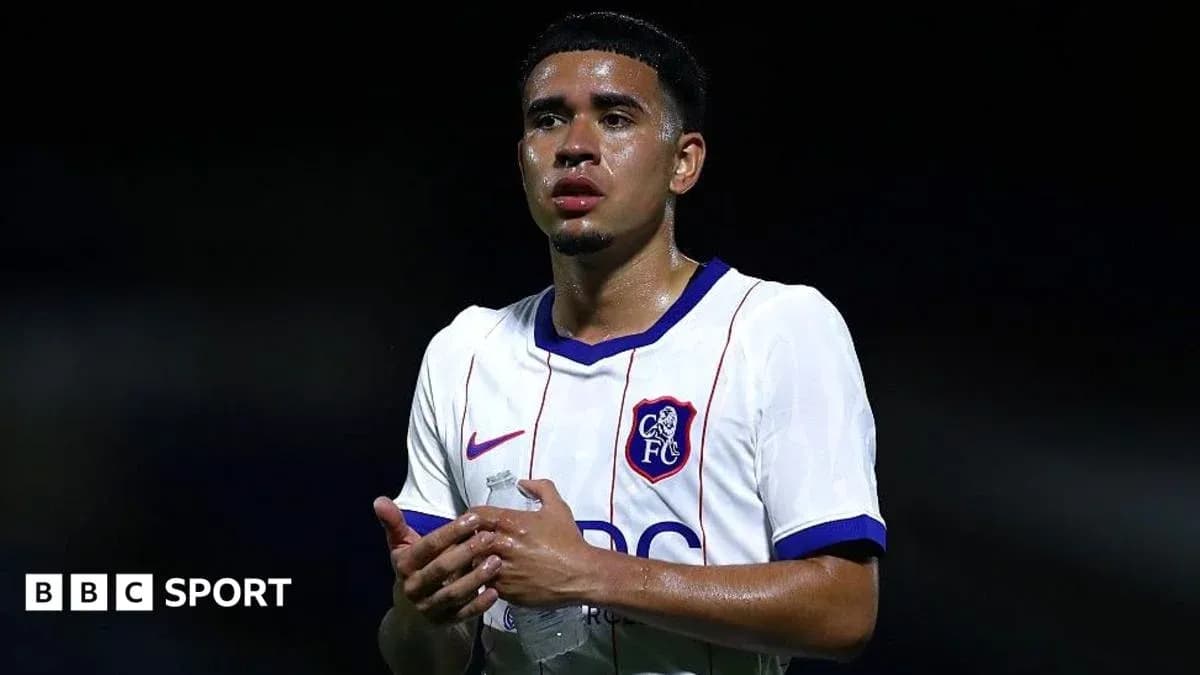
Kendry Paez finally pulled on a Chelsea shirt at the weekend. Not under the lights at Stamford Bridge, not to the roar of a full Shed End, but in front of a sparse crowd for Cobham Next Gen, the club’s rebranded Under-21s, away at Arsenal.
Twelve minutes into the game, the board went up. The Ecuadorian walked on. Three years after Chelsea agreed a £17.27m deal for a 16-year-old prodigy at Independiente del Valle, the long wait for his first appearance in blue – any blue – was over.
It felt symbolic. It also underlined just how complicated his journey has become.
From record-breaker to reality check
Paez did not arrive in Europe as a mystery. He arrived as a phenomenon.
At 15, he became the youngest debutant and goalscorer in Ecuadorian top-flight history. He stepped straight from that into the Copa Libertadores, South America’s answer to the Champions League, as if it were the most natural progression in the world.
International football came just as quickly. At 16 years and 131 days, he played his second game for Ecuador and became the second-youngest South American to feature in World Cup qualifying, behind only Diego Maradona. A month later, he scored in a 2-1 win away to Bolivia and rewrote another line in the record books as the youngest South American to net in a World Cup qualifier.
By the time Chelsea struck the agreement to bring him to London in 2023, he already had 18 caps and two international goals. Scouts talked about him as one of the continent’s great emerging attacking talents, bracketed with names like Estevao Willian. Chelsea moved aggressively. They were convinced.
They invited him to train regularly with the first team even before he was eligible to join officially after his 18th birthday. They went further than football. When violence erupted in Ecuador in early 2024, the club helped provide security for Paez, his family and the family of Moises Caicedo.
The message was clear: this was a player they intended to protect and build around.
Strasbourg, River Plate and a stalled rise
The early signs in Europe suggested the plan might work. Sent on loan to Strasbourg, Chelsea’s sister club, Paez won Ligue 1’s Young Player of the Month for September. The talent that had dazzled in Ecuador flickered again in France.
Then the mood changed.
As the season wore on, then-manager Liam Rosenior publicly demanded more from him. “We expect more, clearly,” Rosenior said. “I’m tired of using the excuse of the player’s youth.” It was a pointed line, and it stuck.
One goal in 21 appearances told its own story. The loan, despite the shared ownership between the clubs, was cut short. Paez moved again, this time to River Plate, one of the giants of Argentine football, on a two-year loan.
The reset never quite arrived. Sources in Argentina raised similar concerns about his attitude. They highlighted a flat display in the Superclasico, a 1-0 defeat to Boca Juniors at the Monumental in April, as a worrying snapshot. Shortly afterwards, club president Stefano Di Carlo listed Paez among 15 players training away from the first team. Some inside the club felt he had not been given enough chances. Others felt he had not done enough with the ones he got.
The numbers were modest: one goal in 14 appearances, 461 minutes in total. The loan ended by mutual consent.
Off the pitch, the picture blurred further. A few months after Chelsea had stepped in to support his family during Ecuador’s unrest, Paez was filmed in a New York strip club while away on international duty. For a teenager still trying to establish himself, the optics were damaging.
Ecuador’s hope, Chelsea’s puzzle
Back home, concern grew. Ecuador had elevated Paez as the next great attacking hope, a player to carry the shirt for a decade. He already has 27 caps and has appeared at this summer’s World Cup. The investment of faith has been huge.
Michel Deller, the owner of Independiente del Valle, spoke with the tone of a worried guardian when he addressed the situation.
“He’s like a son to us. We care about him deeply,” Deller told Hincha Amarillo. “He’s a good kid who’s had a tough time and has made decisions that have complicated his life. We are always hopeful he’ll show his exceptional talent once again but right now, it’s up to him to decide what to do with his life.”
Inside Chelsea and within Paez’s own circle, those concerns are not waved away. They are acknowledged. At the same time, there is a feeling the narrative around him has been exaggerated, that a teenager is being written off before he has even settled into adulthood. The argument is simple: he needs time – to grow as a player, and as a person.
Time, though, is not something elite clubs hand out easily.
New head coach Xabi Alonso has been blunt. Paez, he said, is “not in my plans”. On the club website, Chelsea now list him as an academy player. A loan in English football was explored, but Fifa rules blocked any move abroad after the club filled all six of their available international loan slots.
So, for now, the £17.27m prodigy is back where many careers quietly begin and end: the academy pitches at Cobham.
A flicker in front of 778 fans
At Wycombe in the EFL Trophy, the scene was a long way from the Libertadores and the Monumental. Just 778 people watched Cobham Next Gen lose, Paez again starting on the bench and again operating on the fringes when he came on as a right-sided No 10 in a system mirroring Alonso’s back three.
Yet in the dying moments, there was a flash of the player who once seemed to bend timelines to his will.
From a short corner, he whipped in an outswinging cross that Harrison Bettoni tapped in during added time. Seconds later, another cross from Paez sparked chaos in the Wycombe box as Chelsea chased an equaliser. The comeback never came, but the quality of his delivery stood out.
It mattered, not just for the scoreboard but for the player. Spanish-speaking and still adjusting, Paez had cut a slightly isolated figure before kick-off, standing apart from the other academy players for stretches, joining the warm-up but largely keeping to himself. Those late contributions offered a small but important jolt of confidence.
Three days later, he stepped onto the pitch against Arsenal’s Under-21s, this time earlier, this time in a 4-1 win. It was his first outing in Chelsea colours, and though it arrived far later – and at a far lower level – than anyone predicted back in 2023, it was a start.
A career still in the balance
For all the noise around him, Paez has already packed a lot into a short career. More than 70 appearances for Independiente del Valle. Over 100 senior matches in total. Records set in domestic football and World Cup qualifiers. A World Cup on his CV before his 20th birthday.
That experience is a safety net. It means this is not a story of a talent who never made it out of youth football. It is a story of a player who climbed quickly, perhaps too quickly, and is now trying to steady himself.
Chelsea, for their part, have been encouraged by his response since returning to Cobham. Back in a stable, elite environment, surrounded by family who attended the Wycombe game, he has trained well. The club can now track his progress daily rather than from afar. Scouts from across the English Football League and beyond regularly attend academy fixtures. Every cross, every touch, is a small audition.
The plan is clear enough. Impress over the coming months and a first loan in England could open up in January. Alternatively, if one of Chelsea’s six international loan slots becomes free, the club can test him again abroad.
For now, the hype has gone quiet. The headlines have softened. What remains is a 19-year-old with a left foot that still bends games, a past that has already veered off course, and a future that is very much undecided.
Chelsea once believed Kendry Paez was destined for big things. The question now is simpler, and sharper: what does he do with this second chance?