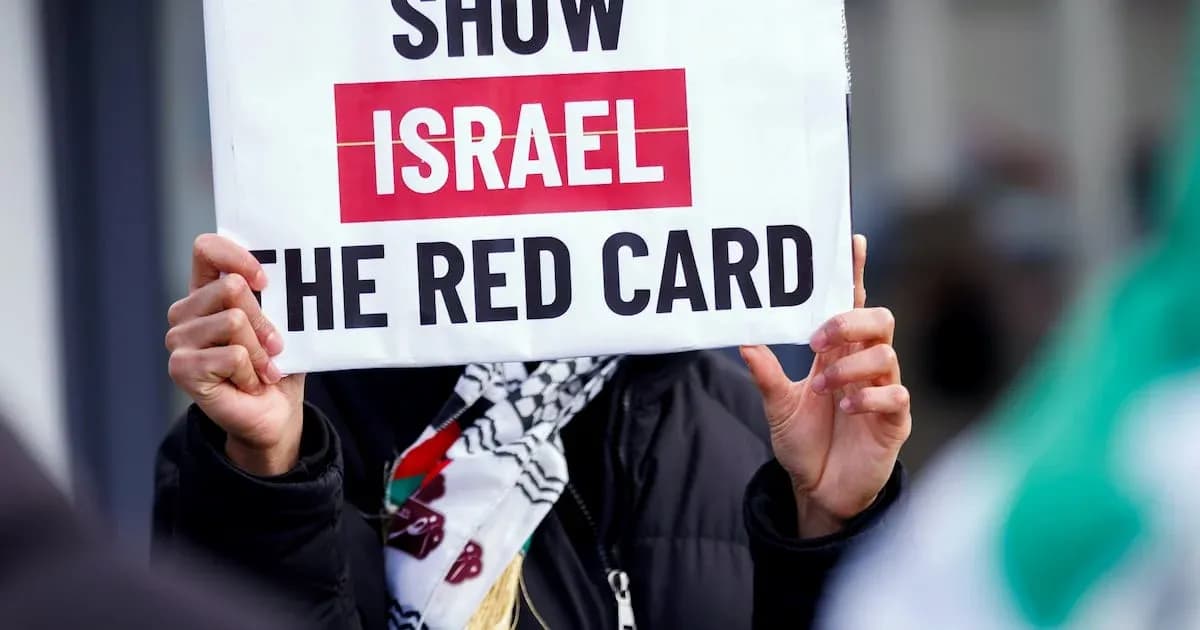
Ireland's Football Squad Faces Moral Dilemma Against Israel
The naming of an Ireland squad has rarely carried this kind of weight.
On Thursday, when Heimir Hallgrímsson reads out the list for the games against Israel, the usual debate about form, shape and omissions will feel strangely small. Every call-up is supposed to be an uncomplicated honour, the purest moment in a player’s career. This time, that pride collides with a question that should never have been dropped at their feet.
The Football Association of Ireland has chosen to play on. The burden of conscience now rests with the players.
A moral question, pushed down the line
The board’s stance has left each individual to decide whether to line out against a nation accused of committing genocide. That is an unreasonable place to leave any athlete. This is not a minor political gesture or a symbolic protest. Genocide is regarded as the gravest crime in international law. The idea that the response to it should be outsourced to a dressing room is astonishing.
The old line that “politics has no place in sport” collapses instantly here. Politics runs through everything: budgets, fixtures, sponsorships, who gets to host tournaments and who gets banned from them. Football does not float above the world; it reflects it.
This, though, is a different scale. The onslaught on Palestine has unfolded with open backing from western powers. That level of support for such devastation has no modern parallel. Some argue that the word “genocide” must wait for the slow turning of legal wheels. But the obligation to act does not. Decisions have to be made in real time, on the basis of what is already known and what is plainly visible.
On that evidence, the charge is clear enough for many: a deliberate, terrorising campaign that meets the threshold of genocide.
From principle to retreat
When institutions are confronted with something this serious, those in charge are supposed to do the hard work, inform themselves fully and then lead. If a nation is widely viewed as guilty of genocide, the default position should be blunt: no fixtures, no business as usual, no sense that anything about the relationship is normal. The idea of playing them should feel impossible.
Last November, the FAI board appeared to agree. It formally asked UEFA to ban Israel. That move carried a simple message: no team, no group of players, should be asked to fulfil a fixture against Israel while the State’s brutality continued. The association was applauded for that stance, for appearing to put principle ahead of qualification pathways, prize money or broadcast schedules.
That was then. The moment Ireland were drawn to face Israel, the principle was quietly shelved.
The decision cannot be viewed in isolation. It sits in a wider pattern. The Government’s long delays over the Occupied Territories Bill set a tone of hesitation and half-measures. Across Irish sport, ethical lines have blurred. The GAA’s refusal to sever commercial ties with Allianz has drawn fierce criticism. Yet it is Irish football’s choice to proceed with these matches that offers Israel something far more valuable than a sponsorship deal: the comfort of normalisation.
The games go ahead, and Israel gets to walk out as just another opponent.
The cost of looking away
The implications run far beyond two dates on a fixture list. Once the ball is kicked on September 27th and October 4th, the scorelines become almost irrelevant. The act of playing is the statement. In that sense, there is only one winner, and it is not Ireland.
Protesters have pushed, argued, marched. They have not shifted the board. The FAI’s position stands. Israel benefits.
The Government cannot claim clean hands either. Its broader response to the war has fallen short of the standard it likes to set for itself on the international stage. That failure grants cover to others. The FAI has taken full advantage of that space, able to point upwards and sideways while pressing on.
When Taoiseach Micheál Martin publicly backed the games going ahead, he reached for the comfort of football clichés. He spoke about a “rejuvenation” of the team, a “journey ahead”, how well they had been doing, and offered the traditional good wishes. The comments jarred badly with the reality of what these fixtures represent. Form guides and fresh starts feel grotesquely out of place beside a death toll that includes more than 25,000 children.
Yet here we are, days away from treating points and prize money from games against Israel as just another part of the campaign. The calculation is stark: competitive advantage and financial gain on one side; tens of thousands of civilian lives on the other.
Irish sport, Irish politics, Irish football: all have been tested by this moment. The response, so far, suggests that principle is cheaper than anyone cared to admit.