Formula 1's Bold Move into Madrid's Football Culture
You don’t come to Madrid to compete with football. You come here to bow to it.
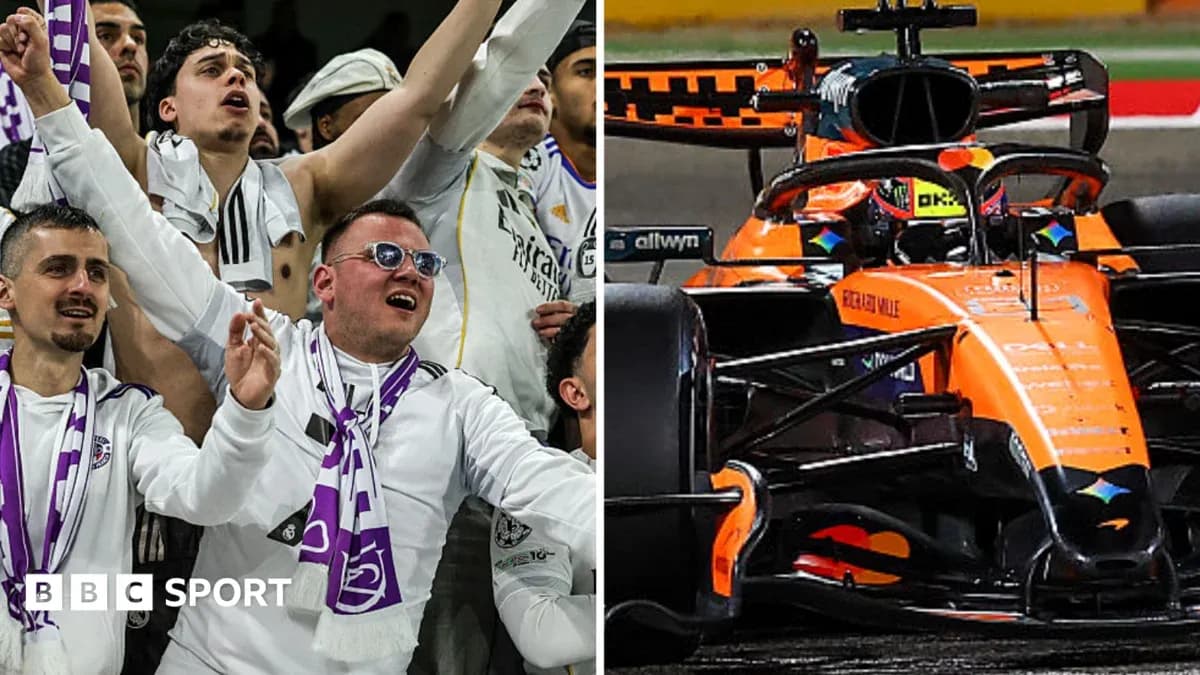
This is the city of Real Madrid, of 15 European Cups, 36 La Liga titles and a conveyor belt of Galacticos that has stretched from Zinedine Zidane and Ronaldo to Jude Bellingham and Kylian Mbappé. A city where 75,000 people can detonate in noise as Mbappé cushions a volley into the net against Malaga and barely raise an eyebrow the next morning.
Yet this weekend, Formula 1 walks straight into that noise and asks for a slice of attention.
No Spanish world champion since Fernando Alonso 20 years ago. No grand prix in Madrid since 1981. A European calendar already straining at the seams. On paper, F1 doesn’t need this race.
Madrid thinks otherwise.
A Football Cathedral, an F1 Experiment
The Santiago Bernabéu, now a gleaming steel spaceship dropped into the heart of the city, looms over the sporting landscape. Its terrifyingly steep stands still feel like they might swallow a visiting team whole. Across town, Real Madrid’s women play in a more modest but atmospheric ground that sits almost shoulder-to-shoulder with the new circuit.
The question is simple: will Madridistas, raised on trophies and drama, turn their heads from the pitch to the paddock?
“Yes, [the F1 race] is good for Madrid,” says one fan, standing in the shadow of the Bernabéu. “There is pride in our sport, Madrid is an open city with open people and open minds. The race can take Madrid’s identity outside of football… But I’m more than excited, I’m curious – I want to see how it goes.”
Curiosity, not conversion. That’s the mood.
Another supporter has followed F1 further afield: “We’ve always been dreaming of having something from F1 closer to home. Having it back is great. I’ve been to Barcelona and the Belgian GP and I think let’s see how it goes. Organising tends to be messy in the first year – I don’t want to be the guinea pig.”
Then the ambition creeps in. “Let’s hope it brings the city more into the spotlight. Madrid has a lot to learn from F1 about how to run a global spectacle; F1 could probably learn the true Spanish way. Barcelona is more international, the drivers and fans coming to Madrid will get more of a taste of Spain.”
Madrid, as the Prado reminds every visitor, knows how to stage great art. The streets chirp with birdsong-style crossing signals, Mexican conifers sway above the traffic, and palatial facades dominate the skyline. It’s beautiful, but not built for a race.
So F1 goes somewhere else.
The Unicorn in the Expo Zone
The grand prix will not weave past the Prado or under the balconies of Salamanca’s wine bars. Instead, it settles in an expo zone by the airport, a patch of city some outsiders might dismiss as anonymous. To Luis García Abad, it was the only way the fantasy could become real.
“It started as a joke, it was a fantasy,” says the Madring boss and former manager to Alonso. “An F1 grand prix is like a unicorn – you are trying always to see the unicorn but at the end you realise [sometimes] it’s impossible.
“The queue of cities trying to organise an F1 GP is huge. They have to choose right – we signed a contract for 10 years.”
Seven or eight years ago, the idea surfaced. Then Ifema, the quasi-state organisation that runs the site, called. “What are you thinking?” they asked.
“After one morning here I said: ‘It’s possible.’”
Madrid’s compact size and strong public transport network did the rest. Organisers have slashed car parking and are telling fans to leave their vehicles at home. The metro and trains will do the heavy lifting.
Not that anyone expects Patrick Dempsey, Rafael Nadal or Mbappé to be queueing at Avenida de América for the pink line. The VIPs will glide into private areas near an expansive paddock built for six separate hospitality zones.
The real story, though, lies inside the fences.
Monumental: A Corner Built to Be Remembered
“It’s a real experience, not just to be in Madrid but for F1,” says Abad. “Every part of the track has its own personality. Monumental… Turn 12, is huge, amazing. We really wanted to have an iconic part of the circuit – more than 30,000 people around one corner.”
Monumental is the word everyone keeps coming back to. A 26-degree banked turn, longer than Zandvoort’s, cutting through what will feel like a temporary town once the grandstands are full.
It rises like a fortress. At the top, a VIP platform fit for the King of Spain and his family. At ground level, a punishing climb in 44C heat, the kind of structure that looks heroic from a distance and unforgiving up close.
“Luis wanted to think of something recognisable in our circuit. Something iconic,” says Carlos Jiménez, operations director for Ifema.
Iconic has not come cheap. The circuit has soaked up 85 million euros, with a further 65 million poured into extra construction around it. Jiménez argues the project leans on sustainability – renewable energy powering the race, existing buildings pressed into service – but the build itself has been a slog.
“We started building it in the wettest winter in 20 years in Spain. The rain was torrential. We suffered a lot, and had to stabilise parts of clay which behaves badly with wet conditions. It was very challenging. There are three layers of asphalt here. We learnt from one layer to the next.”
In 2022, the whole thing still sounded like a wild scheme. Now, Jiménez senses a city hitting its stride. “Madrid has momentum right now; it’s a vibrant city, very well known for football. Like a ski resort must have entertainment for apres-ski, a circuit must have good after-race entertainment. Madrid will become in top position – the offer of this city is incredible in terms of gastronomy, a spectacular climate, which is very mild in September. And the party in Madrid is unbeatable.”
A Street Circuit With Teeth
Make no mistake: Madring is a street circuit, stitched together from public roads and purpose-built sections. Stand on it and you feel the walls closing in.
It’s narrow to the eye, claustrophobic in places, and the obvious question hangs in the air: will anyone be able to overtake?
“From a driver’s point of view it’s quite a harsh circuit,” Abad says. “Twenty-two corners, up and down, banking corners – the circuit is adapted to the new [F1] regulations. I spoke with Charles Leclerc and he said it was an amazing track, and in the race I believe you will have the opportunity to overtake, but not by free. We’re talking about gladiators – the best drivers in the world.”
Plenty of those future gladiators have already sampled it in Formula 3 testing.
“It’s going to be really edgy,” says Madrid’s own F3 driver Bruno del Pino. “You are always on the limit, the corners are quick and the walls are close. It’s like Jeddah but with more difficulty.
“With Monumental, you see so much of an angle it never ends. The first time around, you see it going straight up and you feel like you’ll fly straight out [of the track].
“It is flat for us because of the downforce so it’s not really a corner, but the previous combination of Turns 10 and 11 are high speed and close to the wall – quite a few drivers will kiss the wall.”
Britain’s Freddie Slater, another F3 driver, doesn’t hold back either. “A lap of Madrid is so exhilarating, and the adrenaline is pumping – it’s an incredible track to drive. It’s one of the best tracks on calendar, if not the best. It’s got character, it’s got bumps, uphill and downhill – it’s a bit more old-school.”
Old-school in a city that has spent the last decade reinventing itself.
Does F1 Need Madrid – or Madrid Need F1?
Abad has his own answer.
“Not just Madrid needing F1, maybe even F1 needing Madrid,” he says. “We’re investing money to create an experience inside of a city. The future of the [F1] championship is something in this direction – we need to take care of customers and spectators. They are our future.”
That’s the bet. That a football city, one that worships at the Bernabéu and breathes La Liga, will find room in its heart for the roar of V6 engines and the sight of cars threading a 22-corner gauntlet.
If the stands around Monumental are still full when the chequered flag falls, the unicorn might not feel so mythical after all.