.svg&w=384&q=75 "logo")
Ferrari's Engine Upgrade: Gains but No Knockout Blow
Ferrari’s new power unit did not arrive with fireworks, but it did arrive with substance.
On a Friday that belonged on the stopwatch to Mercedes and George Russell, Ferrari walked out of practice with something almost more valuable at this stage of the season: confirmation that their second engine upgrade works – and a reminder that the gap on the straights is still very real.
Ferrari find gains, but not the knockout blow
Fred Vasseur rarely oversells anything. So when the Ferrari team principal admits they’ve “done a step for sure” with ADUO 2, that matters. His caveat matters even more.
Straight-line performance, he reminded everyone, is not just about horsepower. Drag, weight, efficiency – the whole package. And right now, that package still leaves Ferrari chasing Mercedes in a straight line.
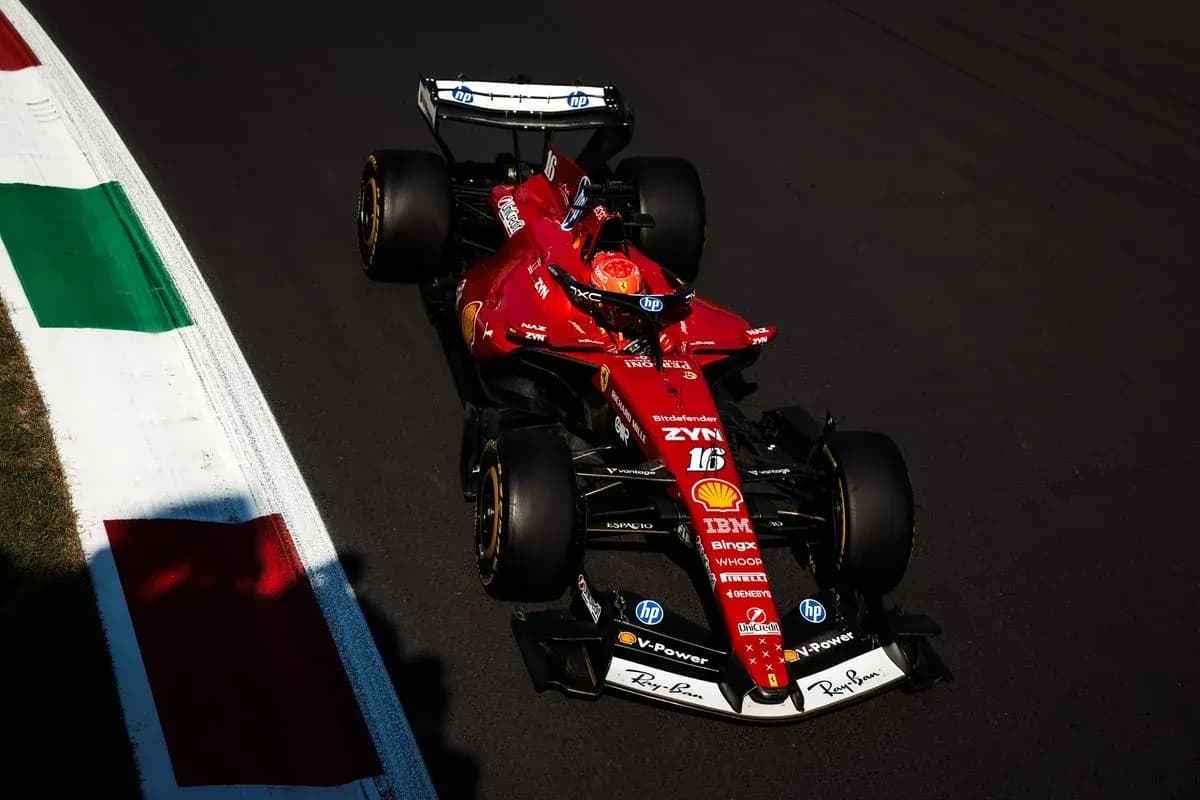
Charles Leclerc’s FP2 told the story in numbers. Second quickest, 0.120s off Russell, with a lap that bled time where the throttle is pinned and clawed it back where the car is dancing.
On his best lap, Leclerc lost roughly six tenths over the first two-thirds of the circuit. The Ferrari simply could not live with the Mercedes down the straights. Only on the run to Parabolica did he recover a chunk of that, helped by Russell suffering more clipping as the Mercedes ran out of deployment. On an energy-hungry track, the fine margins of harvesting and deployment strategy still look wide open.
Yet the headline for Ferrari came not from a single lap, but from the long runs. Leclerc’s race simulation averaged just three hundredths of a second per lap slower than Kimi Antonelli’s Mercedes. The catch: Leclerc was on softs, Antonelli on hards. The pace profile still hints at Ferrari as the nearest challenger, but with the tyre offset and Mercedes’ usual overnight polish, the Scuderia remain the hunters, not the hunted.
Hamilton praises the engine, questions the package
Lewis Hamilton’s verdict on Mercedes’ own upgraded power unit sounded familiar: improvement, yes, but not the full picture.
The seven-time champion wrestled with a car he described as “really hard to pull the lap out of” after FP2 set-up changes left the balance on a knife edge. It was “not an easy one to drive,” yet he walked away convinced there is more to come – both from set-up and from how the team manages energy deployment.
He openly questioned whether they need to trim more downforce to cut drag, or whether the bigger prize lies in the deployment map itself.
“The engine is an improvement,” he said, keen to credit the factory effort. He also highlighted a key positive: the new unit feels “really nice to drive in the low speed”. But Mercedes’ deployment schedule, he noted, runs differently to their rivals, and others appear to be carrying less drag down the straights. That, for Hamilton, is where the next gains must come from.
On the timing screens, though, Mercedes still held the upper hand over a Ferrari that has taken a step – just not a giant one.
Red Bull chasing balance, Lawson quietly shines
Red Bull spent Friday chasing something far more fundamental than a few tenths of deployment: balance.
Max Verstappen’s day started late, after he gave up FP1 to Ayumu Iwasa. That left him short of track time and long on problems. He complained of balance issues, and Red Bull technical director Pierre Wache did not sugar-coat it.
“Clearly we have a balance issue on the car,” Wache said, likening it to their struggles at Zandvoort. The team is now trying to cure it through set-up and components, with only FP3 left to react.
While Verstappen wrestled, Liam Lawson quietly produced one of the standout long runs of the day. His hard-tyre stint in the other Red Bull matched Antonelli’s Mercedes for consistency and speed, a strong effort given Lawson’s complicated build-up. He split his pre-weekend workload between his own team and Racing Bulls, with Isack Hadjar’s fitness in question.
Traffic for both Leclerc and Antonelli during their runs may have flattered Red Bull slightly, but Lawson’s stint still underlined the car’s underlying race pace – if they can get Verstappen comfortable.
McLaren off balance and off the pace
McLaren arrived on a high after Lando Norris’s back-to-back wins. Friday brought a bump back to reality.
Norris ended the day 0.443s off on long-run pace on the hards and 0.384s down on overall pace. By his own admission, it was “much trickier than the last few Fridays”.
The time loss, he said, is “a bit everywhere”. No single corner where the McLaren shines, no obvious strength to lean on. They expected to lose some time on the straights to Mercedes. What stung more was the deficit in high-speed corners – usually McLaren’s playground.
Right now, they are not just slower on the straights. They are “just off the pace everywhere”. That will worry a team that has built its recent charge on a very clear identity: fast in high-speed, razor sharp in balance. On this evidence, that edge has dulled, at least for now.
Midfield: Racing Bulls lead, Haas encouraged, Alpine uneven
In the midfield, Racing Bulls set the tone, with Arvid Lindblad topping a strong day for the team.
The surprise came from Haas. Ollie Bearman finished just 0.021s behind Lindblad, a sharp single-lap effort on a day when Haas rolled out a major aerodynamic upgrade on both VF-26s and a new Ferrari engine on only one of them. Bearman had the upgraded power unit; his team-mate did not.
Team principal Ayao Komatsu confirmed the engine is “delivering in terms of characteristics”. That alone is a relief for a team that has not scored for six races and has been dogged by “inconsistency issues” across both cars, with Esteban Ocon suffering the brunt of those problems recently. The long runs still left Haas trailing Racing Bulls and Alpine, but the direction finally looks positive.
Alpine’s own day swung from optimism to frustration. Franco Colapinto felt “delighted” with the car in FP1, only to describe it as “disconnected” in FP2. The underlying pace was competitive in the midfield group, but the feeling behind the wheel clearly was not.
Audi search for more, Williams bides its time
Audi chose not to bring any aerodynamic upgrades, instead playing their joker on homologated gear ratios and final drive. On Friday’s evidence, it was not enough to put them with the sharp end of the midfield.
They struggled more than expected relative to Racing Bulls and Haas. Single-lap pace left them only just ahead of Williams, and on long runs they actually slipped a fraction behind Carlos Sainz’s soft-tyred Williams.
Sainz and Williams treated Friday as a live experiment, using the track time aggressively ahead of a major upgrade package due in Azerbaijan later this month. The current car is still limited, but the team is clearly focused on learning rather than chasing a flattering headline lap.
Audi, by contrast, will expect to move forward on Saturday. They need to. The midfield pack is too tight to waste a weekend in no-man’s land.
Aston Martin still stuck, Cadillac step up
At the back, an early-season storyline resurfaced. Aston Martin, even with the upgraded Honda engine introduced at Zandvoort, remain mired in difficulty.
The new unit has at least improved driveability. Lance Stroll called it “a little bit better”, which is something, but not nearly enough. Straight-line performance still lags, and Valtteri Bottas’s view that Cadillac “have the upper hand on the straights” underlined the scale of Aston Martin’s task.
Fernando Alonso dragged points out of Zandvoort against the odds. On this evidence, a repeat here would demand something even more improbable.
Ferrari, meanwhile, know exactly where they stand. The engine upgrade works. The car brakes late, turns in hard, and looks after its tyres. But on the straights, the stopwatch still tells the same story.
On a weekend where Mercedes, Red Bull and McLaren all have questions to answer, the bigger one hangs over Ferrari: is this step enough to fight for wins, or just enough to stay close enough to watch someone else take them?