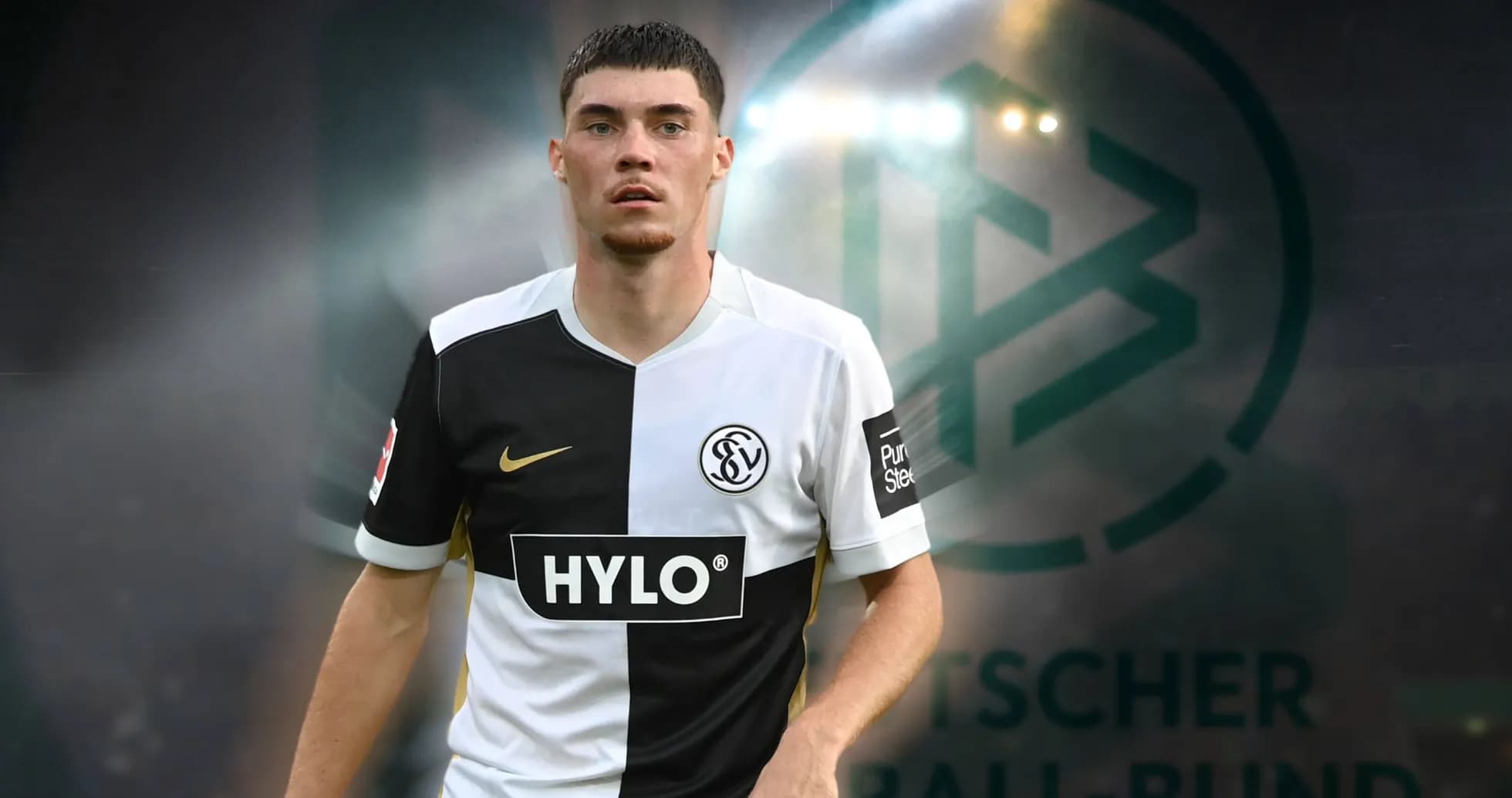
Felix Keidel: Jürgen Klopp's Bold Right-Back Selection for Germany
Jürgen Klopp walked into his first Germany press conference with a simple message: nobody’s shirt was safe. Reputation would not protect anyone. Form, intensity, work rate – those would decide who boarded the next DFB team flight.
He even put a number on it. Fifty-seven players on the initial shortlist. Names kept under wraps, but the intention was obvious. After three failed World Cup campaigns, Germany’s new head coach wanted distance from the scars and the old certainties. Fresh legs. Fresh minds. Fresh hierarchy.
Now, one of the most unexpected names on that list is about to step into the light: Felix Keidel of SV Elversberg.
A right-back from Elversberg in the national team conversation? A player with three Bundesliga appearances to his name? When the first report dropped late on Tuesday evening, via Bild, it felt like a typo. By Wednesday, kicker had confirmed it. No mistake. Klopp really had called up a 23-year-old who has barely tasted top-flight football.
It is, by any measure, a bold move.
From Ingolstadt’s academy to the Bundesliga fast lane
Keidel’s story does not begin in the glamour of a major academy, but in the steady, methodical world of FC Ingolstadt. He joined the club’s U19s in 2012 and simply refused to fall off the ladder. Year after year, he climbed an age group. By the summer of 2022, he had made it into the professional squad.
Once there, he did not lurk on the fringes. At 20, he established himself as a regular in the 3. Liga, racking up 37 appearances in his first full season with the senior side. One goal, four assists, but the numbers only tell part of it. Coaches trusted him. Teammates leaned on him. He became a fixture.
The next step came in 2025. Elversberg, still stung by narrowly missing out on promotion against 1. FC Heidenheim, were reshaping their squad. They identified Keidel, paid a modest €400,000 to free him from Ingolstadt, and bet that his ceiling was far higher than the division he was playing in.
They were right to back their judgement. Keidel needed almost no settling-in period. Under Vincent Wagner, he again played himself into the core of the team. Twenty-five league appearances, 13 of them from the start, and a central role in one of the most remarkable stories in German football: Elversberg’s sensational promotion to the Bundesliga.
From the third tier to the top flight in just over two years. No hype campaign. No social media fanfare. Just steady, relentless progress.
Three games, one goal – and Klopp’s attention
Once in the Bundesliga, Keidel did not have months to find his feet. Elversberg threw him into the deep end against some of the league’s heaviest hitters.
He featured against Leverkusen. He featured against Gladbach. And then came Bayern. Three appearances, one goal. Add to that a DFB Cup outing against MSV Duisburg, where he produced two assists, and the numbers suddenly start to look like a sharp, upward spike rather than a gentle curve.
For a national team coach searching for new energy and new solutions, that spike mattered. Klopp has never been afraid of small sample sizes if the underlying qualities are right: intensity, tactical intelligence, courage on the ball. Keidel, in a handful of games, showed enough of those to be pushed to the front of the queue.
On paper, it is a tiny body of work. On the training pitch and in video analysis, it was clearly something more.
The shape-shifter: full-back, midfielder, playmaker
What sets Keidel apart is not just the speed of his rise, but the sheer breadth of roles he has already covered.
At Ingolstadt, he was football’s equivalent of a Swiss Army knife. Under Sabrina Wittmann, his biggest advocate at FCI, he played both full-back positions. His natural home is right-back in a back four, but he did not stop there. He stepped into central midfield. He moved higher into attacking midfield. He drifted into the half-spaces as a playmaker, operating between the lines and slightly wider when the game demanded it.
Few players in their early twenties get that kind of tactical education. Keidel did – and handled it.
The move to Elversberg nudged him back towards his defensive roots. During the promotion campaign, Wagner used him mainly as a right-back, where his engine and reading of the game shone. This season, there has been another adjustment. Wagner increasingly trusts him in defensive midfield, paired with Lukasz Poreba, where he screens, snaps into duels and helps launch transitions.
This versatility is pure gold for an international coach. One injury, one suspension, one tactical tweak mid-game – and a player like Keidel can plug multiple gaps without weakening the structure. Klopp will have noticed that.
Germany’s long search on the right
Strip away the romance of the story and you arrive at the hard, tactical core: Germany have a right-back problem, and they have had it for years.
Since Philipp Lahm retired and Joshua Kimmich moved into central midfield, the position has been a revolving door. Hansi Flick tried solutions. Julian Nagelsmann tried more. None stuck.
Benjamin Henrichs and Ridle Baku offered promise at RB Leipzig and Wolfsburg respectively, then drifted in and out. Stuttgart’s Josha Vagnoman had a run. Kimmich was even pushed back to right-back again at the 2026 World Cup in a bid to stabilise the flank. Each idea flickered. None truly convinced.
The result: a national team still searching for a high-quality, long-term option at right-back in a back four. In tournament football, that kind of uncertainty on the outside of the defence can be fatal.
Keidel, in Klopp’s plans, looks destined to be assessed first and foremost in that role. His grounding as a natural right-back, his ability to step into midfield zones, his comfort receiving under pressure – these are all traits that fit the modern, hybrid full-back Klopp has used so often at club level.
Is he ready to walk straight into that role for Germany and solve a problem that has lingered since Lahm’s farewell? That remains an open question.
But in a new era defined by risk, renewal and ruthless selection, perhaps it is fitting that the search for stability on the right side of Germany’s defence now runs through a 23-year-old who climbed from the 3. Liga to the Bundesliga in just over two years – and has already convinced Jürgen Klopp he is worth a closer look.